

The Mental Health Assessment Process: What to Expect
A mental health assessment is a structured, collaborative clinical evaluation that helps a qualified provider understand your symptoms, history, and needs so they can recommend the right care. Think of it less as a test and more as a detailed conversation with a purpose.
Here’s what you need to know upfront:
- Purpose: To identify symptoms, assess safety, and build a personalized care plan or referral pathway.
- Typical outcome: A diagnosis or working impression, treatment recommendations, and a follow-up plan.
- Expected duration: A brief screening takes 5–20 minutes; a comprehensive psychiatric evaluation typically runs 1–2 hours.
Clinicians often use standardized screening questionnaires of 20–30 questions during appointments to quickly gauge mood or anxiety baselines before the deeper clinical interview begins.
Table of Contents
- Who conducts a mental health assessment and where?
- What happens during a mental health assessment, step by step
- How long does an assessment take, and what types exist?
- How to prepare for your assessment
- What happens after the assessment
- Your rights and confidentiality during a mental health assessment
- Common screening tools you may encounter
- How telehealth mental health assessments work
- Key Takeaways
- Why honesty and detail make all the difference
- Journeymhw offers virtual psychiatric evaluations when you’re ready
- Useful sources and further reading
Who conducts a mental health assessment and where?
Several types of licensed professionals can conduct a mental health evaluation, and the setting shapes what happens during the visit.
Clinician types:
- Psychiatrists are medical doctors who can diagnose, prescribe medication, and manage complex cases.
- Psychologists conduct diagnostic interviews and administer psychological testing batteries, but in most U.S. states cannot prescribe.
- Licensed Clinical Social Workers (LCSWs) and Licensed Professional Counselors (LPCs) conduct assessments and provide therapy, typically referring out for medication management.
- Primary care physicians (PCPs) often perform initial screenings and refer patients to specialists when symptoms are more complex.
Where assessments happen:
- Primary care offices (initial screenings)
- Outpatient mental health clinics and private practices
- Hospital emergency departments and urgent psychiatric settings
- School-based counseling services
- Telehealth platforms
For telehealth specifically, state licensure matters. A provider must be licensed in the state where you are located at the time of the visit, not just where their practice is based. This affects both who can conduct your evaluation and which medications, if any, can be prescribed afterward. You also have the right to bring a support person or advocate to any appointment, and clinicians can gather collateral information from that person to improve diagnostic accuracy when needed.

What happens during a mental health assessment, step by step
The assessment flow follows a consistent structure, though the depth at each stage depends on the setting and complexity of your situation.
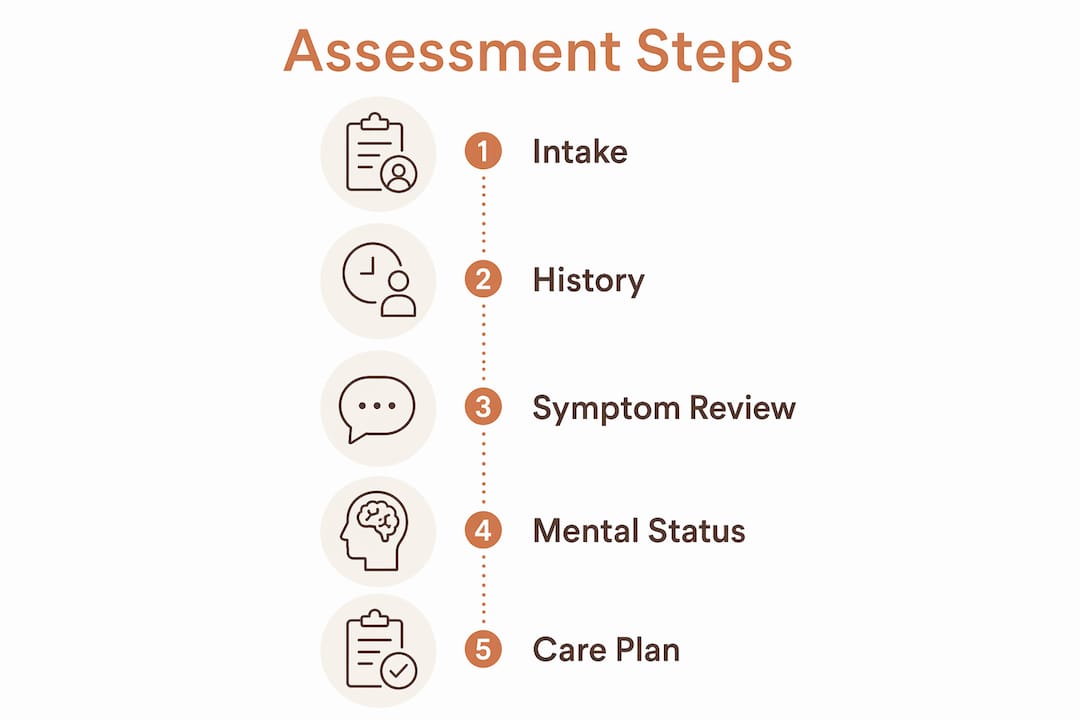
- Referral and intake: You complete demographic and insurance forms, sign consent documents, and briefly describe why you’re seeking care.
- Personal and family history: The clinician asks about your medical history, past mental health treatment, family psychiatric history, and current medications.
- Presenting problem exploration: You describe what’s been happening, when it started, and how it affects your daily functioning.
- Symptom inventory: The clinician asks targeted questions about mood, sleep, appetite, energy, concentration, and any experiences that concern you.
- Mental Status Examination (MSE): A structured clinical observation of your appearance, speech, mood, affect, thought process, thought content, cognition, and insight. Importantly, the MSE begins the moment you meet the clinician — your posture, eye contact, and speech rate are all clinically informative and recorded as standard practice, not as judgment.
- Screening questionnaires: Brief standardized tools (PHQ-9, GAD-7, ASRS) are often completed before or during the visit to establish a symptom baseline.
- Safety and risk assessment: The clinician asks directly about thoughts of self-harm, suicide, or harm to others. This is routine and does not automatically trigger hospitalization.
- Collateral information: When clinically relevant, the provider may request records from prior providers or speak with a support person you’ve brought or designated.
- Clinician synthesis: The provider integrates all findings, shares initial impressions, and outlines recommended next steps.
Sample questions you may be asked:
- “Can you tell me what’s been going on that brought you in today?”
- “How long have you been feeling this way, and has anything made it better or worse?”
- “How are you sleeping? How is your appetite?”
- “Have you had any thoughts of hurting yourself or ending your life?”
- “How is this affecting your work, relationships, or daily routine?”
Pro Tip: Answer safety questions honestly. Clinicians ask about suicidal thoughts routinely, and disclosing them does not automatically mean hospitalization. Providers use clinical judgment to assess actual risk level, and honesty gives them the information they need to keep you safe.
The NHS frames the assessment as a conversation, not an exam. Topics covered typically include symptoms, physical health, housing, relationships, substance use, and personal strengths. That framing is accurate: there are no right or wrong answers, only honest ones.

For a deeper look at how assessment results translate into a care plan, see what a mental health treatment plan involves.
How long does an assessment take, and what types exist?
| Assessment Type | Typical Setting | Duration | Main Purpose |
|---|---|---|---|
| Brief screening | Primary care, telehealth | typically a few minutes | Triage and referral |
| Routine outpatient psychiatric evaluation | Outpatient clinic, telehealth | often around an hour or more | Diagnosis and treatment planning |
| Comprehensive psychological testing | Specialty clinic | Multiple hours across sessions | Personality, neurocognitive, or developmental evaluation |
| Crisis/emergency assessment | ED, urgent psychiatric unit | Variable, focused | Safety evaluation and immediate stabilization |
A brief screening is designed to flag whether a more thorough evaluation is needed. A full psychiatric evaluation covers history, MSE, and symptom review in depth. Psychological testing batteries, such as those used for ADHD, autism, or neuropsychological concerns, can span several sessions and involve structured cognitive tasks alongside clinical interviews. For specialty assessments like autism evaluations, a clinical assessment for autism involves additional collateral data, developmental history, and structured observation beyond a standard psychiatric intake. Crisis assessments are focused and time-sensitive, prioritizing safety over comprehensive history-gathering.
How to prepare for your assessment
Good preparation directly improves the accuracy of your evaluation. Clinicians look for patterns across time, and your notes help them see those patterns more clearly than memory alone can.
Bring with you:
- A current list of all medications, doses, and how long you’ve been taking them
- Any relevant recent medical records or prior psychiatric records
- A brief symptom timeline (when symptoms started, what changed, what triggers or relieves them)
- Notes on sleep, appetite, energy, and daily functioning over the past 2–4 weeks
- A written list of questions you want to ask the clinician
- Contact information for a support person or collateral source, if applicable
Your first appointment checklist can help you organize these items before the visit.
Questions to ask your clinician:
- “What are your initial impressions, and what might explain my symptoms?”
- “What are the next steps, and how soon should I follow up?”
- “Who will have access to my records, and how are they stored?”
- “What happens if I need a prescription — can you manage that, or will I need a referral?”
Pro Tip: Avoid minimizing your symptoms to seem “not that bad.” Clinicians are trained to assess severity, and understating how you feel can lead to a less accurate picture. Describe your worst days, not just your average ones.
What happens after the assessment
Once the evaluation is complete, the clinician shares their findings and outlines a recommended path forward. This usually happens verbally at the end of the appointment, with a written summary or treatment plan to follow.
Common recommendations include:
- A referral to a therapist or psychologist for ongoing psychotherapy
- Medication management, either initiated by the evaluating provider or through a referral to a psychiatrist
- Lifestyle supports such as sleep hygiene, exercise, or stress management strategies
- Specialty testing if the initial evaluation raises questions about cognition, learning, or developmental concerns
- A safety plan if risk was identified during the assessment
Timeline expectations: Medication follow-up visits typically occur 2–4 weeks after a new prescription. Therapy referrals can take days to weeks depending on availability. If urgent action is needed, the clinician will address it before you leave the appointment.
Many providers now use measurement-based care, meaning you’ll complete brief symptom scales (like the PHQ-9 or GAD-7) at each follow-up visit to track whether treatment is working. This creates an objective record of your progress over time. For guidance on structuring your follow-up care, see choosing the right psychiatric care plan.
Your rights and confidentiality during a mental health assessment
Under HIPAA, you have the right to access your own mental health records, request corrections, and control who receives copies. Your provider must explain how your information is stored and shared before the assessment begins, as part of the informed consent process.
Limits to confidentiality — when a provider may disclose information without your consent:
- Imminent risk of harm: If you present a credible, immediate threat to yourself or others, the clinician is legally and ethically obligated to act, which may include contacting emergency services.
- Child or elder abuse: Providers are mandatory reporters in all U.S. states and must report known or suspected abuse.
- Court orders: A judge can compel disclosure of records in certain legal proceedings.
- Coordination of care: With your written consent, providers can share records with other treating clinicians.
These exceptions are narrow. The vast majority of what you share stays between you and your provider.
Pro Tip: Ask your clinician directly: “How are my records stored, who can access them, and how long are they kept?” You have the right to that information, and a good provider will answer clearly.
Common screening tools you may encounter
Standardized tools support the clinical interview but do not replace it. They establish a symptom baseline and help track changes over time. Final diagnosis always rests on the clinician’s integrated judgment.
| Tool | What It Screens For | Questions / Time |
|---|---|---|
| PHQ-9 | Depression severity | 9 questions, ~3 minutes |
| GAD-7 | Generalized anxiety severity | 7 questions, ~2 minutes |
| ASRS | ADHD symptoms in adults | 20–30 questions, 5–20 minutes |
| MMSE | Cognitive functioning and impairment | 5–20 minutes |
| Columbia-SSRS | Suicide risk severity | Variable, clinician-administered |
Each of these tools produces a score that gives the clinician a structured starting point. A high PHQ-9 score, for example, doesn’t confirm a diagnosis of major depression on its own. It tells the clinician where to probe further during the interview. For Texas adults exploring ADHD-specific evaluation, ADHD treatment plan components explains how screening results feed into a full care plan.
How telehealth mental health assessments work
A telehealth psychiatric evaluation follows the same clinical structure as an in-person visit, with a few practical differences.
- Scheduling: You book through a secure online portal and receive a link to the video platform.
- Identity verification: The provider confirms your identity and location at the start of the visit.
- Secure platform: HIPAA-compliant video software is required; standard consumer apps like FaceTime are not permitted for clinical visits.
- Focused intake: You complete intake forms and consent documents electronically before the appointment.
- MSE adaptations: Clinicians assess appearance, speech, affect, and thought process through video. Certain physical observations are limited, but most MSE components translate well to a video format.
- E-prescribing: If medication is appropriate, the provider sends a prescription electronically to your pharmacy. Prescribing of controlled substances via telehealth is subject to state and federal regulations that vary by medication class.
Pro Tip: Before your telehealth visit, find a private, quiet space, test your device and internet connection, and close other applications. If you want a support person present, let the provider know in advance so they can document it appropriately.
State licensure is a real constraint. Your provider must hold an active license in the state where you are physically located during the visit. This affects both who can see you and what they can prescribe. For Colorado-specific care, anxiety care in Colorado outlines what to expect from a licensed telehealth provider in that state.
Key Takeaways
A mental health assessment is a structured clinical evaluation that moves from intake and history through a Mental Status Examination, standardized screening tools, and a safety check to produce a diagnosis and personalized treatment plan.
| Point | Details |
|---|---|
| Assessment structure | Follows a consistent flow: intake, history, symptom review, MSE, screening tools, safety check, and synthesis. |
| Duration varies by type | Brief screenings take 5–20 minutes; comprehensive psychiatric evaluations typically run 1–2 hours. |
| Preparation improves accuracy | Bring a medication list, symptom timeline, and written questions to help clinicians detect patterns. |
| Confidentiality has limits | HIPAA protects your records, but imminent risk of harm, abuse reporting, and court orders are exceptions. |
| Journeymhw telehealth option | Journeymhw offers virtual psychiatric evaluations for adults in Texas and Colorado, with follow-up care and medication management available online. |
Why honesty and detail make all the difference
Most people walk into a mental health assessment worried they’ll say the wrong thing. That anxiety is understandable, but it points to a misunderstanding about what the evaluation actually is. You are not being graded. You are providing data that helps a clinician understand your experience clearly enough to help you.
The assessments that produce the most useful outcomes are the ones where patients describe their worst days, not their average ones. Clinicians are trained to calibrate severity, and they need the full picture to do that accurately. Minimizing symptoms to seem functional, or amplifying them to ensure you’re taken seriously, both distort the clinical picture in ways that can delay the right care.
One thing that often goes unsaid: the open-ended, empathic questioning that good clinicians use is designed specifically to make it easier to share difficult things. If a question feels hard to answer, that’s often a signal it’s worth answering carefully. The prep checklist in this article, particularly the symptom timeline, exists precisely because memory is unreliable under stress. Write it down before you go.
Journeymhw offers virtual psychiatric evaluations when you’re ready
If you’ve read through this guide and feel ready to take the next step, Journeymhw provides telehealth psychiatric evaluations for adults in Texas and Colorado, with no long wait for an initial appointment. The focus is on ADHD, anxiety, and depression, and the process mirrors exactly what this article describes: a structured intake, a clinical interview, standardized screening tools, and a clear treatment recommendation at the end.
After your evaluation, Journeymhw’s providers handle medication management and follow-up care through the same secure platform, so you’re not left navigating referrals on your own. Insurance billing and fee-for-service options are both available. You can explore ADHD treatment, anxiety treatment, or depression treatment to see what the evaluation and care pathway looks like for each condition. To check whether Journeymhw is licensed in your state and to book your first visit, start at journeymhw.com.
This article is general educational information, not professional medical advice. Please consult a licensed clinician or your state’s mental health authority for guidance specific to your situation.
Useful sources and further reading
- Johns Hopkins Medicine: Comprehensive Psychiatric Evaluation — Covers the core components of a full psychiatric evaluation, including MSE domains and typical duration.
- Merck Manual: Initial Psychiatric Assessment — Professional-level overview of assessment flow, screening tools, and documentation standards.
- NCBI Bookshelf: Mental Status Examination — Detailed clinical reference on MSE components and what each domain reveals.
- NHS: Mental Health Assessments — Patient-facing explanation of assessment topics and what to expect during the conversation.
- APA: PsychiatryOnline Practice Guidelines — Evidence-based guidelines for psychiatric evaluation of adults, including interview techniques and collateral information standards.
- ADA.gov: Disability Rights and Accommodations — Guidance on your right to bring a support person or request reasonable accommodations during a clinical assessment.
Recommended
- Mental Health Diagnosis Process for Adults: A Clear Guide – Journey Mental Health
- Your Mental Health Care Checklist for the First Appointment – Journey Mental Health
- Mental Health Diagnosis Explained for Adults – Journey Mental Health
- Urgent Mental Health Care Access Steps: 2026 Guide – Journey Mental Health