

What Is a Mental Health Treatment Plan?
A mental health treatment plan is a collaborative, written roadmap outlining your diagnosis, specific recovery goals, and evidence-based interventions designed to guide your care from the first session forward. If you are managing ADHD, anxiety, or depression, this document is the clinical foundation that connects your symptoms to a structured path toward feeling and functioning better. Clinicians also call it a psychiatric care plan or therapy treatment plan, and both terms refer to the same structured document. Understanding what goes into one, and how you can actively shape it, puts you in a far stronger position to get the most from your care.
What is a mental health treatment plan made of?
A thorough treatment plan includes diagnostic history, measurable goals, intervention strategies, a safety plan, and recommendations for care transitions. Each element serves a specific purpose, and skipping any one of them weakens the whole structure.
Here is what you can expect to find in a well-built plan:
- Diagnostic formulation. This section documents your diagnosis using standardized criteria, along with relevant medical history and any co-occurring conditions. In the US, clinicians use billing codes such as CPT 90791 to document initial psychiatric evaluations.
- Mental Status Examination (MSE). The MSE is a structured assessment that evaluates your cognition, mood, and behavior before the plan is created. Skipping it can lead to poor diagnosis and ineffective treatment, even in virtual settings.
- SMART goals. These are specific, measurable, attainable, relevant, and time-bound objectives. A goal like “reduce panic attacks from five per week to one within 90 days” is far more useful than “feel less anxious.” Clinical guidelines recommend using SMART goals to gauge progress, with reviews every six months.
- Intervention strategies. These are the specific therapy approaches your provider recommends, such as Cognitive Behavioral Therapy (CBT) for anxiety, behavioral activation for depression, or stimulant medication management for ADHD.
- Biopsychosocial assessment. The biopsychosocial model/02%3A_Unit_Two-_Core_Skills/2.03%3A_Treatment_Planning) is the gold standard for treatment planning, evaluating biological factors like genetics and medication response, psychological factors like thought patterns, and social factors like relationships and employment.
- Progress indicators. These are the measurable markers your provider uses to determine whether the plan is working, such as standardized rating scales like the PHQ-9 for depression or the GAD-7 for anxiety.
Pro Tip: Ask your provider to walk you through each section of your plan at your first appointment. Knowing what each component means helps you track your own progress between sessions.
How is a treatment plan developed with your provider?

Effective treatment planning/02%3A_Unit_Two-_Core_Skills/2.03%3A_Treatment_Planning) depends heavily on patient collaboration, and shared goal-setting is a strong predictor of successful outcomes. The plan is not something handed to you. It is built with you.
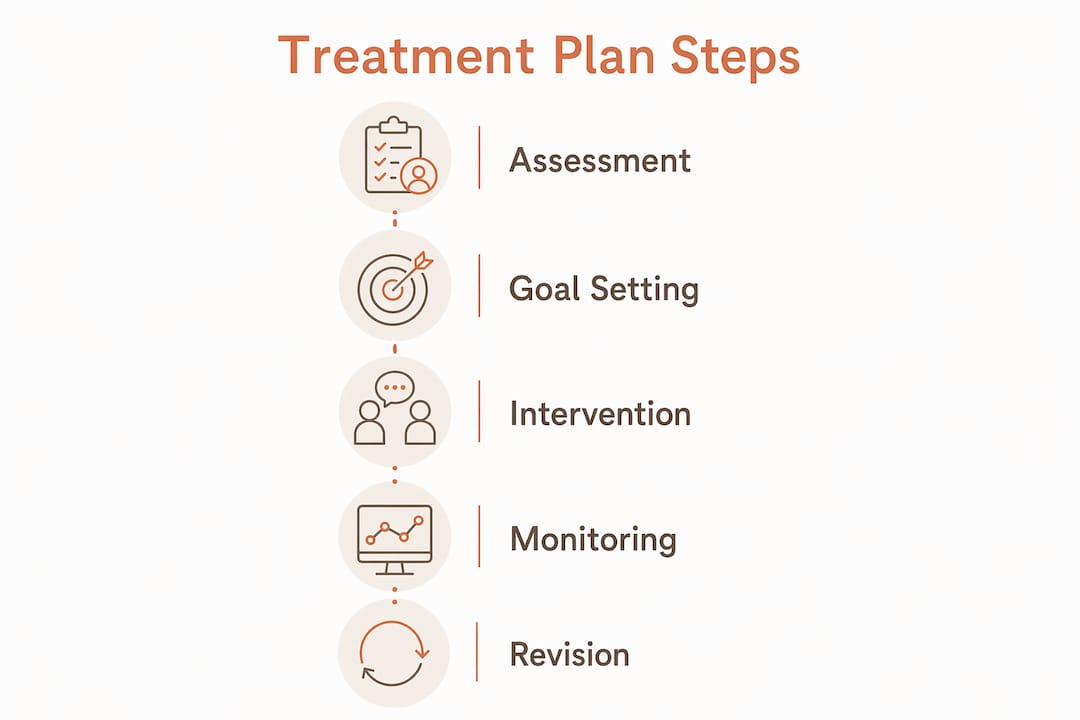
The process typically follows these steps:
- Initial diagnostic consultation. This session usually lasts 30 to 60 minutes. Your provider gathers a thorough personal and psychiatric history, including current symptoms, past treatments, family history, and social context. This is where the mental health assessment begins in earnest.
- Goal prioritization. You and your provider identify which problems to address first. If you have both severe anxiety and disrupted sleep, you may agree to target sleep first because improving it often reduces anxiety symptoms on its own.
- Intervention selection. Your provider recommends specific therapy approaches and, where appropriate, medication options. You have the right to ask why a particular intervention was chosen and whether alternatives exist.
- Documentation and sign-off. Both you and your provider typically sign the completed plan, which formalizes the shared commitment to the agreed goals and methods.
- Scheduled review. A date is set for the first formal review, usually within six months, though earlier if your symptoms change significantly.
When collaboration is missing, plans become generic and ineffective. A provider who fills out a template without meaningful input from you is producing a compliance document, not a care tool. The difference in outcomes is significant.
Pro Tip: Before your first appointment, write down your three biggest concerns and what you most want to change in your daily life. This gives your provider concrete material to work with and helps set goals that actually matter to you.
What are the practical benefits of a structured care plan?
A structured mental health care plan does more than organize paperwork. It changes how care is delivered and experienced.
- Measurable progress tracking. Because goals are written in SMART format, both you and your provider can see objectively whether treatment is working. This removes guesswork and makes it easier to decide when to adjust the approach.
- Coordinated team communication. If your care involves a psychiatrist, therapist, and primary care physician, the treatment plan serves as a shared reference point. Everyone on your team works from the same documented goals and interventions, which reduces the risk of conflicting advice.
- Faster adjustments when life changes. A documented plan makes it easier to identify when something is no longer working. If a job loss or relationship breakdown affects your mental health, your provider can update the plan quickly rather than starting from scratch.
- Patient empowerment. Actively engaging with your plan to track SMART goals yields better recovery outcomes than passively attending sessions. Patients who treat the plan as a self-monitoring tool report stronger feelings of agency in their recovery.
“Treatment plans are most effective when patients feel ownership and actively participate in updating and revising goals rather than passively accepting provider directives.” — Villa Healing Center
For those accessing care through platforms like Journeymhw, a structured plan also creates a clear record of your treatment history, which is useful if you ever need to transfer care or demonstrate clinical need for continued services. You can explore affordable care access options that work alongside your documented plan.
How do treatment plans change over time?
A treatment plan is a living document that should be regularly reviewed and updated to reflect changes in symptoms, life context, or progress toward goals. Treating it as static impedes recovery.
The table below outlines when and why a plan typically gets revised:
| Trigger for revision | What changes and why |
|---|---|
| Scheduled six-month review | Goals are assessed, completed objectives are closed, and new priorities are added based on current functioning. |
| Symptom worsening or relapse | Intervention intensity increases, safety planning is updated, and crisis resources are documented. |
| Significant life change | New stressors like job loss, grief, or a major health diagnosis are incorporated into the biopsychosocial assessment. |
| Treatment goal achieved | The plan advances to the next priority, preventing stagnation and keeping therapy purposeful. |
| Medication change | Monitoring protocols and expected timelines are updated to reflect the new treatment approach. |
Your role in this process is not passive. If you feel your plan no longer reflects your situation, you have every right to request a review before the scheduled date. Providers who are genuinely collaborative will welcome that conversation. Those who resist updating the plan are a signal worth paying attention to. For a deeper look at navigating treatment options as your needs evolve, Journeymhw has published practical guidance on exactly this topic.
Key takeaways
A mental health treatment plan is only as effective as the collaboration behind it, the specificity of its goals, and the consistency with which it is reviewed and updated.
| Point | Details |
|---|---|
| Definition and purpose | A treatment plan is a collaborative clinical document linking your diagnosis to specific, measurable recovery goals. |
| Core components | Every plan should include an MSE, SMART goals, biopsychosocial assessment, interventions, and progress indicators. |
| Collaborative development | You and your provider build the plan together; shared goal-setting is a proven predictor of better outcomes. |
| Practical benefits | Structured plans improve progress tracking, team communication, and patient empowerment in managing recovery. |
| Dynamic nature | Plans must be reviewed at least every six months and updated whenever symptoms, life circumstances, or goals change. |
Why I think most people misunderstand what a treatment plan actually does
After years of working with people managing ADHD, anxiety, and depression, the most common misconception I encounter is this: people assume the treatment plan is for the provider, not for them. They sign it, file it away mentally, and wait to be told what to do next. That is the single biggest missed opportunity in mental health care.
The plan is yours. It is the only document in your care that explicitly states what you want to achieve and how you and your provider agreed to get there. When you treat it as a reference point between sessions, you show up to appointments with more clarity, ask better questions, and notice faster when something is not working.
The other thing I have observed is that people underestimate how much their input shapes the quality of the plan. A provider can write a technically correct plan in 20 minutes using a template. But a plan that reflects your actual priorities, your social context, and your specific barriers to recovery takes a real conversation. That conversation only happens if you come prepared and speak up.
My advice is direct: read your plan before every appointment. If a goal no longer feels relevant, say so. If a new problem has emerged, bring it up. The therapeutic alliance that forms when you engage this way is, according to clinical research, one of the strongest predictors of successful outcomes. You are not a passive recipient of care. You are a co-author of your own recovery.
— Jamie
Start your personalized treatment plan with Journeymhw
If you are ready to move from uncertainty to a structured, personalized path forward, Journeymhw offers virtual psychiatric evaluations and treatment planning for ADHD in Colorado, anxiety in Texas and Colorado, and depression treatment across both states. The process starts with a thorough online assessment, and appointments are available quickly to reduce the wait between deciding to seek help and actually receiving it. Journeymhw’s structured care approach means your plan is built with you, not handed to you. If you are in Texas or Colorado and want care that is accessible, clinically grounded, and designed around your specific needs, this is where to start.
FAQ
What is a mental health treatment plan?
A mental health treatment plan is a written, collaborative document created by you and your provider that outlines your diagnosis, recovery goals in SMART format, and the specific interventions your care team will use. It serves as both a clinical guide and a progress-tracking tool throughout your treatment.
What does a mental health assessment include?
A mental health assessment typically includes a Mental Status Examination (MSE), a review of your psychiatric and medical history, and an evaluation of biological, psychological, and social factors using the biopsychosocial model. This assessment forms the foundation of your treatment plan.
How often should a treatment plan be reviewed?
Treatment plans should be formally reviewed every six months, though revisions can happen sooner if your symptoms worsen, you experience a significant life change, or you achieve a major goal. Treating the plan as a living document leads to better outcomes than leaving it unchanged.
Can I change my treatment plan if it is not working?
Yes. You have the right to request a plan revision at any time. Clinicians encourage patients to advocate for updates when goals feel irrelevant or when new challenges arise, as active patient involvement is a key driver of recovery success.
Do online mental health platforms provide treatment plans?
Yes. Telehealth platforms like Journeymhw provide structured psychiatric evaluations and documented treatment plans for conditions including ADHD, anxiety, and depression, delivered entirely through virtual appointments from your home.