

Your Colorado Mental Health Anxiety Care Plan Guide
Anxiety does not follow a schedule, and living with it without a clear plan can make everything feel harder. If you are a Colorado resident searching for structured support, understanding what a Colorado mental health anxiety care plan actually involves is the most practical place to start. This guide breaks down what these plans look like in practice, how to access them in Colorado specifically, and what you can do right now to move from uncertainty toward real, coordinated care.
Table of Contents
- Key takeaways
- What a Colorado mental health anxiety care plan really is
- Preparing to build your personalized anxiety care plan
- Executing your anxiety care plan step by step
- Overcoming common obstacles in your care plan
- Measuring progress and planning for long-term wellness
- My take on navigating anxiety care in Colorado
- How Journeymhw supports your anxiety care in Colorado
- FAQ
Key takeaways
| Point | Details |
|---|---|
| Structured plans address root causes | Effective anxiety care combines therapy, medication management, and coping strategies to treat more than symptoms. |
| Colorado-specific resources exist | Free care navigator services like OwnPath and Colorado LIFTS can connect you to treatment regardless of insurance status. |
| Care plans require regular updates | Your provider team should review and adjust your plan as your needs and progress change over time. |
| Crisis planning is part of the process | A proactive crisis plan created while you are calm can serve as your safety net during high-anxiety episodes. |
| Virtual care removes common barriers | Telehealth options make it possible to access quality anxiety treatment without leaving your home. |
What a Colorado mental health anxiety care plan really is
The phrase “care plan” gets used loosely, so it helps to define it clearly. In clinical settings, a structured mental health support plan for anxiety is a documented, personalized roadmap created between you and your provider that outlines your diagnosis, treatment goals, chosen therapies, medication protocols if needed, and how progress will be measured. It is not a single prescription or a one-time therapy session. It is an ongoing framework.
In Colorado, anxiety treatment is most often delivered through one of two primary formats. Outpatient care involves weekly or biweekly sessions with a therapist or psychiatrist. For more intensive needs, Intensive Outpatient Programs (IOPs) offer weekly individual therapy, monthly medication management, and frequent group therapy sessions while allowing you to maintain work or school commitments.
What separates effective plans from ineffective ones is scope. A well-built anxiety care plan addresses both the symptoms you feel and the biological or emotional roots driving them. Integrating CBT with somatic or trauma-informed therapies produces better outcomes including improved sleep and concentration. Symptom control alone rarely holds long-term.
Key components typically found in a structured plan include:
- Individual therapy (usually weekly or biweekly)
- Medication evaluation and ongoing management
- Group therapy or peer support sessions
- A documented crisis plan with triggers and contacts created while you are calm
- Regular progress reviews with your care team
Pro Tip: Ask your provider to give you a written copy of your care plan at the first appointment. Having it in writing helps you track changes, prepare questions, and stay engaged between sessions.
Colorado’s integrated behavioral health model combines psychologists, psychiatrists, and social workers in a coordinated team approach. This is called the CIBH+ model, and it is one of the more practical frameworks available in the state for getting full-spectrum support.
Preparing to build your personalized anxiety care plan
Before your first provider appointment, taking stock of your own situation makes a real difference. Here is how to prepare effectively.
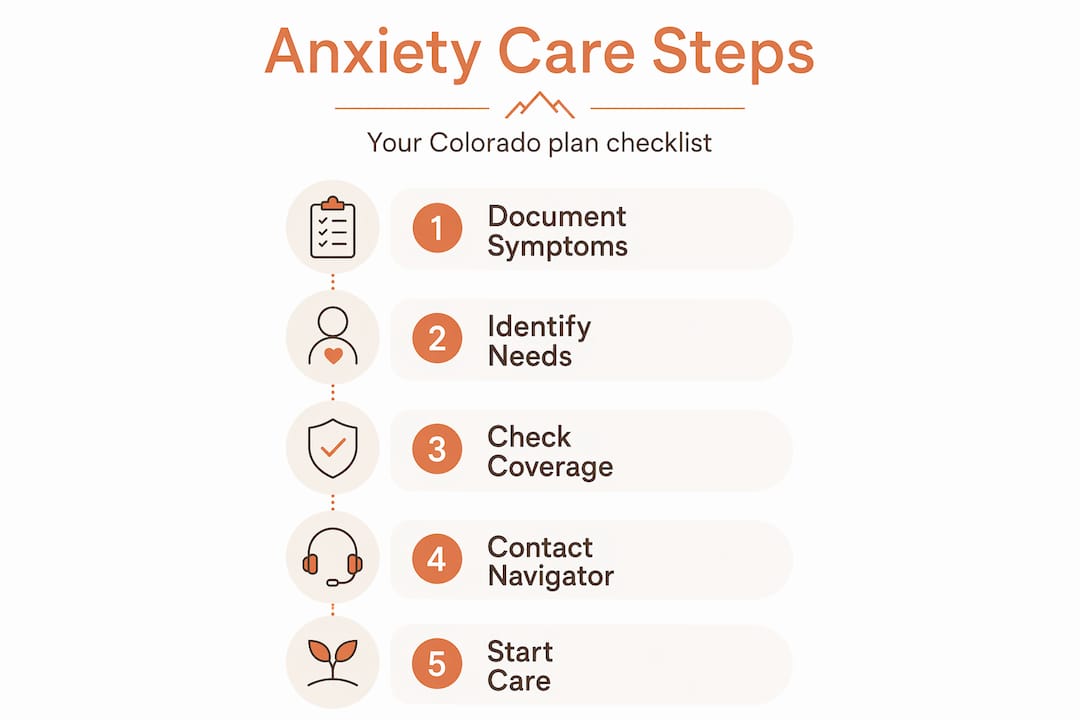
Step 1: Document your symptoms. Write down how anxiety shows up for you. Note frequency, intensity, physical symptoms, and specific triggers. This gives your provider the clearest possible picture from the first session.
Step 2: Identify your care needs. Are you looking for therapy only, or do you also need medication evaluation? Do you need intensive support or standard outpatient care? Knowing this ahead of time helps you ask the right questions.
Step 3: Check your insurance and budget. Review what your plan covers for mental health services. If you are uninsured or underinsured, do not stop there.
Step 4: Contact a care navigator. Colorado care navigators through OwnPath Care Directory and Colorado LIFTS are available weekdays from 8 a.m. to 5 p.m. to help you connect with services regardless of your financial situation. This is one of the most underused resources in the state.
Step 5: Verify your provider’s service mix. Because integrated care programs vary widely in Colorado, confirm that the provider you choose actually offers the specific therapies and medication management you need before committing.
The table below summarizes key Colorado-specific resources and what they offer.
| Resource | What it provides |
|---|---|
| OwnPath Care Directory | Statewide searchable directory for behavioral health services |
| Colorado LIFTS | Free care navigation support to connect individuals to treatment |
| Colorado CIBH+ model | Integrated team care combining therapy, psychiatry, and social work |
| Journeymhw telehealth | Virtual evaluations, medication management, and structured treatment plans |
One note worth flagging: no standardized statewide anxiety care plan exists in Colorado. Care is entirely personalized based on your provider, facility, and available resources. That makes your own preparation and self-advocacy more important than it might be in a more centralized system.
Executing your anxiety care plan step by step
Once your plan is in place, active engagement is what drives results. Understanding the typical structure of care helps you participate rather than just show up.
Therapy is the backbone of most plans. Cognitive Behavioral Therapy (CBT) is the most widely used approach, teaching you to identify and restructure thought patterns that fuel anxiety. For those with trauma histories or significant physical symptoms, combining CBT with somatic approaches produces more durable outcomes. Your provider should explain which modality they are using and why it fits your specific presentation.

Medication management, when included, typically starts with a psychiatric evaluation followed by monthly check-ins. This is not a set-it-and-forget-it process. Dosages are adjusted, effects are monitored, and decisions are made collaboratively. Colorado-specific factors like high altitude can also influence how certain medications metabolize, making regular communication with your prescriber especially relevant.
Group therapy is often underestimated. It provides peer accountability, shared coping strategies, and a reduced sense of isolation. Many IOP programs build group sessions into weekly schedules, making them a consistent and practical part of the care structure.
Here is what strong day-to-day engagement looks like:
- Track mood, sleep, and anxiety levels between sessions using a simple journal or app
- Practice coping strategies between appointments rather than only in session
- Notify your provider promptly if medication side effects appear or symptoms worsen significantly
- Review your structured mental health plan at each appointment, not just at quarterly reviews
- Be honest with your care team about what is not working
Pro Tip: The coping strategies in your plan are most effective when practiced consistently, not just during a crisis. Treat them the same way you would a physical therapy exercise: regular, low-stakes practice builds the capacity you need when stress spikes.
Overcoming common obstacles in your care plan
Even with a solid plan in place, barriers come up. Knowing how to handle them in advance reduces the chance that an obstacle derails your progress entirely.
-
Appointment delays and provider shortages. Colorado’s mental health system faces real access challenges, particularly for younger residents. Delayed appointments and limited inpatient capacity affect timely care across the state. If your wait time is long, ask to be placed on a cancellation list and use the interim period to work with a care navigator on alternative options.
-
Insurance and cost barriers. If cost is blocking access, contact Colorado LIFTS before giving up. This service exists specifically to get people past the financial barriers that prevent intake appointments.
-
Recognizing when your plan needs adjustment. If your anxiety is not improving after 6 to 8 weeks of consistent treatment, or if your daily functioning is getting worse rather than better, that is a signal to bring to your next appointment, not to wait out.
-
Using your crisis plan. A crisis plan created while you are calm gives you a concrete set of steps to follow when anxiety peaks and clear thinking is harder. It should include your triggers, calming strategies, support contacts, and emergency resources. Treat it as a reference document, not a sign of failure.
“The most important thing you can do during a high-anxiety episode is follow a plan you created when you were not in crisis. That version of you was thinking clearly.”
- Seeking additional support. If your current provider cannot offer a modality your plan calls for, it is reasonable to ask for a referral. You can also explore anxiety therapy options through telehealth platforms if in-person access is limited in your area.
Measuring progress and planning for long-term wellness
A care plan without measurable goals is just a list of appointments. Working with your provider to define what success looks like gives the entire process direction and helps both of you know when adjustments are needed.
| Milestone | How to measure it |
|---|---|
| Reduced anxiety frequency | Track episodes per week using a mood journal or app |
| Improved daily function | Assess work, sleep, and social engagement monthly |
| Medication stability | Confirm with prescriber at each monthly check-in |
| Crisis plan readiness | Review and update plan every 90 days |
| Long-term wellness maintenance | Schedule check-in appointments every 3 to 6 months after acute phase |
Preventive practice matters after the intensive phase of treatment ends. Natural coping strategies including structured sleep, regular movement, and deliberate social connection help sustain the progress made in therapy. These are not replacements for clinical care. They are the habits that protect what you worked hard to build.
Community resources in Colorado also support ongoing mental health. Peer support groups, community mental health centers, and state programs through the Behavioral Health Administration provide continuity between formal treatment episodes. Planning for future care adjustments as life circumstances change is not pessimistic. It is responsible self-care.
My take on navigating anxiety care in Colorado
I have spent considerable time reviewing how people in Colorado try to access anxiety treatment, and the pattern I keep noticing is this: most people wait too long to act and then expect a single intervention to fix everything. That is not how anxiety responds to treatment.
What actually works is a coordinated, team-based approach where your therapist, prescriber, and care navigator are all on the same page. I have found that the biggest gap is not the quality of care available. It is the fragmented way people try to access it without guidance. Colorado’s CIBH+ model and the OwnPath navigator system are genuinely useful tools that most residents never use simply because they do not know they exist.
My honest recommendation: start with a care navigator before you even schedule a therapy appointment. They save you weeks of confusion and misdirected effort. The benefits of structured planning go far beyond the clinical. Having a written plan in your hands changes how you show up to every appointment and how much you get out of each session.
Anxiety does not improve by chance. It improves when you stop managing symptoms in isolation and start treating the whole picture with consistent, coordinated support.
— Jamie
How Journeymhw supports your anxiety care in Colorado
If you are ready to move from research to real support, Journeymhw makes it straightforward. Their telehealth platform serves Colorado residents with personalized anxiety treatment plans that include psychiatric evaluations, structured therapy pathways, and ongoing medication management. Everything is designed for people who want quality care without navigating a fragmented system on their own.
Journeymhw’s care model prioritizes speed and personalization. Appointments are available quickly, and your plan is built around your specific symptoms, history, and goals, not a generic template. For Colorado residents managing anxiety, their mental health treatment services offer a clear, accessible starting point. You can also explore their medication management options as part of a complete care plan. Starting is as simple as completing an online assessment.
FAQ
What does a Colorado anxiety care plan typically include?
A structured anxiety care plan in Colorado typically includes individual therapy, medication management if needed, group support, and a proactive crisis plan. Components vary by provider and are personalized to your symptoms and goals.
How do I access free anxiety care in Colorado?
Colorado offers free care navigation through OwnPath Care Directory and Colorado LIFTS, available weekdays from 8 a.m. to 5 p.m. These services help connect you to treatment regardless of insurance or financial situation.
What is the difference between IOP and standard outpatient care for anxiety?
Standard outpatient care typically involves weekly therapy sessions, while an Intensive Outpatient Program provides more frequent individual and group therapy alongside medication management. IOPs are designed for people who need more structured support without inpatient admission.
How do I know if my care plan is working?
Track measurable indicators like anxiety frequency, sleep quality, and daily functioning over 6 to 8 weeks. If symptoms are not improving or are getting worse, discuss adjusting your plan with your provider rather than continuing without change.
Can I get anxiety treatment in Colorado through telehealth?
Yes. Telehealth platforms like Journeymhw provide virtual psychiatric evaluations, structured treatment plans, and medication management for Colorado residents, removing geographic and scheduling barriers to consistent care.
Recommended
- Your guide to navigating mental health treatment options – Journey Mental Health
- Your Mental Health Care Checklist for the First Appointment – Journey Mental Health
- Your Structured Mental Health Treatment Plan Guide – Journey Mental Health
- Anxiety Treatment in Texas & Colorado | Online Anxiety Help & Medication – Journey Mental Health