

Mental Health Diagnosis Explained for Adults
A mental health diagnosis explained clearly is something most people never actually receive. You might complete an online quiz, score high on a depression screener, or read a symptom list that feels uncomfortably familiar, and suddenly wonder if you have ADHD, anxiety, or depression. But those moments of recognition are just the beginning, not a diagnosis. The real process is more thorough, more nuanced, and far more useful than any checklist. Understanding how it actually works can help you feel less lost and more prepared to get the care that fits you.
Table of Contents
- Key takeaways
- What a mental health diagnosis really involves
- Diagnosing depression and generalized anxiety disorder
- ADHD diagnosis in adults: what makes it different
- Why screening tools are not the whole story
- My honest take on what patients get wrong
- Start your evaluation with Journeymhw
- FAQ
Key takeaways
| Point | Details |
|---|---|
| Diagnosis requires clinical evaluation | Screening scores alone do not confirm a mental health condition; a licensed clinician must interpret your full history. |
| DSM-5-TR guides all major diagnoses | Conditions like depression, anxiety, and ADHD must meet specific criteria including duration, impairment, and symptom count. |
| Symptoms must appear across settings | For ADHD especially, symptoms need to show up in multiple areas of your life, not just one context. |
| Screening tools are starting points | Tools like the PHQ-9 and GAD-7 flag potential concerns but require professional follow-up to mean anything clinically. |
| Diagnosis opens doors to treatment | A formal diagnosis is not a label. It is the foundation for a personalized treatment plan that actually addresses your needs. |
What a mental health diagnosis really involves
When people search for mental health diagnosis explained, they often expect a simple answer: take a test, get a result, receive a label. The reality is that diagnosis is a clinical process, not a checklist exercise. It involves gathering detailed information about your symptoms, your history, your functioning, and the context of your life.
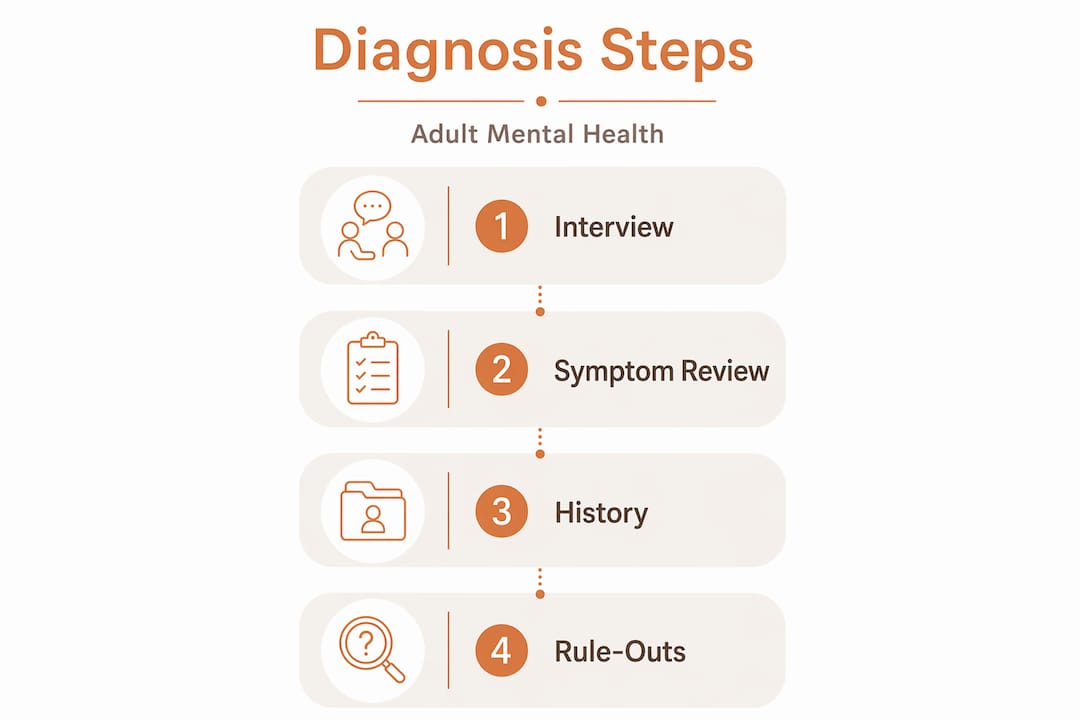
A licensed clinician, whether a psychiatrist, psychologist, or advanced practice provider, conducts what is called a diagnostic assessment or psychiatric evaluation. This typically includes a structured clinical interview where you discuss your symptoms in detail, when they started, how often they occur, and how they affect your ability to work, maintain relationships, and manage daily tasks.
Understanding mental health diagnosis also means understanding what gets ruled out. Differential diagnosis requires clinicians to rule out medical conditions, substance use, and other psychiatric disorders before confirming a diagnosis. Thyroid problems, for example, can mimic depression. Sleep disorders can look like ADHD. That process of elimination is not inefficiency. It is precision.
Here is what a thorough mental health evaluation process typically includes:
- A full symptom review covering frequency, duration, and severity
- Personal and family psychiatric history
- Medical history and current medications
- Assessment of functional impairment at work, school, and in relationships
- Screening for co-occurring conditions like substance use or trauma
- Review of any prior diagnoses or treatment history
Pro Tip: Before your first appointment, write down your top three concerns and the specific moments when symptoms interfered with your life. Clinicians can assess you much more accurately when you arrive with that kind of concrete detail. See the first appointment checklist for a full preparation guide.
The guiding reference for all of this is the DSM-5-TR, the Diagnostic and Statistical Manual of Mental Disorders, Fifth Edition, Text Revision. It sets the mental illness diagnostic criteria that clinicians use to determine whether your symptoms meet the threshold for a specific diagnosis.
Diagnosing depression and generalized anxiety disorder
Two of the most commonly diagnosed conditions in adults are Major Depressive Disorder and Generalized Anxiety Disorder. Both have clear criteria in the DSM-5-TR, but both are also frequently misunderstood or underdiagnosed.

Major Depressive Disorder
Major Depressive Disorder criteria require at least 5 of 9 specific symptoms present nearly every day for a minimum of two weeks. One of those five must be either depressed mood or a significant loss of interest or pleasure. The other symptoms include changes in appetite or weight, sleep disturbances, psychomotor changes, fatigue, feelings of worthlessness or guilt, difficulty concentrating, and recurrent thoughts of death or suicide.
Critically, these symptoms must cause clinically significant distress or impairment in how you function. Feeling sad for a week after a hard life event does not meet the threshold. The symptoms also cannot be explained by substance use, medication, or another medical condition. For more on how high-functioning depression can present differently than expected, it is worth understanding how some people meet diagnostic criteria while still appearing to manage daily life.
Generalized Anxiety Disorder
The picture for GAD looks different. GAD criteria require excessive and uncontrollable worry about multiple topics on most days for at least six months, accompanied by at least three of six associated symptoms: restlessness, fatigue, difficulty concentrating, irritability, muscle tension, and sleep disturbance.
| Condition | Core requirement | Duration | Additional symptoms needed |
|---|---|---|---|
| Major Depressive Disorder | Depressed mood or loss of interest | 2+ weeks | 5 of 9 symptoms |
| Generalized Anxiety Disorder | Uncontrollable, excessive worry | 6+ months | 3 of 6 associated symptoms |
Accurate GAD documentation must include clear records of symptom duration, functional impact, and differentiation from other anxiety disorders like panic disorder or social anxiety. This specificity matters for both clinical accuracy and treatment planning.
Pro Tip: GAD and depression frequently co-occur. If you are being evaluated for one, ask your clinician to screen for the other as well. Treating only one condition when both are present significantly limits how much you will improve.
ADHD diagnosis in adults: what makes it different
Adult ADHD diagnosis is one of the most frequently misunderstood areas in mental health care. Many adults were never identified as children and only seek evaluation after years of struggling with focus, organization, or impulsivity. Understanding how ADHD is diagnosed in adults requires knowing how the criteria shift from childhood.
Adult ADHD diagnosis under DSM-5-TR requires 5 of 9 symptoms in either the inattentive or hyperactive-impulsive category, compared to 6 of 9 for children. This lower threshold acknowledges that hyperactive symptoms often become less visible as people age, even while impairment continues.
The three presentations are:
- Predominantly inattentive: Missing details, difficulty sustaining attention, losing items, becoming easily distracted, forgetting daily tasks
- Predominantly hyperactive-impulsive: Fidgeting, leaving your seat, excessive talking, difficulty waiting, interrupting others
- Combined presentation: Symptoms from both categories meeting the thresholds for each
Three requirements often trip people up in the assessment process. Symptoms must have been present before age 12. They must appear in at least two different settings, such as at work and at home. And they must cause clear impairment in social, academic, or professional functioning.
Adult ADHD diagnosis often requires collateral history from family members or partners who knew you as a child, because self-report alone may not capture the full developmental picture. Structured interviews and rating scales are helpful, but clinical judgment is what ties everything together. Anxiety and mood disorders frequently produce overlapping symptoms, which is why accurate anxiety vs. ADHD differentiation is a critical part of the evaluation.
Why screening tools are not the whole story
This is where many people get misled. Signs of mental health conditions can show up clearly on a PHQ-9 or GAD-7 questionnaire. You score a 14 on the PHQ-9 and assume you have depression. But that score is a signal, not a sentence.
PHQ-9 scores fall into severity bands that suggest probable symptom load, but they do not confirm a diagnosis. A score at or above 10 typically prompts a deeper clinical evaluation. The tool helps clinicians know where to look, not what to conclude.
There is also one item on the PHQ-9 that carries extra clinical weight. Item 9 screens for suicidal ideation, and a positive response there triggers an immediate clinical workflow, regardless of the overall score. This is not just a data point. It is a safety protocol that requires direct, urgent clinical follow-up.
Mental health diagnoses are best understood as frameworks that describe patterns of distress, not rigid disease categories. As noted by Psychology Today, experts increasingly view diagnosis as a guide to clinical care rather than a fixed label that fully captures a person’s experience.
Here is why relying on screening tools alone can mislead you:
- Two people with the same PHQ-9 score may have entirely different diagnoses
- Questionnaires cannot assess context, history, trauma, or life circumstances
- Overlapping symptoms across conditions require professional interpretation
- Self-diagnosis based on scores often leads to incorrect conclusions about what treatment you need
Pro Tip: Use screening tools like the PHQ-9 to prepare for a conversation with your clinician, not to reach a conclusion. Bring your results to your appointment and let a professional put them in context.
The importance of mental health diagnosis done properly cannot be overstated. A missed or incorrect diagnosis does not just delay treatment. It can mean receiving the wrong treatment entirely, which can worsen how you feel and function over time.
My honest take on what patients get wrong
I’ve worked with and around the mental health assessment process long enough to see a consistent pattern. Patients come in with a diagnosis they’ve given themselves, built from online quizzes, social media content, and symptoms that feel painfully relatable. And I understand why. When you are struggling and something finally seems to explain it, you hold on to it.
But what I’ve seen is that the most helpful thing diagnosis can offer is precision, not validation. A formal evaluation doesn’t just confirm what you suspect. It often reveals something more specific, or something additional, that changes the entire direction of treatment. I’ve seen people spend years treating anxiety when the core issue was undiagnosed ADHD. I’ve seen the reverse just as often.
The emotional weight of either receiving a diagnosis or being told you don’t meet criteria is real and deserves acknowledgment. Not getting a diagnosis doesn’t mean nothing is wrong. It means the clinician needs more information, or that what you’re experiencing fits a different category than expected. Keep asking questions. Push for thorough evaluation. Bring someone who knows you well to your appointment if you can.
What I want readers to take away from this is simple. Diagnosis is not a label to fear. It is a tool that, when applied carefully and with clinical rigor, opens a door to care that is actually designed for you.
— Jamie
Start your evaluation with Journeymhw
If reading about the mental health evaluation process has made you realize you’re ready to talk to someone, Journeymhw is built for exactly that moment.
Journeymhw is a telehealth platform serving adults in Texas and Colorado who are looking for professional evaluation and treatment for ADHD, anxiety, and depression. Whether you are trying to understand your symptoms or ready to move forward with care, the process starts with a psychiatric evaluation conducted entirely online. From there, treatment and medication management are coordinated through structured care plans designed around your specific needs. To see the full range of conditions and services available, visit the conditions we treat page and take the first step at a time that works for you.
FAQ
What does a mental health diagnosis involve?
A mental health diagnosis involves a clinical interview, symptom review, personal and family history, and ruling out other medical or psychiatric causes. A licensed professional uses DSM-5-TR criteria to determine whether your symptoms meet the threshold for a specific condition.
How is ADHD diagnosed in adults?
Adult ADHD diagnosis under DSM-5-TR requires 5 of 9 symptoms in the inattentive or hyperactive-impulsive category, evidence of childhood onset before age 12, and symptoms present in multiple settings. Clinicians also rule out anxiety and mood disorders, which can produce similar symptoms.
Can a screening tool like the PHQ-9 diagnose depression?
No. The PHQ-9 is a screening tool that flags potential symptoms and informs clinical conversations, but it does not confirm a diagnosis. A score above 10 suggests further evaluation is needed, and a positive response on item 9 requires immediate clinical follow-up.
What is the DSM-5-TR and why does it matter?
The DSM-5-TR is the Diagnostic and Statistical Manual of Mental Disorders, Fifth Edition, Text Revision. It is the standard reference clinicians use to define mental illness diagnostic criteria, including required symptoms, duration, and functional impairment thresholds for conditions like depression, anxiety, and ADHD.
Why might I not receive a diagnosis even if I feel something is wrong?
Not meeting full criteria for a specific diagnosis does not mean your symptoms are not real or serious. It may mean the symptoms fit a different condition, more information is needed, or you are experiencing subsyndromal distress that still warrants clinical support and monitoring.
Recommended
- Your guide to navigating mental health treatment options – Journey Mental Health
- Why ADHD treatment improves daily function in adults – Journey Mental Health
- The Benefits of Virtual Mental Health Care for Depression, Anxiety and ADHD your guide – Journey Mental Health
- Your Mental Health Care Checklist for the First Appointment – Journey Mental Health