

Urgent Mental Health Care Access Steps: 2026 Guide
What to do first when you need urgent mental health care
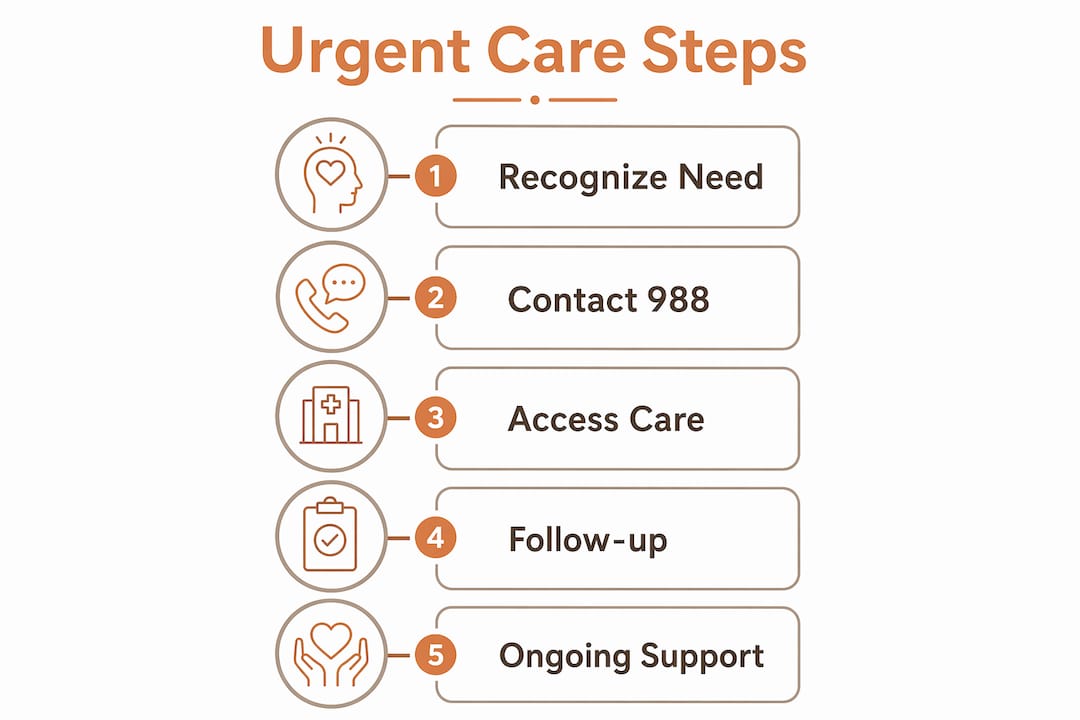
When a mental health crisis hits, the right first step depends on how serious the situation is right now. Here is a clear breakdown of what to do, in order of urgency.
- Life-threatening emergency: Call 911 or go to your nearest emergency department immediately. This includes active suicidal behavior, loss of consciousness, or any situation where someone could be seriously harmed.
- Non-life-threatening crisis: Call or text 988 to reach the 988 Suicide & Crisis Lifeline, available 24/7 by phone, text, or chat at 988lifeline.org. A trained counselor will listen, assess your situation, and connect you with local resources.
- Worsening chronic symptoms: Contact your mental health provider right away if your condition is deteriorating but you are not in immediate danger. Getting ahead of a worsening episode is far easier than managing a full crisis.
- No current provider: Call your primary care physician and request an urgent appointment, just as you would for any acute physical illness.
- Finding local services: Call 211 or visit 211.org to locate behavioral health urgent care centers, mobile crisis teams, and other community resources near you.
The principle guiding all of these options is least restrictive care. The goal of crisis response in the U.S. is to stabilize you in the community whenever possible, not to hospitalize you automatically. Knowing this can make it much easier to ask for help early.
What behavioral health urgent care centers actually offer you

Behavioral Health Urgent Care (BHUC) centers are a relatively new category of care that sits between a therapist’s office and a hospital emergency department. They are designed for people who need more than a scheduled outpatient appointment but do not require emergency hospitalization.
These centers provide:
- Same or next-day psychiatric evaluations
- Psychopharmacology appointments within 72 hours of an initial evaluation, as modeled by Massachusetts MassHealth BH Urgent Care sites
- Substance use assessments and referrals
- Extended weekday hours and, at many sites, weekend availability
- Walk-in access without a prior referral at many locations
The Massachusetts BH Urgent Care network is one of the most developed in the country and serves as a practical model for what these centers can look like at scale. Availability varies significantly by state and region. To find crisis services near you, call 211, search your county health department’s website, or ask a 988 counselor directly during a call.
BHUCs are a strong option if you are managing a chronic condition like anxiety or depression and your symptoms have escalated beyond what your regular care plan can handle right now.
How telehealth gives you faster access to psychiatric care
Telehealth platforms have changed what “prompt access” to psychiatric care actually means. For conditions like ADHD, anxiety, and depression, virtual evaluations can often be scheduled within days rather than weeks, and ongoing medication management happens without the friction of in-person visits.
What to prepare before your virtual psychiatric appointment:
- A list of your current diagnoses and any prior psychiatric history
- All current medications and dosages
- Your insurance card and any prior authorization information
- A quiet, private space with a stable internet connection
- Two or three specific concerns or questions you want to address
Journeymhw offers structured virtual psychiatric care for ADHD, anxiety, and depression, with a clear pathway from initial evaluation to ongoing medication management. For patients in Texas and Colorado, appointments are available with minimal wait time through a straightforward online booking process.
On insurance and cost: Most major insurers now cover telehealth psychiatric visits at the same rate as in-person care, following federal parity requirements. If you are uninsured or underinsured, ask your telehealth provider about self-pay rates or sliding-scale options. A practical overview of affordable mental health care can help you understand your options before your first appointment.
What modern crisis response actually looks like
Most people hesitate to call for help because they fear the worst: police showing up, being forced into a hospital, or losing control of the situation. The reality of modern crisis response is quite different.
“The 988 Lifeline coordinated response is intended to promote stabilization and care in the least restrictive manner. Most crises are managed by counselors working with you to de-escalate the situation and without involving law enforcement.” — SAMHSA, 988 FAQs
When you contact 988, a counselor works with you directly. If more support is needed, they can dispatch a mobile crisis team to come to you in the community, assess your needs on-site, and connect you with appropriate care, all without requiring hospitalization. These teams typically include trained mental health professionals and, in some cases, peer support workers.
If law enforcement does become involved, you can specifically request Crisis Intervention Team officers by stating “this is a mental health crisis” when you call 911. CIT officers receive specialized training in de-escalation and are familiar with local mental health resources. You can also call your non-emergency police line ahead of time to ask whether CIT officers are available in your area.
Pro Tip: If you are supporting a loved one through a mental health crisis, early outreach is the single most effective thing you can do. Early intervention consistently reduces the risk of escalation and hospitalization.
Crisis lines also function as navigators. A 988 counselor can tell you what urgent care clinics, mobile crisis teams, and stabilization units are available specifically in your location, not just generic national resources.
How to stay on track after your first urgent contact
Getting through the first moment of a crisis is one thing. Staying connected to care afterward is where many people lose momentum. These steps help you maintain continuity.
- Build your emergency information document. Write down your diagnoses, all current medications and dosages, your provider’s contact information, and your insurance details. Keeping this ready speeds up every future assessment and reduces delays when you need help fast.
- Schedule follow-up care within 14 days. After any urgent contact, book a follow-up appointment with your existing provider or request a referral to a new one. Many BH Urgent Care centers schedule all follow-up appointments within 14 calendar days of an initial evaluation.
- Address medication needs promptly. If you need a prescription adjusted or a new medication started, contact your prescriber directly. Telehealth providers like Journeymhw offer medication management as part of ongoing care, which can be faster than waiting for an in-person appointment.
- Use your first appointment checklist. Preparing documents, questions, and your history before any new provider visit saves time and helps you get the most from the session.
- Connect with population-specific resources. Veterans can access specialized counselors through the Veterans Crisis Line by pressing 1 after dialing 988. Youth and families can reach the Crisis Text Line by texting HOME to 741741. Older adults can ask their primary care provider for a geriatric psychiatry referral or contact their local Area Agency on Aging for care coordination support.
- Tell your support network. Share your emergency plan with one or two trusted people. NAMI recommends that your care team and close contacts all know how to reach your providers in an emergency.
- Ask about a structured treatment plan. A written treatment plan gives you and your provider a shared roadmap, which is especially valuable for managing chronic conditions like ADHD, anxiety, or depression over time.
Journeymhw makes virtual psychiatric care straightforward
When you are ready to move from crisis stabilization into consistent, ongoing care, having a reliable telehealth provider matters. Journeymhw offers virtual psychiatric evaluations and ongoing ADHD treatment for patients in Texas and Colorado, with a process built to reduce the delays that make chronic condition management so frustrating.
We specialize in ADHD, anxiety, and depression. From your first evaluation to continued medication management, everything happens virtually, on your schedule, without long waits or complicated referral chains. Patients in Texas can access psychiatric care in Tyler, while those in Colorado can connect with Denver-based psychiatry services, all through the same platform. When you are ready to get started, book your appointment directly online.
Key Takeaways
Accessing urgent mental health care in the U.S. requires knowing which resource matches your level of need, from 911 for emergencies to telehealth for ongoing chronic condition management.
| Point | Details |
|---|---|
| Match resource to urgency | Call 911 for life-threatening situations; use 988 for crisis counseling; contact your provider for worsening chronic symptoms. |
| BHUCs fill a critical gap | Behavioral Health Urgent Care centers offer same or next-day evaluations and timely psychopharmacology appointments. |
| Least restrictive care is the standard | Most U.S. crisis responses prioritize community-based stabilization over hospitalization or law enforcement involvement. |
| Preparation speeds up care | An emergency document with your diagnoses, medications, and provider contacts reduces delays at every point of contact. |
| Journeymhw for ongoing virtual care | Journeymhw provides scheduled virtual psychiatric evaluations and medication management for ADHD, anxiety, and depression in Texas and Colorado. |
Recommended
- Affordable Mental Health Care Access: Your Practical Guide – Journey Mental Health
- Your Mental Health Care Checklist for the First Appointment – Journey Mental Health
- Your guide to navigating mental health treatment options – Journey Mental Health
- The Benefits of Virtual Mental Health Care for Depression, Anxiety and ADHD your guide – Journey Mental Health