

ADHD Testing Process for Adults: Your 2026 Guide
Adult ADHD testing is defined as a comprehensive clinical evaluation that combines structured interviews, validated rating scales, and a full symptom history review to determine whether ADHD criteria are met under DSM-5 standards. There is no single test that diagnoses ADHD. A thorough assessment takes 1–3 hours for the core interview and rating scales, with possible neuropsychological testing adding 4–8 hours more. This adhd testing process adults guide walks you through every stage, from preparation to receiving your results, so you know exactly what to expect.
What is the ADHD assessment process for adults?
The adult ADHD assessment process is a multi-step clinical evaluation, not a pass/fail exam. Clinicians follow DSM-5 criteria, which require symptoms to be present across multiple life domains, cause measurable functional impairment, and trace back to childhood. That last point surprises many adults. You may not remember struggling in elementary school, but the evaluator will ask detailed questions about your academic history, relationships, and work performance to build a complete picture.
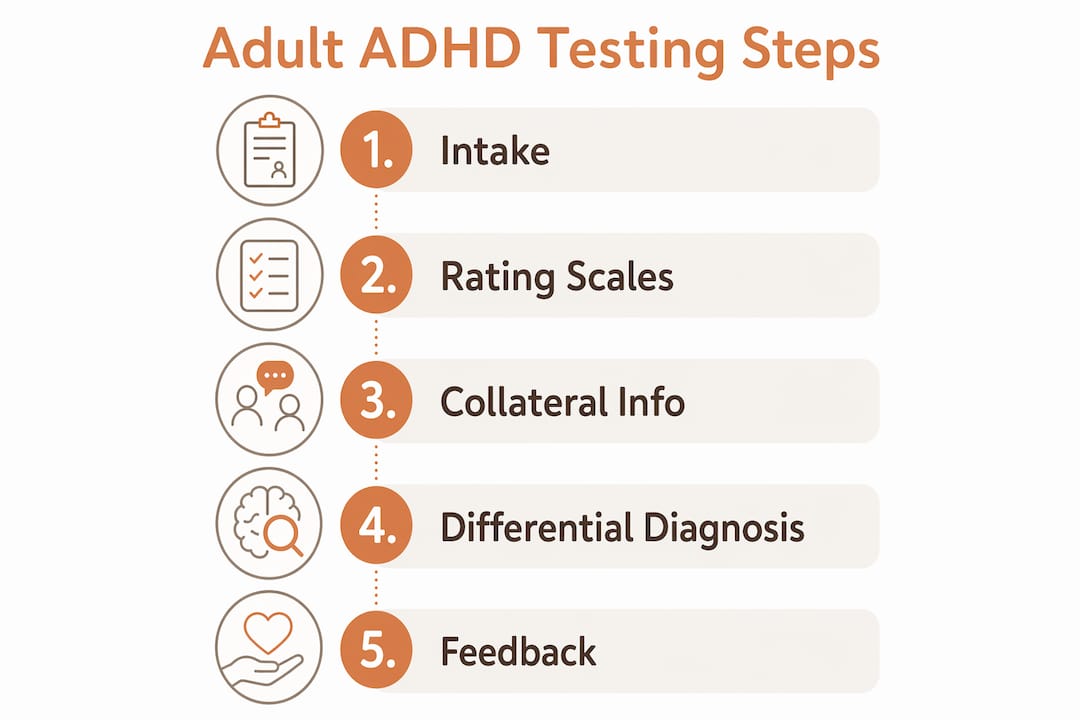
The standard clinical process includes four core components: a structured clinical interview, standardized rating scales such as the ASRS (Adult ADHD Self-Report Scale) or CAARS (Conners’ Adult ADHD Rating Scales), collateral information from someone who knows you well, and a review of any prior medical or psychiatric records. Each component adds a layer of accuracy. Relying on self-report alone misses a significant portion of the clinical picture because ADHD itself impairs self-awareness, making symptom underreporting common.

Clinicians also screen for conditions that mimic ADHD, including anxiety, depression, sleep disorders, thyroid dysfunction, and trauma responses. This differential diagnosis step is not optional. It protects you from receiving an inaccurate diagnosis and ensures your treatment plan addresses the right condition.
How to prepare before your adult ADHD evaluation
Preparation directly improves the accuracy of your evaluation. Walking in with organized information gives your clinician more to work with and reduces the chance of missing key symptoms.
Gather these items before your appointment:
- A written list of specific examples where symptoms affected your work, relationships, or daily tasks
- Your full medical and psychiatric history, including any prior diagnoses
- A current medication list, including supplements
- School records, report cards, or teacher notes if available
- Contact information for a parent, partner, or close friend who can provide collateral input
Validated screening tools you may encounter:
| Tool | What it measures | Format |
|---|---|---|
| ASRS v1.1 | Adult ADHD symptom frequency | 18-item self-report |
| CAARS | Symptom severity and DSM-5 subscales | Self and observer versions |
| Brown ADD Rating Scales | Executive function and emotional regulation | Self-report |
| Vanderbilt Assessment Scale | Childhood symptom history | Parent/teacher report |
These tools do not diagnose ADHD on their own. They quantify symptom frequency and severity so the clinician can compare your scores against established norms.
Pro Tip: Ask a parent or close friend to complete the observer version of the CAARS before your appointment. Clinicians weigh third-party input heavily, and having it ready on day one can shorten your overall evaluation timeline.
What to expect during the adult ADHD testing process step by step
The evaluation follows a predictable structure. Knowing the sequence reduces anxiety and helps you give more accurate answers.
- Intake and records review. Your clinician reviews any documents you submitted in advance, including prior evaluations, medical history, and completed rating scales.
- Clinical interview. This is the core of the evaluation. Expect detailed questions about your current symptoms, childhood behavior, academic performance, work history, relationships, and family mental health history. This portion alone typically runs 60–90 minutes.
- Standardized rating scales. You complete validated questionnaires like the ASRS and CAARS during or before the session. These provide quantifiable data to support clinical observations.
- Collateral information collection. Your clinician may contact a family member or partner to gather third-party observations about your behavior across different settings.
- Differential diagnosis review. The clinician systematically rules out other conditions including anxiety, depression, and sleep disorders that share symptoms with ADHD.
- Neuropsychological testing (if referred). Not everyone needs this step. If recommended, it involves 4–8 hours of standardized tasks measuring working memory, processing speed, and cognitive flexibility.
Pro Tip: Bring a written list of three to five specific situations where your symptoms caused real problems. Concrete examples, like missing a work deadline or forgetting a bill three months in a row, give your clinician far more useful data than general descriptions.
The table below summarizes what each stage involves and how long it typically takes.
| Assessment component | What happens | Typical duration |
|---|---|---|
| Clinical interview | Symptom history, childhood, functioning | 60–90 minutes |
| Rating scales | ASRS, CAARS, observer forms | 20–30 minutes |
| Collateral contact | Third-party behavioral report | 15–30 minutes |
| Differential diagnosis | Rule out anxiety, depression, sleep issues | Integrated into interview |
| Neuropsychological testing | Executive function battery (if referred) | 4–8 hours |
How to interpret your ADHD evaluation results
After your evaluation, you receive a written report containing diagnostic impressions and specific recommendations. This document is the clinical record of your assessment. It details which DSM-5 criteria you met, which you did not, and what conditions were ruled out. The report also identifies which ADHD presentation applies to you: predominantly inattentive, predominantly hyperactive-impulsive, or combined.
A feedback session follows the report. Your clinician walks you through the findings, answers your questions, and outlines a treatment plan. This session matters. Many adults leave evaluations confused about what their diagnosis actually means for daily life. Use this time to ask about ADHD and anxiety overlap if co-occurring conditions were identified, since treatment priorities can shift depending on which condition drives more impairment.
What your report typically includes:
- A summary of your symptom history and how it maps to DSM-5 criteria
- Scores from standardized rating scales with normative comparisons
- Differential diagnosis conclusions and any co-occurring conditions identified
- Specific recommendations for medication, behavioral therapy, or both
- Suggested ADHD lifestyle treatment strategies and accommodations
Reports from comprehensive evaluations are typically delivered within 5–7 business days after your assessment. That timeline gives you a clear window for planning your next steps.
Common misconceptions about adult ADHD testing
The biggest misconception adults carry into evaluations is that the process is a test they can pass or fail. The ADHD evaluation is a diagnostic conversation, not an exam. There are no right or wrong answers. Trying to present symptoms in a certain way actually reduces accuracy and can lead to a misdiagnosis.
“Adults often come in either minimizing their symptoms because they’ve learned to cope, or amplifying them because they’re desperate for answers. Neither approach helps. The most useful thing you can do is describe your actual experience as specifically and honestly as possible.”
A second common challenge is the overlap between ADHD and other conditions. Adults with ADHD frequently have co-occurring anxiety or depression, and the symptoms look nearly identical on the surface. A clinician who skips differential diagnosis may treat the wrong condition entirely.
Other misconceptions worth addressing:
- “I’ve managed this far, so it can’t be ADHD.” Compensation strategies mask symptoms but do not eliminate impairment. Many adults receive a first diagnosis in their 30s, 40s, or later.
- “I need a brain scan to confirm it.” No imaging test diagnoses ADHD. The clinical interview and rating scales are the gold standard.
- “Telehealth evaluations aren’t as thorough.” Virtual evaluations use the same validated tools and clinical standards as in-person assessments. Behavioral health claims in Colorado doubled from 2.9 million in 2019 to 6.3 million in 2025, reflecting how widely telehealth has expanded access without sacrificing quality.
Pro Tip: Before your evaluation, write down three situations from childhood and three from the past six months where attention or impulse control caused a specific problem. This preparation addresses both the childhood history requirement and current functional impairment criteria in one step.
Key Takeaways
A complete adult ADHD evaluation requires clinical interviews, validated rating scales, collateral input, and differential diagnosis to meet DSM-5 standards and produce a reliable, treatment-ready result.
| Point | Details |
|---|---|
| No single test diagnoses ADHD | Evaluation combines interviews, rating scales, and history review across 1–3 hours minimum. |
| Preparation improves accuracy | Gather medical history, symptom examples, and a collateral contact before your appointment. |
| Differential diagnosis is required | Clinicians must rule out anxiety, depression, and sleep disorders before confirming ADHD. |
| Results come with a written report | Expect diagnostic impressions, DSM-5 criteria mapping, and treatment recommendations within 5–7 business days. |
| Telehealth expands access | Virtual evaluations use the same clinical standards and are widely available in states like Colorado and Texas. |
What I’ve learned from watching adults go through this process
Adults who struggle most with the evaluation are usually the ones who spent years convincing themselves they were just “bad at focusing” or “lazy.” By the time they sit down for an assessment, they’ve built up so much self-doubt that they either undersell their symptoms or expect the clinician to catch them exaggerating. Neither posture serves them.
The most productive patients I’ve observed come in with specific examples, not general complaints. They say things like, “I’ve been late to work 40 times this year because I lose track of time getting ready,” not “I’m always disorganized.” That specificity is what gives a clinician something to work with under DSM-5 criteria.
Telehealth has genuinely changed the picture for adults in states like Colorado and Texas. The barrier used to be a six-month wait for an in-person neuropsychologist. Now a structured virtual evaluation with a qualified clinician can happen within weeks. That speed matters because untreated ADHD compounds over time. Every year without an accurate diagnosis is another year of avoidable friction at work, in relationships, and in daily functioning.
My honest advice: treat the evaluation as a fact-finding mission, not a performance. The goal is an accurate picture of how your brain actually works, not a label. Understanding that distinction makes the whole process less stressful and far more useful.
— Jamie
How Journeymhw supports adults through ADHD evaluation and care
Journeymhw offers virtual ADHD evaluations for adults in Colorado and Texas, conducted by experienced clinicians using the same validated tools and DSM-5 standards described in this guide. The process runs from intake through a full feedback session, with flat-fee pricing and no hidden costs.
After your evaluation, Journeymhw connects you directly to ADHD medication management and structured treatment planning, so there is no gap between diagnosis and care. Adults who want to move from assessment to treatment without navigating multiple providers will find the process clear and direct. You can book your evaluation online and get started without a referral or a long wait.
FAQ
What does the adult ADHD testing process involve?
Adult ADHD testing involves a structured clinical interview, standardized rating scales like the ASRS or CAARS, collateral input from a third party, and differential diagnosis to rule out conditions with overlapping symptoms. The core evaluation typically takes 1–3 hours.
How long does it take to get ADHD test results?
Written evaluation reports are typically delivered within 5–7 business days after the assessment, followed by a feedback session to review findings and discuss treatment options.
Can I get an ADHD evaluation done virtually in Colorado?
Yes. Virtual ADHD evaluations in Colorado use the same clinical standards and validated tools as in-person assessments. Telehealth access has expanded significantly, with behavioral health claims in Colorado more than doubling between 2019 and 2025.
Do I need a referral to get tested for ADHD as an adult?
Most telehealth platforms, including Journeymhw, do not require a referral to begin an adult ADHD evaluation. You can schedule directly and complete the full assessment process online.
What happens after an ADHD diagnosis in adults?
After diagnosis, your clinician provides a written report with treatment recommendations, which may include medication management, behavioral therapy, or both. A feedback session helps you understand your results and plan your next steps.