

ADHD and Anxiety Overlap Explained for Adults
ADHD and anxiety overlap is defined as the co-occurrence of attention-deficit/hyperactivity disorder and anxiety disorders in the same individual, producing shared symptoms that complicate both diagnosis and treatment. Over half of adults with ADHD also carry a comorbid anxiety disorder, making this the single most common pairing in adult psychiatric care. Understanding the ADHD anxiety connection matters because treating one condition without recognizing the other produces incomplete results at best and worsening symptoms at worst. The DSM-5, ICD-11, and structured diagnostic tools like DIVA and CAADID exist precisely because this overlap demands precision. Getting the distinction right changes everything about your treatment path.
How do ADHD and anxiety symptoms overlap and differ in adults?
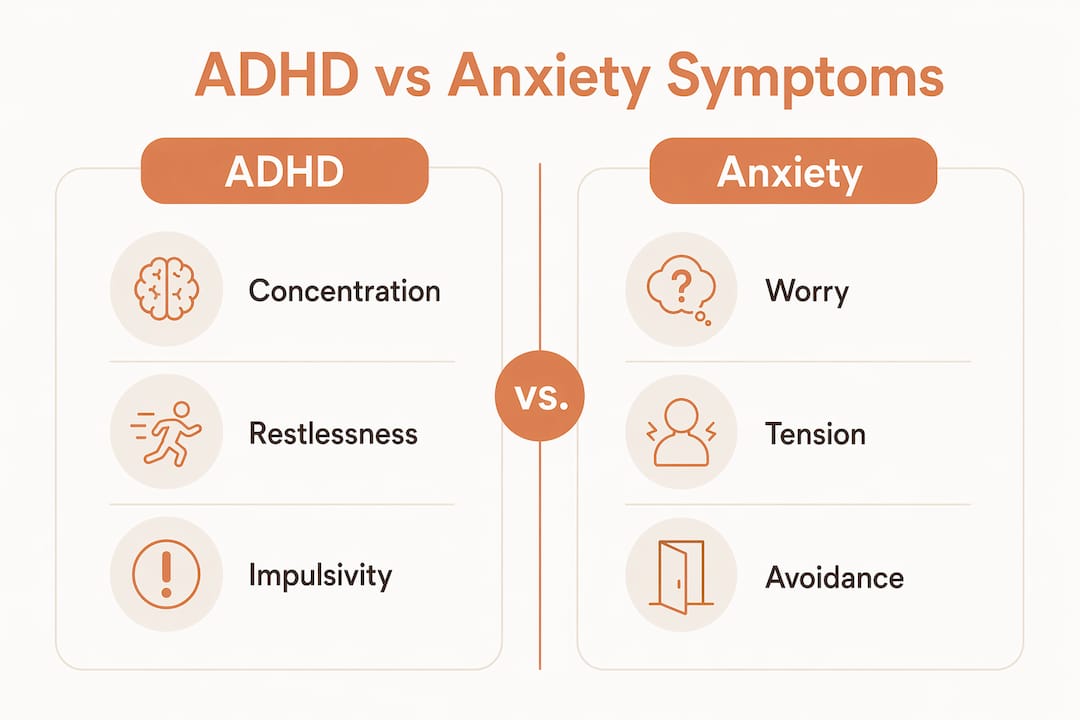
ADHD and anxiety share a striking cluster of surface symptoms that make them easy to confuse. Both conditions produce restlessness, difficulty concentrating, sleep disruption, irritability, and problems completing tasks. For adults experiencing these symptoms, the experience feels nearly identical regardless of which condition is driving it.
The critical difference lies in the mechanism, not the sensation. Anxiety disorders, particularly generalized anxiety disorder (GAD), are characterized by persistent, excessive fear and behavioral changes that cause clinically significant distress. The worry in GAD is content-driven. You worry about specific things: finances, health, relationships. In ADHD, the restlessness and mental noise stem from dysregulation in attention and impulse control, not from fear-based thought patterns.
A useful real-world example: an adult with GAD who cannot concentrate during a work meeting is distracted because they are mentally rehearsing a feared outcome. An adult with ADHD who cannot concentrate in the same meeting is distracted because their brain has moved on to three other topics without permission. The behavior looks the same. The driver is entirely different.

Pro Tip: Keep a symptom journal for two weeks before any clinical evaluation. Note whether your concentration problems occur in all settings or only when you are worried about something specific. This single distinction gives your clinician critical diagnostic data.
| Symptom | ADHD presentation | Anxiety presentation |
|---|---|---|
| Concentration difficulty | Pervasive, across all topics including enjoyable ones | Tied to worry content or feared situations |
| Restlessness | Physical and mental, constant baseline | Triggered by perceived threat or uncertainty |
| Sleep disruption | Racing thoughts, difficulty winding down | Rumination about specific worries |
| Task avoidance | Driven by boredom or overwhelm | Driven by fear of failure or judgment |
| Irritability | Frustration from executive function failures | Tension from sustained hypervigilance |
Understanding the key differences between ADHD and anxiety at the symptom level is the foundation for accurate evaluation.
What challenges arise in diagnosing ADHD and anxiety overlap in adults?
Diagnosing the overlap of ADHD and anxiety in adults is one of the most technically demanding tasks in outpatient psychiatry. The core challenge is that both conditions must meet independent clinical thresholds, and symptoms from one can mask or amplify the other.
NHS 2026 quality standards require that adult ADHD diagnosis document pervasive, persistent symptoms with significant life impact across multiple settings, verified through structured tools like DIVA or CAADID. This is not a checklist exercise. It requires detailed developmental history, collateral information, and careful documentation of when symptoms first appeared. For GAD, the DSM-5-TR requires excessive worry for 6+ months with at least three associated symptoms causing significant distress. Both bars are high, and both can be met simultaneously.
The risk of getting this wrong is real. Clinicians who see anxiety symptoms first and stop there may prescribe SSRIs without ever addressing the underlying ADHD. Patients who receive only ADHD treatment may continue to struggle if a true primary anxiety disorder is also present. Semi-structured diagnostic interviews reduce this error rate by forcing systematic documentation of symptom thresholds across settings and time.
Key diagnostic considerations to discuss with your clinician:
- Symptom onset: ADHD symptoms must trace back to childhood, even if they were not formally identified then. Anxiety disorders can emerge at any age.
- Symptom pervasiveness: ADHD impairs function across all domains. Anxiety tends to cluster around specific feared situations or themes.
- Comorbidity formulation: A good evaluation explicitly states whether anxiety is primary, secondary to ADHD, or both. This distinction drives treatment sequencing.
- Ruling out medical causes: Thyroid disorders, sleep apnea, and substance use can mimic both conditions and must be excluded.
- Collateral history: Reports from partners, family members, or past teachers add reliability that self-report alone cannot provide.
Pro Tip: Ask your evaluating clinician directly: “Is my anxiety primary or secondary to ADHD?” If they cannot answer that question, the evaluation may not be complete enough to guide treatment.
Reviewing common misdiagnoses involving ADHD and anxiety before your evaluation helps you ask better questions and advocate for a thorough workup.
What does neuroscience reveal about ADHD anxiety vs. primary anxiety?
The neurobiological distinction between ADHD-related anxiety and primary anxiety disorders is the most important and least discussed aspect of this overlap. These two types of anxiety feel similar but originate in different brain systems.
ADHD anxiety arises from prefrontal cortex deficits in prediction, working memory, and temporal processing. The prefrontal cortex is responsible for simulating future events, holding plans in mind, and regulating responses to uncertainty. When this system underperforms, the brain cannot reliably model what comes next. The result is a structural intolerance of uncertainty. You feel anxious not because you fear a specific outcome but because your brain cannot generate a clear picture of any outcome. This is time blindness producing anxiety, not fear producing anxiety.
Primary anxiety disorders, including GAD, operate through amygdala hyperreactivity. The amygdala detects threat and triggers the fear response. In GAD, this system is chronically overactivated, producing excessive worry about real or imagined threats. The content of the worry matters. The fear is the driver.
This distinction has direct treatment implications. SSRIs show no significant benefit over placebo for anxiety symptoms in ADHD populations, according to research by Fu et al. (2025). This finding makes sense once you understand the mechanism. SSRIs modulate serotonin pathways connected to amygdala reactivity. They do not address prefrontal underactivation or working memory deficits. Prescribing an SSRI for ADHD-driven anxiety is targeting the wrong brain system.
| Mechanism | ADHD-related anxiety | Primary anxiety (GAD) |
|---|---|---|
| Brain region | Prefrontal cortex | Amygdala |
| Core deficit | Working memory, temporal processing | Threat detection dysregulation |
| Anxiety trigger | Uncertainty from planning failure | Fear of specific outcomes |
| SSRI response | Minimal to none | Clinically significant |
| First-line treatment | Stimulants or atomoxetine | SSRIs or SNRIs plus therapy |
The ADHD anxiety connection is further complicated by the feedback loop it creates. Missed deadlines and chronic overwhelm caused by ADHD symptoms generate real-world failures that then produce secondary anxiety. Over time, this secondary anxiety can become entrenched enough to function like a primary disorder, even though the root cause remains ADHD-driven executive dysfunction.
How can adults manage overlapping ADHD and anxiety symptoms effectively?
Effective management of co-occurring ADHD and anxiety symptoms starts with a clear answer to one question: which condition is primary? The answer determines where treatment begins.
Clinical guidelines from the European Society of Medicine recommend treating disabling ADHD symptoms first with stimulants, then reassessing anxiety needs afterward. This sequencing approach is not arbitrary. When ADHD is the primary driver, treating it with stimulants like amphetamine salts or methylphenidate often reduces associated anxiety as a direct result of improved executive function. You miss fewer deadlines. You feel less overwhelmed. The anxiety that was feeding on those failures begins to recede. Starting multiple medications simultaneously obscures which intervention is working and increases the risk of polypharmacy complications.
For adults where stimulants are not appropriate, atomoxetine (a non-stimulant norepinephrine reuptake inhibitor) offers an alternative that addresses both ADHD symptoms and some anxiety symptoms through a single mechanism. It is slower to take effect than stimulants but avoids the cardiovascular considerations that make stimulants less suitable for some patients.
Behavioral strategies complement medication at every stage:
- Time blocking with external anchors: Use Google Calendar or Todoist with audible alerts to compensate for time blindness. Do not rely on internal reminders.
- Working memory supports: Offload mental tasks to written lists, voice memos, or apps like Notion. Reduce the cognitive load your prefrontal cortex must carry.
- Structured worry time: If anxiety is also primary, schedule 15 minutes daily for deliberate worry. This technique from cognitive behavioral therapy (CBT) contains rumination without suppressing it.
- Sleep hygiene as a clinical priority: Both ADHD and anxiety worsen significantly with sleep deprivation. Consistent sleep and wake times are non-negotiable, not optional.
- Regular psychiatric monitoring: Medication needs change. What works at month three may need adjustment at month six.
Pro Tip: If you start a stimulant and your anxiety increases rather than decreases, tell your prescriber immediately. This response suggests either the dose needs adjustment or a primary anxiety disorder requires separate treatment. It is diagnostic information, not a reason to stop treatment.
Understanding why ADHD treatment improves daily function helps you set realistic expectations for what medication and behavioral support can achieve together.
Key takeaways
ADHD and anxiety overlap requires differential diagnosis because the two conditions share symptoms but arise from distinct brain mechanisms that respond to different treatments.
| Point | Details |
|---|---|
| Prevalence is high | Over half of adults with ADHD carry a comorbid anxiety disorder, making evaluation of both conditions standard practice. |
| Mechanisms differ | ADHD anxiety stems from prefrontal cortex deficits; primary anxiety disorders involve amygdala hyperreactivity. |
| SSRIs have limits | SSRIs show minimal benefit for anxiety driven by ADHD, because they target the wrong neurological system. |
| Sequence treatment carefully | Treating ADHD first often reduces secondary anxiety and clarifies whether a separate anxiety intervention is needed. |
| Diagnosis requires structure | Tools like DIVA, CAADID, and DSM-5/ICD-11 criteria are required to accurately separate and document both conditions. |
What I’ve learned from watching this overlap get missed
I have seen the ADHD and anxiety overlap mismanaged more often than I would like to admit. The pattern is almost always the same. An adult presents with anxiety symptoms. A clinician prescribes an SSRI. The patient returns three months later reporting that the anxiety is somewhat better but they still cannot function at work, still miss appointments, still feel like they are perpetually behind. The ADHD was never assessed.
The uncomfortable truth is that anxiety is a more socially legible diagnosis. Patients often present it first because it feels more acceptable than saying “I cannot pay attention.” Clinicians sometimes accept it first because it fits a familiar treatment algorithm. The result is years of partial treatment.
What actually works is the reverse of what most people expect. Treating the ADHD first, even when the anxiety feels more acute, produces better outcomes in the majority of cases where ADHD is the primary driver. I have watched patients who were convinced they had severe anxiety disorder discover that their anxiety dropped substantially once their ADHD was properly managed. The missed deadlines stopped. The overwhelm reduced. The fear of failure lost its fuel.
That said, some adults genuinely carry both conditions independently, and those cases require careful sequencing rather than a single-track approach. The key is never assuming. Always evaluate both. Always ask which came first and which is driving the other. The answer shapes everything that follows.
— Jamie
Get the right evaluation for ADHD and anxiety
If you recognize yourself in this article, the most important next step is a structured evaluation that assesses both conditions together, not separately. Journeymhw provides virtual psychiatric evaluations and personalized mental health treatment for adults in Texas and Colorado, with a specific focus on ADHD, anxiety, and their overlap. The platform offers online appointments, medication management, and care plans designed around your specific symptom profile. You do not need a referral or a long wait. If you are in Texas or Colorado, you can access ADHD and anxiety care from home, with clinicians who understand the diagnostic complexity this overlap demands.
FAQ
What percentage of adults with ADHD also have anxiety?
51.2% of adults with ADHD receiving care have a comorbid anxiety disorder, making anxiety the most common ADHD comorbidity in adults.
Can ADHD cause anxiety, or do they just co-occur?
ADHD can directly cause secondary anxiety through chronic overwhelm, missed deadlines, and executive function failures. This is distinct from a primary anxiety disorder, though both can be present simultaneously.
Why don’t SSRIs always work for anxiety in people with ADHD?
SSRIs target amygdala-driven fear responses, but ADHD anxiety originates in prefrontal cortex deficits. Treating the wrong mechanism explains why SSRI monotherapy shows no significant benefit over placebo in ADHD populations.
How is ADHD and anxiety overlap diagnosed accurately?
Accurate diagnosis requires structured tools like DIVA or CAADID, documented symptom history across multiple settings, and explicit formulation of whether anxiety is primary or secondary to ADHD.
Should ADHD or anxiety be treated first?
Clinical guidelines recommend treating disabling ADHD symptoms first with stimulants, then reassessing anxiety. This sequence clarifies which symptoms resolve with ADHD treatment and which require additional intervention.