

ADHD Lifestyle Treatment Approach: Your 2026 Guide
The ADHD lifestyle treatment approach is defined as a structured set of non-pharmacological strategies, including behavioral, environmental, and psychotherapeutic interventions, designed to reduce symptom burden and improve daily functioning in adults with ADHD. These strategies work alongside medication when prescribed, but they also deliver measurable benefits on their own. The approach covers five core domains: psychotherapy, exercise, sleep, nutrition, and environmental design. If you are an adult managing ADHD, understanding how these domains interact gives you a practical framework for building a life that works with your neurology, not against it.
What is the ADHD lifestyle treatment approach for adults?
The ADHD lifestyle treatment approach is the recognized clinical term for non-pharmacological support that addresses the behavioral, cognitive, and environmental factors driving ADHD symptoms in daily life. It is not a single technique. It is a coordinated system of changes that reduce the cognitive load placed on an already taxed executive function network.
Psychotherapy adapted for adults is the cornerstone of this approach. A 2025 review confirms that CBT, DBT, and metacognitive therapy must be tailored to adult-specific challenges such as time management, workplace performance, and relationship strain. Generic CBT protocols designed for anxiety or depression do not address the organizational deficits and emotional dysregulation patterns specific to adult ADHD. Clinicians who specialize in ADHD use adapted protocols like CADDI and Hesslinger, which integrate mindfulness and behavioral activation to reduce procrastination and improve attention regulation.

Exercise, sleep hygiene, dietary adjustments, and environmental modifications complete the framework. Each component has its own evidence base, and each addresses a different mechanism through which ADHD disrupts functioning. Together, they form a system that supports the brain’s regulatory capacity from multiple angles simultaneously.
What are the core components of the ADHD lifestyle treatment approach?
Each component of this approach targets a specific gap in executive functioning. Here is how they work and what the current evidence says.
Psychotherapy and behavioral strategies
CBT protocols with mindfulness and behavioral activation show significant improvements in organizational skills, attention regulation, and procrastination in adults with ADHD. The Hesslinger protocol, for example, combines psychoeducation with mindfulness exercises and behavioral analysis across a structured group format. Dialectical Behavior Therapy adds distress tolerance and interpersonal effectiveness skills, which are particularly useful for adults whose ADHD co-occurs with emotional dysregulation.
Exercise and cognitive function
Aerobic and skill-based exercise twice weekly for 60 to 90 minutes improves executive functions including inhibitory control and cognitive flexibility within weeks. This is not a minor effect. Exercise increases dopamine and norepinephrine availability in the prefrontal cortex, the same neurotransmitter systems targeted by stimulant medications. Research also shows that skill-based activities like martial arts and basketball provide cognitive benefits beyond aerobic exercise alone, because they require coordination, sequencing, and real-time decision-making.
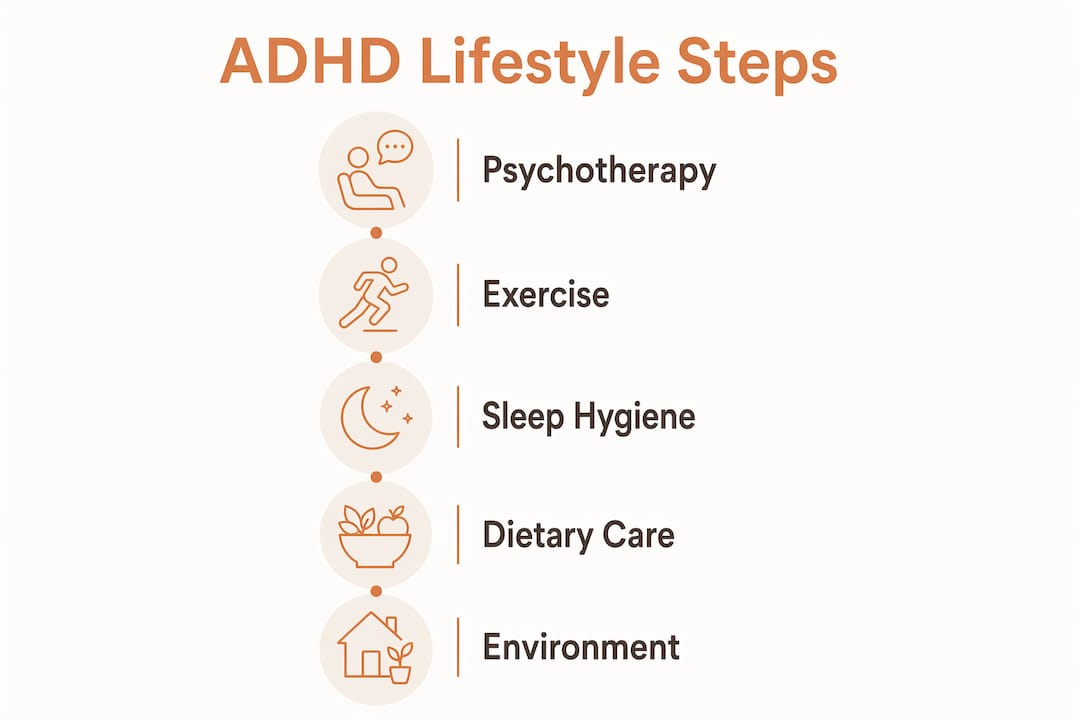
Sleep hygiene
Consistent bedtime routines and turning off screens one hour before bed improve sleep quality and directly support attention and emotion regulation the following day. Adults with ADHD are disproportionately affected by delayed sleep phase syndrome, meaning their natural sleep timing runs later than average. A fixed wake time, even on weekends, is one of the most effective anchors for stabilizing the sleep-wake cycle.
Dietary considerations
Diet functions as a supportive tool, not a cure. Expert-reviewed guidance targets approximately 1,000 mg per day of omega-3s alongside adequate micronutrient intake, particularly zinc, iron, and magnesium. Reducing ultra-processed foods and artificial additives is also recommended, though the evidence for specific elimination diets remains mixed. The practical goal is a nutrient-dense baseline that supports neurotransmitter synthesis and reduces inflammatory load.
Environmental modifications
External scaffolding such as alarms, timers, visual planners, and organized physical spaces reduces the demand on working memory and impulse control. This is the systems design principle at the heart of effective ADHD management. You are not trying to strengthen willpower. You are redesigning your environment so that the right behavior becomes the path of least resistance.
Pro Tip: Set three daily alarms labeled “Start,” “Transition,” and “Wind Down” to anchor your morning, midday, and evening routines without relying on internal time awareness.
How does lifestyle treatment complement other ADHD treatments?
Lifestyle changes are not a replacement for medication or psychotherapy. They are a force multiplier. A 2026 randomized study found that combining CBT and parent training with medication produced better symptom outcomes and daily functioning than medication alone. While that study focused on children, the principle extends directly to adults: psychosocial and behavioral interventions address real-world functioning in ways that medication cannot fully reach on its own.
Here is how lifestyle strategies integrate with other treatments:
- With medication: Exercise and sleep hygiene stabilize the neurochemical environment that medication acts on, making stimulant and non-stimulant treatments more consistent in their effects.
- With CBT: Structured routines and environmental modifications reinforce the skills practiced in therapy sessions, closing the gap between what you learn in a session and what you actually do on a Tuesday morning.
- With non-stimulant options: For adults exploring non-stimulant ADHD treatment, lifestyle strategies often provide the behavioral scaffolding that helps these slower-acting medications reach their full effect.
A common misconception is that committing to lifestyle changes means you no longer need medication. The evidence does not support this. What lifestyle changes do is reduce the total symptom burden, improve treatment response, and build the daily functioning skills that medication alone cannot teach.
What practical strategies can adults with ADHD use daily?
Translating the framework into daily life requires specificity. Vague intentions like “exercise more” or “sleep better” do not work for ADHD brains. Concrete, scheduled, and externally cued systems do.
Here is a structured approach organized by time of day:
- Morning anchor routine (30 minutes): Wake at the same time every day. Use a visual checklist on your bathroom mirror covering hygiene, medication, and a protein-rich breakfast. Set a departure alarm 10 minutes before you actually need to leave.
- Work block structure: Use the Pomodoro Technique with a physical timer (apps like Forest or a simple kitchen timer) to work in 25-minute focused blocks with 5-minute breaks. This externalizes time awareness, which is a core deficit in ADHD.
- Exercise scheduling: Block two 60-minute sessions per week for aerobic or skill-based activity. Morning sessions are preferable because exercise-induced dopamine release improves focus for the hours that follow.
- Nutrition prep: Spend 30 minutes on Sunday preparing grab-and-go snacks and meals. Omega-3 supplementation at 1,000 mg daily is a low-effort, evidence-supported addition. Reducing caffeine after 2 PM protects sleep onset.
- Evening wind-down (60 minutes before bed): Screens off. Use a dim lamp, light reading, or a brief mindfulness practice. Write tomorrow’s three priority tasks in a paper planner before you sleep.
Pro Tip: Pair a new habit with an existing one using “habit stacking.” Take your omega-3 supplement immediately after brushing your teeth at night. The existing cue removes the need to remember.
The table below summarizes recommended frequency and duration for key lifestyle strategies:
| Strategy | Recommended frequency | Duration per session |
|---|---|---|
| Aerobic or skill-based exercise | 2 to 3 times per week | 60 to 90 minutes |
| Mindfulness or breathing practice | Daily | 10 to 15 minutes |
| Structured sleep routine | Every night | 7 to 9 hours total sleep |
| Omega-3 supplementation | Daily | 1,000 mg target dose |
| CBT or behavioral therapy sessions | Weekly or biweekly | 50 to 60 minutes |
For adults managing executive function challenges, the key is building systems that do not depend on motivation or memory. External cues carry the cognitive load that your working memory cannot reliably hold.
How do different lifestyle strategies compare in evidence strength?
Not all lifestyle interventions carry equal research support. Understanding the evidence quality helps you prioritize where to invest your energy first.
| Intervention | Evidence strength | Primary benefit | Key consideration |
|---|---|---|---|
| CBT and adapted psychotherapy | Strong (multiple RCTs) | Organizational skills, procrastination, emotional regulation | Must be adapted for adult ADHD specifically |
| Aerobic and skill-based exercise | Strong (meta-analyses) | Executive function, attention, mood | Consistency and skill variety matter more than intensity |
| Sleep hygiene | Moderate to strong | Attention, emotion regulation, medication response | Fixed wake time is the single highest-leverage habit |
| Omega-3 and dietary quality | Moderate | Neurotransmitter support, inflammation reduction | Supportive role only; does not replace other treatments |
| Mindfulness-based practices | Moderate | Attention regulation, impulsivity, stress reduction | Benefits build over weeks; short daily practice beats occasional long sessions |
| Environmental design and scaffolding | Practical consensus | Working memory support, routine adherence | Highly individualized; requires deliberate setup |
The strongest evidence sits with adapted psychotherapy and structured exercise. Sleep hygiene and dietary changes provide meaningful support with relatively low effort. Mindfulness practices show real benefits but require consistent daily engagement to accumulate effect. Environmental design is not a single intervention but a principle that amplifies every other strategy on this list.
Key takeaways
The ADHD lifestyle treatment approach works because it addresses the systems-level deficits in executive function that medication alone cannot fully resolve, combining adapted psychotherapy, structured exercise, sleep hygiene, nutrition, and environmental design into a coordinated daily framework.
| Point | Details |
|---|---|
| Psychotherapy is the cornerstone | CBT, DBT, and metacognitive therapy adapted for adults produce the strongest behavioral outcomes. |
| Exercise delivers neurochemical benefits | Twice-weekly aerobic and skill-based activity improves executive function within weeks. |
| Environmental design reduces cognitive load | Alarms, timers, and organized spaces remove reliance on willpower and working memory. |
| Lifestyle changes amplify medication | Behavioral strategies improve treatment response and address functioning gaps medication cannot reach. |
| Sleep is a high-leverage habit | A fixed wake time and screen curfew one hour before bed directly support attention and regulation. |
Why I think most adults with ADHD are solving the wrong problem
After working in mental health content for years and speaking with clinicians who specialize in adult ADHD, I keep seeing the same pattern. Adults come in convinced that the goal is to become more disciplined. They have tried productivity apps, motivational frameworks, and sheer determination. None of it stuck. That is not a character flaw. That is a systems problem being misdiagnosed as a willpower problem.
The most meaningful shift I have seen in how clinicians approach adult ADHD is the move toward treating it as an environmental design challenge. Your brain is not broken. It is operating in an environment that was not built for it. When you stop trying to force internal change through effort and start redesigning your external environment, the results are genuinely different. Alarms replace memory. Visual checklists replace mental tracking. Scheduled exercise replaces the hope that you will feel motivated.
The adults who make the most progress are not the ones who try harder. They are the ones who build better systems and then get professional support to maintain and refine those systems over time. Seeking structured psychiatric care is not giving up on lifestyle change. It is the most practical thing you can do to make those changes last.
— Jamie
Ready to build a personalized ADHD treatment plan?
Understanding the components of an ADHD lifestyle treatment approach is a strong first step. Putting them into practice consistently is where professional support makes the real difference.
At Journeymhw, we offer virtual psychiatric evaluations and structured ADHD care for adults in Texas and Colorado. Our providers combine medication management with evidence-based behavioral guidance, creating personalized treatment plans that integrate lifestyle strategies with clinical care. You can start an assessment from home, access appointments quickly, and work with a provider who understands adult ADHD specifically. If you are in Colorado, explore ADHD treatment options available through our platform. If you are in Texas, ADHD care in Texas is available with the same structured, accessible approach.
FAQ
What is the ADHD lifestyle treatment approach?
The ADHD lifestyle treatment approach is a set of non-pharmacological strategies, including adapted psychotherapy, exercise, sleep hygiene, dietary changes, and environmental modifications, designed to reduce ADHD symptoms and improve daily functioning in adults.
Can lifestyle changes replace ADHD medication?
Lifestyle changes complement but do not replace medication for most adults with ADHD. Research shows that combining behavioral strategies with medication produces better outcomes than medication alone.
What type of exercise is best for ADHD?
Aerobic exercise combined with skill-based activities like martial arts or basketball provides the strongest cognitive benefits for ADHD, with twice-weekly sessions of 60 to 90 minutes recommended based on current meta-analyses.
How does CBT help adults with ADHD?
CBT adapted for adult ADHD targets time management, procrastination, and organizational deficits using structured protocols like CADDI and Hesslinger, which integrate mindfulness and behavioral activation to improve attention regulation.
What are the most practical ADHD management techniques to start with?
The highest-leverage starting points are a fixed daily wake time, two scheduled exercise sessions per week, and three externally cued alarms to anchor morning, midday, and evening routines.