

How ADHD Impacts Adult Relationships: a 2026 Guide
ADHD in adults is defined clinically as a neurodevelopmental disorder characterized by persistent inattention, impulsivity, and executive dysfunction that directly disrupts how people connect, communicate, and maintain commitments in their closest relationships. Understanding how ADHD impacts adult relationships is not about assigning blame. It is about recognizing that ADHD symptoms create friction in ways that are predictable, well-documented, and, critically, addressable. Sources including HelpGuide, Psychology Today, and the European Society of Medicine have all confirmed that these challenges do not automatically doom a relationship. What they do require is awareness, honest communication, and a shared commitment to building systems that work for both partners.
How ADHD impacts adult relationships through core symptoms
The three symptoms that most consistently damage partnerships are distractibility, impulsivity, and executive dysfunction. Each one creates a distinct pattern of harm that, without context, looks like indifference or disrespect.
Distractibility causes a partner with ADHD to lose track of conversations mid-sentence, forget agreed plans, or appear mentally absent during important moments. Psychology Today confirms that this perceived inattentiveness is one of the most common triggers for conflict in ADHD-affected couples. The non-ADHD partner often interprets it as a lack of caring, when the actual cause is neurological, not motivational.

Impulsivity shows up as interrupting conversations, making financial decisions without consulting a partner, or reacting emotionally before thinking through consequences. These behaviors escalate tension quickly and leave the non-ADHD partner feeling unheard and disrespected. The damage compounds over time when neither partner understands the underlying mechanism.
Executive dysfunction is perhaps the least visible but most corrosive symptom. It affects time management, task initiation, and follow-through on household responsibilities. Behavior that appears as laziness often reflects executive dysfunction, not willful neglect. That distinction matters enormously for how couples respond to recurring failures.
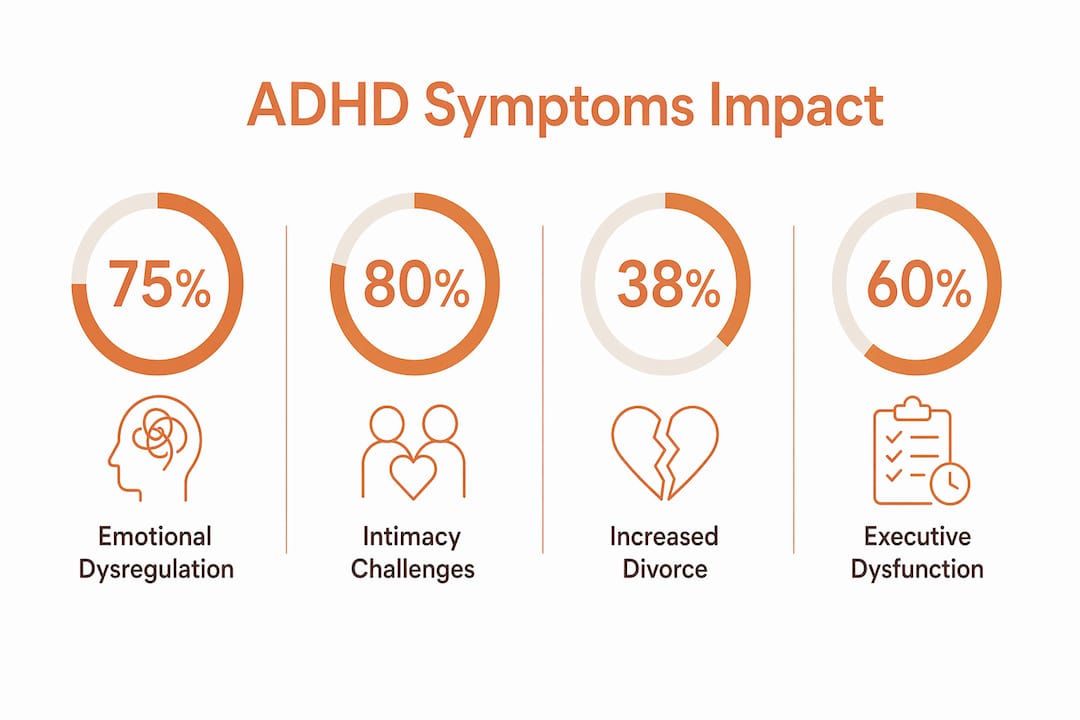
The data on relationship outcomes is sobering. Adults with ADHD report less satisfaction and higher divorce rates than non-ADHD adults, with emotional lability and comorbidities worsening relational distress. A survey cited by ADDitude found that 96% of couples reported ADHD symptoms interfering with household management and communication, and 38% said their marriage had nearly ended as a direct result.
Here is a summary of how core symptoms translate into relationship strain:
- Distractibility: Missed conversations, forgotten plans, perceived emotional absence
- Impulsivity: Reactive arguments, unilateral decisions, interrupting or talking over a partner
- Executive dysfunction: Incomplete chores, chronic lateness, failure to follow through on commitments
- Emotional lability: Rapid mood shifts that destabilize the emotional climate of the relationship
- Forgetfulness: Missed anniversaries, appointments, and promises that erode trust over time
Pro Tip: If you or your partner have ADHD, try naming the symptom in the moment rather than the behavior. Saying “I think my distractibility just kicked in” reframes the conversation away from blame and toward problem-solving.
How does emotional dysregulation affect intimacy and communication?
Emotional dysregulation is the ADHD symptom that does the most damage to intimacy, yet it receives the least attention in mainstream conversations about the condition. It goes beyond mood swings. It includes a phenomenon called rejection sensitive dysphoria, or RSD, which is an intense emotional response to perceived criticism or rejection that can feel physically overwhelming.
A 2025 qualitative study summarized by Zalfol identified a pattern called rejection sensitivity oscillation, in which a partner with ADHD alternates between hyperfocus and emotional withdrawal depending on perceived acceptance or rejection from their partner. Early in a relationship, hyperfocus creates an intense, almost euphoric connection. As the relationship matures and hyperfocus fades, the withdrawal phase can feel like abandonment to the non-ADHD partner. This cycle, left unnamed, generates enormous confusion and hurt on both sides.
Intimacy is also affected at a physiological level. Nearly 80% of ADHD-affected individuals report intimacy challenges due to racing thoughts, performance pressure, and sensory sensitivities. This means that intimacy difficulties relate more to ADHD-driven cognitive and sensory mechanisms than to mismatched desire. Couples who understand this distinction stop trying to solve a desire problem and start addressing the actual sensory and attentional barriers.
Communication cycles break down in a specific sequence. One partner misinterprets an ADHD behavior as intentional. The other partner, sensing criticism, reacts defensively due to RSD. The first partner escalates. Neither person addresses the root cause. Research also shows that adults with ADHD experience deficits in cognitive empathy and emotion recognition, which makes reading a partner’s emotional state genuinely harder, not a choice.
Here is how couples can interrupt these cycles:
- Agree on a “pause signal” both partners can use when a conversation starts escalating.
- Separate the behavior from the intention. Ask “what did you mean by that?” before assuming.
- Schedule regular, low-stakes check-ins to address small frustrations before they compound.
- Discuss RSD openly so both partners recognize it as a symptom, not a personality flaw.
- Consult a therapist who specializes in ADHD to help decode recurring communication patterns.
Pro Tip: Couples dealing with rejection sensitivity oscillation benefit from learning about emotionally invalidating patterns from childhood, since early experiences often amplify RSD responses in adult relationships.
In what ways do executive function deficits complicate shared responsibilities?
Executive function deficits create what researchers and clinicians call the caregiver or manager dynamic. One partner, typically the non-ADHD partner, gradually takes on the role of household manager, tracking appointments, managing finances, and reminding the other partner of commitments. This dynamic is exhausting for the manager and infantilizing for the partner with ADHD. Both people end up resentful.
The table below maps the most common executive function challenges against the reactions they typically generate in a partner:
| Executive function challenge | Common partner reaction |
|---|---|
| Forgetting agreed tasks | Frustration, repeated reminders, resentment |
| Chronic lateness | Embarrassment, distrust of future plans |
| Difficulty initiating chores | Perception of laziness or lack of investment |
| Poor financial planning | Anxiety, loss of financial trust |
| Missing appointments or deadlines | Feeling unsupported and overburdened |
Nagging is the most common response to these failures, and it is also the least effective. It reinforces the parent-child dynamic, increases shame in the partner with ADHD, and produces short-term compliance at best. Effective ADHD relationship support includes externalizing memory and time management through shared routines, digital tools like Google Calendar or Todoist, and clear expectations about engagement and presence. These external systems reduce the cognitive load on the partner with ADHD without requiring the non-ADHD partner to become a full-time reminder service.
ADHD treatment that improves daily function also directly reduces the burden on shared responsibilities. When medication and behavioral strategies reduce executive dysfunction, the caregiver dynamic naturally softens. Both partners gain more space to relate as equals rather than as manager and dependent.
Pro Tip: Replace verbal reminders with shared digital systems. A joint Google Calendar with automatic notifications removes the emotional charge from task management and reduces the need for one partner to act as the other’s memory.
What strategies and therapy approaches help couples manage ADHD’s effects?
The most effective interventions for ADHD-affected couples address both the neurological symptoms and the relational patterns they create. ADHD-focused psychoeducation and integrated couples therapy can improve relationship outcomes by targeting symptoms and emotional challenges simultaneously. Therapy is most effective when clinicians address ADHD symptoms explicitly, rather than treating relationship problems solely as communication issues.
Psychoeducation is the foundation. Both partners need to understand what ADHD actually is, how it manifests in their specific relationship, and why certain behaviors occur. This shared understanding shifts the frame from “you keep failing me” to “we are dealing with a condition that affects both of us.” That reframe is not a soft platitude. It is the precondition for any other intervention to work.
Medication management is a significant factor. When ADHD is treated effectively with stimulant or non-stimulant medication, many of the behaviors that drive conflict, including impulsivity, forgetfulness, and emotional reactivity, decrease in frequency and intensity. Medication alone is not sufficient, but it creates the neurological conditions under which behavioral strategies can take hold.
Here are the approaches with the strongest evidence base for couples managing ADHD:
- ADHD-specific couples therapy: Focuses on breaking cycles of blame and building compensatory systems together.
- Individual therapy for the ADHD partner: Addresses shame, self-esteem, and emotional regulation skills.
- Support for the non-ADHD partner: Prevents burnout and helps them separate ADHD behaviors from personal rejection.
- Behavioral strategies: Structured routines, written agreements, and external organizational tools reduce reliance on memory and willpower.
- Intimacy reframing: Couples benefit from negotiating pacing and sensory needs rather than assuming desire mismatches are the core problem.
Pro Tip: Ask your therapist directly whether they have experience treating ADHD in a relational context. General couples therapy without ADHD expertise often misattributes symptoms as character flaws, which makes outcomes worse, not better.
How does ADHD affect friendships and broader social connections?
ADHD’s effects on relationships extend well beyond romantic partnerships. Friendships suffer from many of the same patterns: forgotten plans, impulsive comments that land badly, difficulty sustaining attention during conversations, and the appearance of disinterest when the actual cause is attentional. Adults with ADHD often describe a pattern of intense, close friendships followed by gradual drift as the effort required to maintain contact exceeds their executive capacity.
Social skill deficits in adults with ADHD are partly developmental. Many adults with ADHD missed critical social learning experiences during childhood because their symptoms interfered with peer relationships. Comorbid ADHD and anxiety compounds these challenges further, since social anxiety and ADHD together create a particularly difficult combination of avoidance and impulsivity. The compounding effect across romantic, familial, and social relationships creates a risk of cumulative relationship burnout.
Practical approaches that help include:
- Using calendar reminders to initiate contact with friends, removing the reliance on spontaneous memory
- Disclosing ADHD to trusted friends so they understand the context for occasional lapses
- Choosing social environments that match sensory and attentional needs, such as smaller gatherings over large events
- Addressing co-occurring conditions like anxiety and depression, which often amplify social withdrawal
Key takeaways
ADHD affects adult relationships through specific, identifiable symptom patterns that both partners can learn to recognize and address together.
| Point | Details |
|---|---|
| Symptoms drive conflict | Distractibility, impulsivity, and executive dysfunction create predictable friction, not intentional harm. |
| Emotional dysregulation is central | Rejection sensitive dysphoria and intimacy challenges require explicit discussion, not just better communication habits. |
| Caregiver dynamic is harmful | The manager-dependent pattern exhausts both partners; external systems replace nagging more effectively. |
| Integrated therapy works | ADHD-specific couples therapy targeting both symptoms and relational patterns produces the strongest outcomes. |
| Social relationships are also affected | Friendships and family bonds face similar ADHD-driven challenges that benefit from the same awareness and structure. |
What I’ve learned from watching couples misread ADHD for years
I have spent a long time observing how ADHD plays out in adult relationships, and the most consistent pattern I see is not conflict. It is misattribution. One partner does something that looks like carelessness. The other partner concludes it is carelessness. Neither person is wrong given what they can observe. But both people are working from incomplete information, and that gap is where relationships quietly deteriorate.
The couples who do well are not the ones who fight less. They are the ones who build a shared vocabulary for what is happening. They stop asking “why did you do that?” and start asking “was that an ADHD moment?” That shift sounds small. It is not. It changes the entire emotional charge of the conversation.
I also want to push back on the idea that the non-ADHD partner simply needs more patience. Patience without understanding is just suppressed resentment. What actually helps is knowledge, structure, and professional support that addresses the condition directly. Relationship interventions must focus on altering interaction patterns over time, because one-off apologies rarely resolve ADHD-driven relationship cycles. The couples who build real resilience do it through repeated, deliberate practice, not through good intentions alone.
The hopeful truth is that ADHD-affected relationships, when both partners are informed and supported, can be deeply connected and functional. The condition creates challenges. It does not create a ceiling.
— Jamie
Getting the right support for ADHD and your relationships
If you recognize these patterns in your relationship, professional support is the most direct path forward. Journeymhw offers virtual psychiatric evaluations and structured ADHD treatment plans designed for adults who need care that fits their real lives, not a waiting room schedule.
Whether you are in Texas or Colorado, Journeymhw connects you with licensed clinicians who understand how ADHD affects not just focus and productivity, but the relationships that matter most to you. From medication management to personalized care plans, the process is built to reduce barriers and get you to effective treatment quickly. If you are ready to take the next step, explore ADHD treatment in Texas or ADHD care in Colorado and start with an assessment today.
FAQ
Can ADHD cause relationship problems even without a diagnosis?
Yes. Undiagnosed ADHD produces the same symptom-driven patterns, including impulsivity, forgetfulness, and emotional dysregulation, that strain relationships. Many adults only recognize ADHD after a partner or therapist identifies the pattern.
Does ADHD affect both partners equally in a relationship?
ADHD directly affects the partner who has it, but research shows the non-ADHD partner experiences significant stress, burnout, and resentment from managing compensatory responsibilities. Both partners need support.
Is divorce more common in couples where one partner has ADHD?
Yes. Adults with ADHD report higher divorce rates than non-ADHD adults, and surveys indicate 38% of ADHD-affected couples say their marriage nearly ended due to ADHD-related conflict.
What type of therapy works best for ADHD-affected couples?
ADHD-focused couples therapy that addresses symptoms explicitly, rather than treating the relationship as a generic communication problem, produces the strongest outcomes according to ESMED research.
Can treating ADHD improve a relationship?
Treating ADHD with medication and behavioral strategies reduces the core symptoms that drive conflict, which directly improves communication, shared responsibility, and emotional connection in most couples.