

Care Coordination's Role in Mental Health Treatment
Why care coordination is central to mental health treatment
Care coordination in mental health is the deliberate organization of patient care activities and information sharing among all providers involved, so that each person receives safer, more effective, and more personalized support. The Agency for Healthcare Research and Quality identifies it as a key strategy with the potential to improve the effectiveness, safety, and efficiency of the American healthcare system. When done well, it means your needs and preferences are known ahead of time, communicated to the right people at the right moment, and used to guide every decision about your care.
The importance of care coordination becomes clearest when you look at what happens without it. Fragmented care leads to repeated tests, conflicting prescriptions, unnecessary emergency visits, and patient confusion, especially for people managing complex mental health conditions. Coordination directly addresses these gaps by connecting services and ensuring nothing falls through the cracks.
Key benefits documented in the research include:
- Reduced hospitalizations and emergency visits
- Fewer medication errors and conflicting prescriptions
- Improved access to community and specialty services
- Decreased psychological distress and unmet needs
- Better continuity of care across providers and settings
- Stronger interservice collaboration among clinical teams
- Greater patient safety through timely information sharing
What does a mental health care coordinator actually do?
A mental health care coordinator holds together the web of services a patient needs, acting as both a clinical support and a system navigator. In the United States, these roles are most often filled by mental health nurses or social workers, though occupational therapists, nurse practitioners, and psychiatrists also take on coordination responsibilities depending on the setting.
Their work spans both clinical and non-clinical tasks, and understanding the difference matters. Clinical tasks require professional training and direct patient assessment. Non-clinical tasks focus on organizing access and support across services.
Clinical responsibilities include:
- Reviewing mental health diagnoses and current medications
- Preparing coordinated treatment plans tailored to each patient
- Implementing crisis triage when a patient’s condition deteriorates
- Providing individualized clinical interventions
- Educating patients and treatment teams about managing co-occurring conditions
Non-clinical responsibilities include:
- Reviewing and accepting referrals based on eligibility criteria
- Conducting psychosocial assessments to identify patient needs
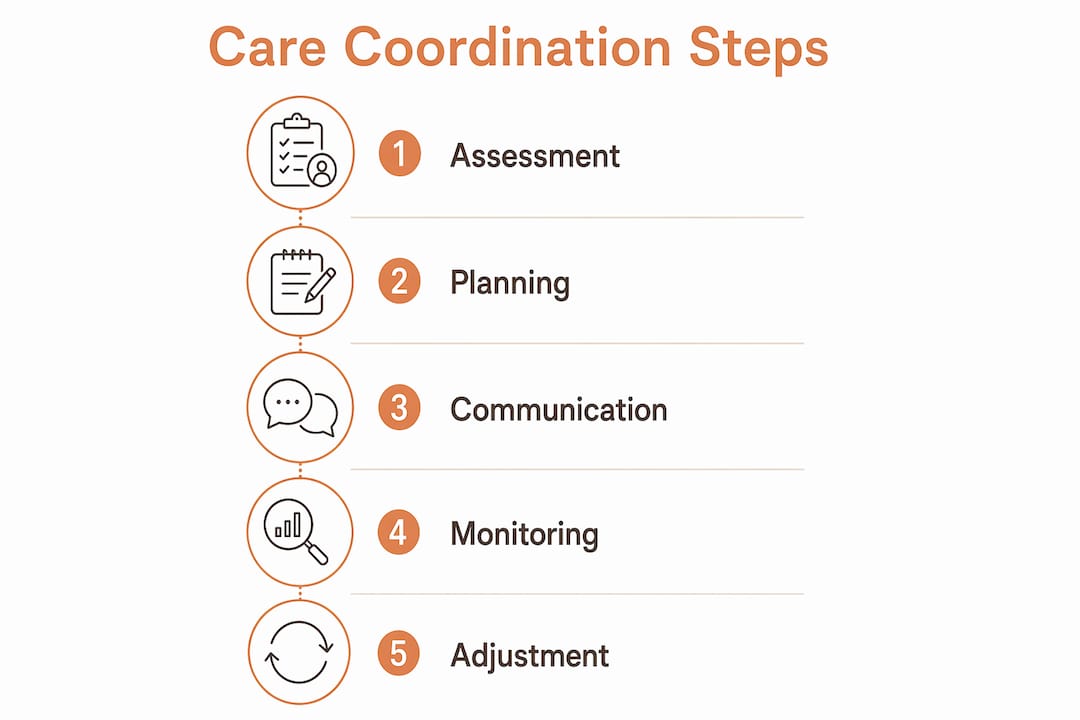
- Developing and implementing a plan for service involvement
- Monitoring outcomes and adjusting the plan as needs change
- Coordinating transport, advocacy, and emotional support
Eligibility for care coordination is typically restricted to patients at high risk of deterioration or those who cannot independently access multiple services. If you are unsure whether your coordinator handles clinical or non-clinical tasks, asking directly helps set accurate expectations for the support you will receive.
Core activities that make mental health care coordination work
Effective coordination is built on a set of interconnected activities that keep care consistent and responsive. The AHRQ framework outlines these clearly: establishing accountability, communicating knowledge, supporting care transitions, assessing patient needs, creating proactive care plans, and monitoring follow-up. Each activity depends on the others.
“Care coordination involves deliberately organizing patient care activities and sharing information among all of the participants concerned with a patient’s care to achieve safer and more effective care. The patient’s needs and preferences are known ahead of time and communicated at the right time to the right people.” — Agency for Healthcare Research and Quality
Multidisciplinary teamwork sits at the center of this process. Psychiatrists, therapists, primary care providers, social workers, and community agencies each hold a piece of the patient’s picture. Coordination brings those pieces together so care decisions reflect the whole person, not just one provider’s view.
Technology plays a growing role here. Electronic health records, secure messaging platforms, and shared care plan tools allow providers to share patient information across settings without delays. The European Psychiatric Association recommends digital technology such as electronic health records to enhance care coordination, noting that sufficient funding and access to these tools must be secured for the approach to work.

One detail that often gets overlooked: coordination must be tailored to each patient’s preferences and capacity, not just their diagnosis. A plan that works logistically but ignores what the patient can realistically manage tends to break down quickly.
How care coordination improves outcomes for mental health patients
The benefits of well-implemented coordination are concrete and measurable. Research on care coordination programs for people supporting adults with severe mental illness in the US documented significant decreases in psychiatric hospitalizations, days admitted to a psychiatric hospital, emergency room visits, and arrests, as well as a decrease in costs per patient.
Beyond those numbers, coordination reduces the daily burden patients carry. When providers communicate with each other, you spend less time repeating your history, less time managing conflicting advice, and less time navigating a system that feels designed for providers rather than patients.
Specific outcome improvements include:
- Decreased self-harming behavior and psychological distress
- Reduced unmet needs related to daily activity, employment, and physical health
- Improved access to services that were previously out of reach
- Greater patient satisfaction with the overall care experience
- Better interservice collaboration that prevents care gaps
- More consistent medication management and treatment adherence
Pro Tip: If you are starting a new treatment plan, ask your provider whether a care coordinator is available. Even one point of contact who knows your full situation can prevent the kind of miscommunication that leads to setbacks.
The team approach itself is a benefit. When nurses, social workers, psychiatrists, and community agencies work from a shared plan, each provider’s contribution reinforces the others rather than working in isolation. For patients managing conditions like ADHD, anxiety, or depression alongside other health concerns, that coordination can make the difference between a plan that holds and one that collapses under complexity. Learning more about managing co-occurring conditions can help you understand how coordinated care applies to your specific situation.
Common challenges that get in the way of effective coordination
Care coordination in mental health faces real, persistent obstacles. Administrative burdens and resource constraints often force coordinators to operate beyond their formal roles, stretching their professional competence and risking a reduction of coordination to box-ticking rather than meaningful patient support. This gap between what coordination is designed to do and what it actually looks like under pressure is one of the field’s most documented problems.
Other significant barriers include:
- Fragmented communication: Providers using incompatible systems cannot easily share records, leading to repeated assessments and conflicting plans.
- Staff shortages and large caseloads: When coordinators manage too many patients, the depth of engagement suffers.
- Insurance and funding gaps: Lack of coverage for coordination services limits who can access them and for how long.
- Unclear processes: Without defined roles and eligibility criteria, patients and providers alike face confusion about who is responsible for what.
- Variability in service availability: Rural and underserved communities often lack the community agencies needed to complete a coordinated care network.
- Patient engagement difficulties: Some patients, particularly those in crisis or with limited social support, are hard to reach consistently.
In the United States specifically, the decentralized healthcare system means coordination quality varies widely depending on the provider’s resources and capability. Unlike nationalized programs with standardized approaches, most Americans with mental health needs receive coordination services of differing intensity from different settings, and satisfaction with those services is highly variable.
Best practices and effective models for coordinating mental health care in the US
The most effective care coordination models in the US share a few defining features. They prioritize patient-centered, recovery-focused care. They use team-based approaches. And they define roles and eligibility criteria clearly so no one is left wondering who handles what.
Frameworks endorsed by the Institute of Medicine and AHRQ emphasize that well-designed, targeted coordination delivered to the right patients improves outcomes for patients, providers, and payers alike. Models like Assertive Community Treatment, Collaborative Care, and Intensive Case Management each build care coordination into their structure as a core feature, not an afterthought.
Practical best practices include:
- Assigning a named coordinator with clear accountability for each patient
- Using proactive care plans that anticipate transitions and potential crises
- Holding regular multidisciplinary team reviews to update shared plans
- Reducing documentation burden so coordinators spend more time with patients
- Linking patients to community resources, not just clinical services
- Measuring outcomes consistently using validated quality indicators
- Training coordinators in both clinical knowledge and relationship-building skills
The quality of the coordinator-patient relationship is as important as the logistical structure. Models that treat coordination as purely administrative tend to underperform those that invest in sustained, collaborative relationships. Recovery-focused care means working with patients on their goals, not just their diagnoses. For a broader look at how structured mental health plans support this approach, the evidence consistently points to planning as a foundation for better outcomes.
How telehealth platforms strengthen mental health care coordination
Telehealth has changed what coordinated mental health care looks like in practice. Virtual platforms remove geographic barriers, reduce wait times, and give providers tools to share information in real time, all of which directly support the goals of coordination. Telehealth platforms enhance care coordination by enabling easier access to providers, better communication among stakeholders, and more complete health record sharing, with documented links to improved patient engagement and continuity of care.
Common telehealth features that support coordination include:
- Secure messaging: Patients and providers communicate between appointments without delays.
- Shared care plans: All members of a care team access the same treatment plan in real time.
- Virtual appointments: Patients attend psychiatric evaluations and follow-ups from home, reducing missed visits.
- Electronic health records integration: Providers across specialties see the same clinical history, reducing repeated assessments.
- Self-management tools: Patients track symptoms, medications, and goals between sessions.
Journeymhw offers virtual psychiatric evaluations and medication management through a structured telehealth process, serving patients in Texas and Colorado who need accessible, organized mental health care. The platform’s approach reflects what coordinated care looks like when technology and clinical structure work together: quick appointment availability, clear care pathways, and personalized treatment plans that reduce delays in intervention.
For patients who have struggled to access consistent care, telehealth coordination can close gaps that geography, scheduling, or provider shortages would otherwise leave open. You can also explore inclusive mental health care models that inform how coordinated services are designed to reach more people effectively.
How to involve patients and families in the coordination process
Patient and family involvement is not a courtesy feature of good care coordination. It is a clinical requirement. The AHRQ framework explicitly includes supporting patients’ self-management goals and assessing patient needs and preferences as core coordination activities, not optional additions.
Families and caregivers often hold critical information about a patient’s daily functioning, triggers, and support network that providers cannot observe in a clinical setting. Leaving them out of the coordination process creates blind spots.
Effective strategies for involving patients and families include:
- Co-producing the care plan: Patients and, where appropriate, family members participate in setting goals and selecting services, not just receiving a plan created without them.
- Shared decision-making: Providers explain options, trade-offs, and expected outcomes so patients can make informed choices about their treatment.
- Regular check-ins: Scheduled touchpoints with both the patient and family members keep the plan aligned with changing needs.
- Education and skill-building: Teaching patients and families about the conditions being treated and the services available reduces confusion and builds confidence.
- Peer support integration: Connecting patients with peer specialists who have lived experience of mental health challenges adds a layer of support that clinical providers alone cannot offer.
- Transparent communication: Patients should know who is on their care team, what each person’s role is, and how to reach them.
Research on care coordination for children with psychiatric conditions shows that family engagement and co-selection of treatment strategies are among the most important process features, leading to more planning, reduced unmet need, and greater satisfaction with care. The same principle applies to adults. When you feel like a partner in your own care rather than a recipient of decisions made about you, adherence improves and outcomes follow.
Journeymhw makes it straightforward to access structured, coordinated mental health care from home. Whether you are managing ADHD, anxiety, or depression, our virtual platform connects you with psychiatric providers who build personalized treatment plans around your needs. Book your appointment today and take the first step toward care that actually connects.
Key Takeaways
Care coordination in mental health works because it deliberately connects providers, patients, and services around a shared plan, reducing hospitalizations, medication errors, and unmet needs while improving access and satisfaction.
| Point | Details |
|---|---|
| Coordination reduces hospitalizations | Programs have documented significant decreases in psychiatric hospitalizations, emergency room visits, and arrests among mental health patients. |
| Coordinators handle clinical and non-clinical tasks | Roles include medication management and crisis triage alongside referrals, advocacy, and outcome monitoring. |
| Relationship quality drives outcomes | The coordinator-patient relationship is as critical as logistical service linking for successful mental health coordination. |
| Administrative burden is a real risk | Resource constraints can reduce coordination to box-ticking, undermining its purpose of collaborative patient support. |
| Telehealth expands coordination access | Virtual platforms improve provider communication, record sharing, and patient engagement in coordinated mental health care. |
Recommended
- Medication Management for Mental Health: A Practical Guide – Journey Mental Health
- What Is a Mental Health Treatment Plan? – Journey Mental Health
- Benefits of Structured Mental Health Plans Explained – Journey Mental Health
- Your guide to navigating mental health treatment options – Journey Mental Health