

Medication Management for Mental Health: A Practical Guide
Medication management for mental health is defined as a continuous clinical relationship in which a prescriber selects, monitors, and adjusts psychiatric medications to improve your symptoms and daily functioning. This process goes well beyond writing a prescription. It involves regular check-ins, honest communication, and shared decision-making between you and your provider. For adults managing ADHD, anxiety, or depression, especially those using virtual healthcare, understanding how this process works gives you a real advantage. Journeymhw offers structured, virtual psychiatric care designed to make this process clear and accessible from day one.
What is medication management for mental health?
Medication management is a supportive clinical relationship involving regular assessment, symptom tracking, and dose adjustments. It is not a one-time event. The clinical term used in psychiatric practice is “pharmacological management,” though medication management is the widely accepted patient-facing term. Both describe the same ongoing process of tailoring treatment based on how you respond, not just a checklist of symptoms.
The 2026 SAMHSA guidelines emphasize shared decision-making and periodic reassessment as core principles of responsible psychiatric care. That means your prescriber is not the only decision-maker. You bring critical information to every appointment, including how you sleep, how you function at work, and how you feel day to day. That information shapes every medication decision.

Virtual care makes this partnership more accessible than ever. You can attend appointments from home, track symptoms between visits using apps or written logs, and message your provider when something changes. For adults in Texas and Colorado, Journeymhw delivers this entire process online, without waiting rooms or long delays.
How do you prepare for psychiatric medication management?
Starting psychiatric medication management requires preparation on your end. A thorough psychiatric evaluation is the foundation. Your provider will review your symptom profile, medical history, current medications, and how your condition affects your daily life. Arriving at your first appointment prepared with this information speeds up the process and improves accuracy.
Before your first virtual visit, gather the following:
- A list of all current medications, including supplements and over-the-counter drugs
- A written summary of your symptoms, including when they started and what makes them better or worse
- Notes on any previous psychiatric medications you have tried, including side effects
- Your sleep schedule, exercise habits, and any recent major life stressors
- A private, quiet space with a reliable internet connection for your virtual appointment
Common medications prescribed for ADHD include stimulants such as amphetamine salts and methylphenidate, as well as non-stimulants like atomoxetine. For anxiety, providers often prescribe SSRIs, SNRIs, or buspirone. Depression is frequently treated with SSRIs, SNRIs, or bupropion. Your prescriber selects the right starting point based on your full clinical picture, not a generic protocol.
Pro Tip: Write down two or three specific goals before your first appointment. For example: “I want to focus at work without crashing in the afternoon” or “I want to stop waking up at 3 a.m. with racing thoughts.” Concrete goals help your prescriber choose the right medication and measure real progress.
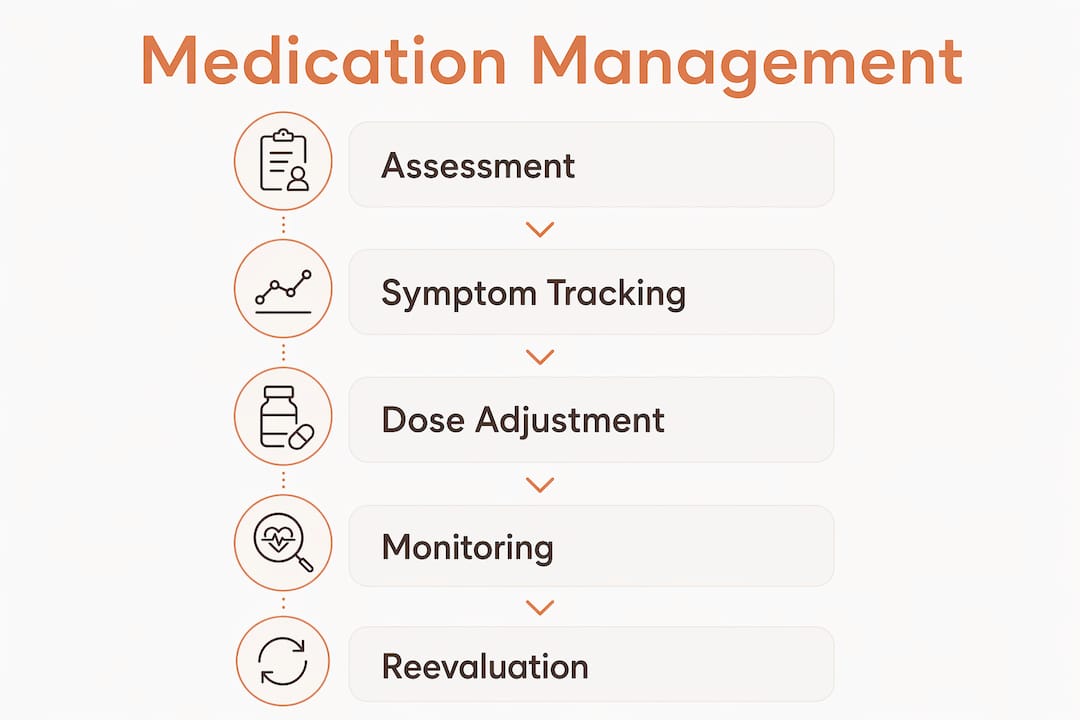
What does the medication management process look like step by step?
The medication management process follows predictable clinical phases. Knowing what to expect at each stage reduces anxiety and helps you stay the course when things feel uncertain.
- Initial prescribing. Your prescriber selects a starting medication and dose based on your evaluation. This is a starting point, not a final answer.
- Early monitoring (weeks 1–2). You check in frequently during this phase. Follow-ups occur every 1–2 weeks during the first 4–6 weeks. Your provider watches for early side effects and confirms you are tolerating the medication.
- Therapeutic effect assessment (weeks 4–8). Full therapeutic effects of most antidepressants and anti-anxiety medications appear between weeks 4 and 8. This is when your provider evaluates whether the medication is actually working.
- Dose adjustment or medication change. If the medication is not working well enough, your prescriber may increase the dose, switch medications, or add a second medication. This is called augmentation.
- Stabilization and maintenance. Once your symptoms are well controlled, appointments become less frequent. Your provider continues to monitor you for long-term safety and effectiveness.
| Phase | Typical Timeframe | Primary Goal |
|---|---|---|
| Early monitoring | Weeks 1–2 | Confirm tolerability, catch side effects |
| Therapeutic assessment | Weeks 4–8 | Evaluate symptom improvement |
| Dose adjustment | As needed | Optimize response |
| Maintenance | Ongoing | Sustain stability, reassess necessity |
Honest communication during virtual check-ins is the single most important factor in moving through these phases successfully. If you feel worse, say so clearly. If a side effect is affecting your work or relationships, your provider needs to know.
Pro Tip: Keep a simple daily log between appointments. Rate your mood, energy, focus, and sleep on a scale of 1–10. Bring that log to every virtual visit. It gives your prescriber real data instead of memory-based estimates.
How do you handle side effects, adherence challenges, and symptom changes?
Side effects are the most common reason people stop psychiatric medications too early. Side effects like nausea, headache, or fatigue are common in the first few weeks but often resolve on their own within 2–3 weeks. Stopping a medication during this window means you never find out whether it would have worked.
The key is distinguishing between a side effect and an intolerance. A side effect is uncomfortable but manageable and typically fades. An intolerance is a reaction that is severe, worsening, or affecting your safety. If you are unsure which category your experience falls into, contact your provider before stopping the medication.
Adherence is the other major challenge. Psychiatric medication adherence requires consistency. Missing doses disrupts the steady blood levels that most psychiatric medications need to work. Common barriers include forgetting, cost concerns, stigma, and feeling better and assuming the medication is no longer needed.
Practical strategies that improve adherence:
- Set a daily phone alarm at the same time each day
- Keep your medication next to something you already do every morning, like brushing your teeth
- Use a weekly pill organizer to track whether you have taken your dose
- Talk openly with your prescriber if cost is a barrier. Generic options and patient assistance programs exist for most psychiatric medications.
Stopping a psychiatric medication abruptly, without clinical guidance, can cause withdrawal symptoms and rapid symptom relapse. Always contact your provider before making any changes to your regimen.
Symptom fluctuations are normal, especially during periods of high stress, illness, or major life changes. Augmentation and medication switches are standard clinical steps, not signs that your treatment has failed. Your prescriber adjusts your regimen based on your individual biological response and functional needs, not a fixed formula.
How does medication management work alongside therapy and lifestyle?
Medication and therapy work best together. Medication reduces symptoms that interfere with therapy engagement, creating a synergy that neither approach achieves alone. For example, an adult with severe anxiety may struggle to practice cognitive behavioral therapy techniques when their nervous system is in constant overdrive. The right medication lowers that baseline, making therapy genuinely productive.
Lifestyle factors directly affect how well psychiatric medications work. Effective medication management considers your sleep patterns, physical health, and daily functioning, not only your psychiatric symptom scores. Poor sleep, for instance, blunts the effectiveness of antidepressants and stimulants alike. Regular physical activity improves mood regulation and can reduce the dose needed to achieve the same effect.
For adults managing ADHD, anxiety, and depression together, coordinated care between your prescriber and therapist is especially valuable. Virtual platforms make this coordination easier. Your prescriber and therapist can share notes, align on treatment goals, and adjust their approaches based on what you report in each session.
Key lifestyle factors that support psychiatric medication effectiveness:
- Sleep. Aim for 7–9 hours. Sleep deprivation worsens every psychiatric condition and reduces medication response.
- Nutrition. Some medications require food to absorb properly. Others interact with specific foods. Ask your prescriber directly.
- Physical activity. Even 20–30 minutes of moderate exercise three times per week improves mood and cognitive function.
- Alcohol and substance use. Both interact with psychiatric medications and can destabilize treatment. Be honest with your provider about your use.
Key takeaways
Effective psychiatric medication management is a structured, ongoing clinical process that requires your active participation at every stage.
| Point | Details |
|---|---|
| It is a process, not a prescription | Medication management involves regular monitoring, dose adjustments, and shared decision-making over time. |
| Early side effects are expected | Most side effects resolve within 2–3 weeks; stopping too early prevents you from seeing real results. |
| Therapeutic effects take time | Full benefits of most antidepressants and anti-anxiety medications appear between weeks 4 and 8. |
| Medication works best with therapy | Reducing symptoms through medication allows you to engage more fully in therapy and lifestyle changes. |
| Virtual care supports consistency | Telehealth appointments make it easier to maintain the frequent check-ins that early medication management requires. |
What I have learned from watching patients navigate medication management
The biggest mistake I see is treating medication management like a passive experience. Patients wait for the medication to work, say little during appointments, and then stop when things feel uncomfortable. That approach almost always leads to a cycle of failed trials and growing frustration.
The patients who do best treat every appointment as a working session. They bring notes. They ask specific questions. They tell their prescriber exactly what is and is not working, in plain language. That level of participation changes the quality of care they receive.
I also think the mental health field does a poor job of preparing people for the iterative nature of this process. Finding the right medication often takes several adjustments. That is not a failure of the medication or the prescriber. It reflects the genuine complexity of brain chemistry. Expecting perfection on the first try sets people up to quit before they find what works.
Virtual care has genuinely changed what is possible for patients who previously could not access consistent psychiatric support. The ability to check in from home, message your provider between visits, and maintain appointments during a busy week removes barriers that used to derail treatment entirely. That accessibility is not a compromise. For many people, it is the reason treatment finally sticks.
— Jamie
Psychiatric care from Journeymhw, available online
Journeymhw provides virtual psychiatric evaluations and structured medication management for adults with ADHD, anxiety, and depression in Texas and Colorado. The process is designed to be clear, fast, and personal, with appointments available online and care plans built around your specific symptoms and goals.
Whether you are managing ADHD medication online or looking for virtual anxiety treatment, Journeymhw connects you with experienced psychiatric providers who take the time to understand your full picture. You can also access virtual depression care through the same platform, with integrated support at every phase of treatment. Scheduling your first evaluation takes minutes, and care begins quickly.
FAQ
What is the role of medication management in mental health treatment?
Medication management is a continuous clinical process involving medication selection, monitoring, and adjustment to improve symptoms and daily functioning. It works best when combined with therapy and lifestyle support.
How long does it take for psychiatric medications to work?
Full therapeutic effects of most antidepressants and anti-anxiety medications appear between weeks 4 and 8. Early side effects typically resolve within 2–3 weeks.
How often will I have appointments during medication management?
Follow-ups occur every 1–2 weeks during the first 4–6 weeks of treatment. Appointment frequency decreases as your symptoms stabilize.
What should I do if my medication stops working?
Contact your prescriber promptly. Dose adjustments, medication switches, and augmentation are standard clinical steps in psychiatric treatment, not signs of failure.
Can I manage my psychiatric medications through telehealth?
Yes. Virtual psychiatric care supports the full medication management process, including evaluations, follow-ups, and prescription management. Journeymhw offers this service for adults in Texas and Colorado.
Recommended
- ADHD Medication Management in Texas & Colorado | Online ADHD Prescriptions – Journey Mental Health
- Affordable Mental Health Care Access: Your Practical Guide – Journey Mental Health
- Top 3 Providers for Depression Medication Management 2026 – Journey Mental Health
- Managing ADHD, Anxiety, and Depression Together in 2026 – Journey Mental Health