

Generalized Anxiety Disorder Treatment Guide
Generalized anxiety disorder treatment is defined as a structured clinical approach combining cognitive-behavioral therapy (CBT), medication, and coping strategies to reduce chronic, excessive worry. CBT, SSRIs, and SNRIs are the gold-standard options, with 60–80% of patients experiencing significant symptom relief lasting 2–6 years after completing 8–12 therapy sessions. That level of effectiveness makes GAD one of the most treatable anxiety conditions an adult can face. If you have been living with persistent worry, restlessness, or sleep problems for six months or more, effective help is available and well within reach.
What are the main types of therapy for generalized anxiety disorder?
Cognitive-behavioral therapy is the most evidence-based of all therapies for generalized anxiety. It works by teaching you to observe your thoughts objectively rather than react to them automatically. CBT and ACT reduce emotional reactivity by helping patients step back from anxious thoughts, not by forcing positive thinking or eliminating worry entirely. That distinction matters because many people expect therapy to make anxiety disappear. The real goal is to change your relationship with anxious thoughts so they no longer control your behavior.

Acceptance and commitment therapy (ACT)
Acceptance and commitment therapy, or ACT, is a close relative of CBT that has strong research support for GAD. Where CBT focuses on challenging distorted thinking, ACT encourages you to accept uncomfortable thoughts without acting on them. Both approaches are typically delivered in 8–12 weekly sessions with a licensed therapist. Completing that full course is what produces the lasting 2–6 year relief documented in clinical research.
Exposure therapy and newer modalities
Exposure therapy is used when avoidance behavior is a major driver of your anxiety. A therapist guides you through gradual, controlled contact with feared situations until the anxiety response weakens. Virtual reality exposure therapy is an emerging option that delivers this same process in a simulated environment, which is particularly useful for people who cannot easily access real-world exposure scenarios. These newer formats are expanding access to effective care without requiring in-person sessions.
The quality of your relationship with your therapist is not a soft factor. A strong therapist connection directly improves treatment outcomes by enabling more personalized interventions that target your specific thought and behavior patterns. If you do not feel heard or understood by your current provider, switching is a clinically sound decision.
Key therapy options for GAD include:
- Cognitive-behavioral therapy (CBT): Targets distorted thinking patterns and avoidance behaviors over 8–12 sessions
- Acceptance and commitment therapy (ACT): Builds psychological flexibility by accepting thoughts without reacting to them
- Exposure therapy: Reduces avoidance by gradually confronting feared situations in a controlled setting
- Virtual reality exposure therapy: Delivers exposure-based treatment through simulated environments for greater accessibility
- Supportive therapy: Provides emotional validation and problem-solving support alongside structured techniques
Pro Tip: If you are unsure which therapy fits your symptoms, ask a provider to explain how each approach targets your specific pattern of worry. The right match accelerates progress.
What medications are commonly prescribed for generalized anxiety disorder?
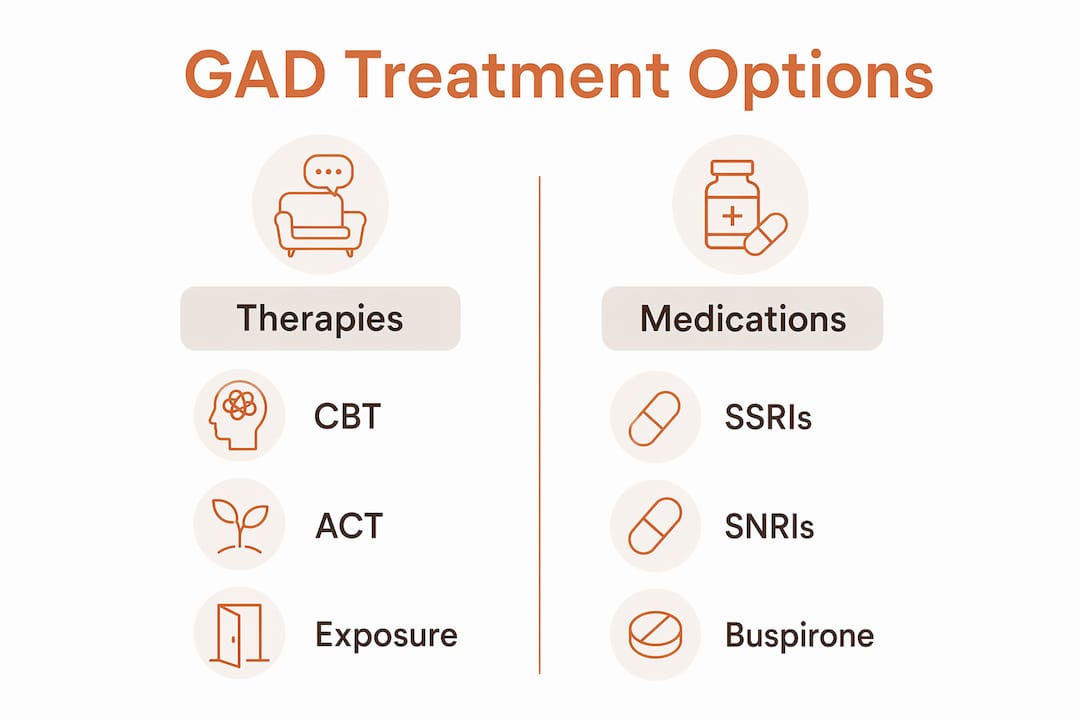
SSRIs and SNRIs are the first-line medications for GAD, prescribed more often than any other drug class. Common SSRIs include sertraline (Zoloft) and escitalopram (Lexapro). Common SNRIs include venlafaxine (Effexor) and duloxetine (Cymbalta). These medications work by regulating serotonin and norepinephrine levels in the brain, which reduces the intensity and frequency of anxious thoughts over time.
How long do medications take to work?
SSRIs and SNRIs require 3–6 weeks before you notice meaningful symptom improvement. That delay is one of the most common reasons people stop medication too early. Clinicians often address this gap by prescribing short-term benzodiazepines to manage acute symptoms while the antidepressant builds to a therapeutic level. Benzodiazepines such as lorazepam or clonazepam provide fast relief but carry a real risk of dependence, so they are not intended for long-term use.
Additional medication options
| Medication Class | Examples | Primary Use | Key Consideration |
|---|---|---|---|
| SSRIs | Sertraline, Escitalopram | First-line long-term treatment | 3–6 week onset; monitor for side effects |
| SNRIs | Venlafaxine, Duloxetine | First-line long-term treatment | May raise blood pressure at higher doses |
| Benzodiazepines | Lorazepam, Clonazepam | Short-term acute symptom relief | Risk of dependence; not for long-term use |
| Buspirone | Buspirone | Non-addictive long-term option | Takes 2–4 weeks; no sedation risk |
| Pregabalin | Pregabalin | Adjunct or alternative option | Effective for physical anxiety symptoms |
Buspirone is a non-addictive alternative that works well for long-term management without the sedation or dependence risks associated with benzodiazepines. Pregabalin is another option, particularly useful when physical symptoms like muscle tension are prominent. Your prescriber will weigh your symptom profile, medical history, and lifestyle before recommending any of these.
Pro Tip: Track your symptoms in a simple daily log during the first six weeks on a new medication. Concrete notes help your provider make faster, more accurate adjustments at your follow-up.
What coping strategies complement formal GAD treatment?
Coping strategies for anxiety are evidence-based tools that work alongside therapy and medication. They do not replace clinical care, but they meaningfully reduce baseline anxiety between sessions. Matching coping tools to your symptom type improves both engagement and results. Body-based symptoms like muscle tension and rapid heartbeat respond best to physical techniques. Cognitive symptoms like persistent worry respond better to thought-based tools.
Effective anxiety management techniques to use alongside your treatment plan:
- Box breathing: Inhale for 4 counts, hold for 4, exhale for 4, hold for 4. Repeat 4–6 cycles to activate the parasympathetic nervous system and lower heart rate
- Progressive muscle relaxation: Systematically tense and release muscle groups from feet to face to reduce physical tension stored in the body
- Grounding exercises: The 5-4-3-2-1 technique (name 5 things you see, 4 you hear, 3 you can touch) pulls attention back to the present moment during acute anxiety
- Journaling: Writing out worry thoughts externalizes them and creates cognitive distance, making them easier to examine and challenge
- Cognitive reframing: Identify a catastrophic thought, then write two realistic alternative outcomes to reduce its emotional weight
- Physical activity: Regular aerobic exercise, such as 30 minutes of walking five days per week, reduces cortisol and supports mood regulation
- Media boundaries: Intentional limits on news consumption reduce anxiety absorption from distressing global events, a principle supported by both CBT and ACT research
You can learn more about how exercise and grounding techniques fit into a broader anxiety management plan on the Journeymhw blog.
How do you personalize a GAD treatment plan?
Personalized care is the standard for effective GAD management, not the exception. No two people experience anxiety the same way, and treatment that works well for one person may need significant adjustment for another. A provider who understands your symptom severity, daily functioning, and personal preferences will build a plan that fits your life, not a generic protocol.
Here is what a structured, personalized treatment process typically looks like:
- Initial evaluation: A licensed provider assesses your symptoms, duration, and severity using standardized tools like the GAD-7 questionnaire. This step establishes your baseline and guides the first treatment decisions.
- Treatment selection: Based on your evaluation, your provider recommends therapy, medication, or a combination. Combined treatment consistently produces stronger outcomes than either approach alone.
- Therapy engagement: You begin weekly sessions with a therapist trained in CBT or ACT. Most people notice meaningful progress within 4–6 sessions, with full benefit realized by session 8–12.
- Medication initiation (if prescribed): Your prescriber starts you on an SSRI or SNRI at a low dose and increases gradually. You track symptoms and side effects during the 3–6 week onset window.
- Progress review: Follow-up appointments every 3 months allow your provider to monitor efficacy, adjust dosage, and address any side effects before they become barriers to progress.
- Open communication: You report changes in symptoms, sleep, mood, or function at every appointment. Your provider cannot adjust what they cannot see, so honest reporting is part of the treatment itself.
- Long-term planning: After symptoms stabilize, you and your provider decide together whether to continue, taper, or transition to maintenance care. Many people benefit from periodic check-ins even after reaching their goals.
If you are managing both anxiety and attention difficulties, reviewing comorbid ADHD and anxiety considerations with your provider can prevent treatment gaps. Symptoms of these two conditions frequently overlap, and addressing both leads to better outcomes than treating only one.
Key takeaways
Effective GAD treatment requires combining evidence-based therapy, appropriate medication, and personalized coping strategies under consistent clinical supervision.
| Point | Details |
|---|---|
| CBT is the first-line therapy | Complete 8–12 sessions for 60–80% symptom relief lasting up to 6 years. |
| SSRIs and SNRIs lead medication options | Allow 3–6 weeks for onset; short-term benzodiazepines can bridge the gap safely. |
| Match coping tools to symptoms | Use body-based techniques for physical symptoms and cognitive tools for persistent worry. |
| Quarterly follow-ups protect progress | Schedule check-ins every 3 months to adjust medication and monitor symptom changes. |
| Personalized plans outperform generic ones | Combine therapy and medication based on your specific symptom profile for best results. |
What i have learned from watching GAD treatment work
After years of observing how adults move through anxiety treatment, one pattern stands out clearly. The people who improve fastest are not the ones who find the perfect medication on the first try or connect instantly with their first therapist. They are the ones who stay in the process long enough for it to work.
The 3–6 week medication onset window is where most people lose confidence. They feel no different at week two and assume the medication is not working. Stopping early is one of the most common and most preventable setbacks in GAD care. Patience during that window is not passive. It is an active clinical strategy.
The same applies to therapy. CBT and ACT do not produce dramatic breakthroughs in session one. They build gradually, and the skills compound over time. I have seen people dismiss therapy after three sessions because they expected faster results. The research is clear: the full 8–12 session course is where the lasting change happens.
The other thing worth saying plainly is that coping skills are valuable adjuncts, not replacements for clinical care. Breathing exercises and journaling are genuinely useful. They will not substitute for a well-matched medication or a skilled therapist. Use them as daily support tools, not as a reason to delay getting evaluated.
If you are in Texas or Colorado and wondering whether starting treatment online is a legitimate path, the answer is yes. Telehealth has made consistent, high-quality psychiatric care more accessible than it has ever been. The barrier to starting is lower than most people realize.
— Jamie
How Journeymhw supports adults seeking anxiety treatment
Journeymhw is a telehealth platform built for adults who are ready to take anxiety seriously and want structured, professional support to do it.
Journeymhw offers personalized anxiety treatment in Texas and Colorado through virtual psychiatric evaluations, medication management, and evidence-based care plans. The process is designed to get you from evaluation to treatment quickly, without the long waits that delay care in traditional settings. Whether you need therapy coordination, medication management, or both, Journeymhw builds a plan around your specific symptoms and goals. If you are ready to move forward, book your appointment and start with a structured evaluation from the comfort of your home.
FAQ
What is the most effective treatment for GAD?
CBT combined with SSRIs or SNRIs is the most effective approach for generalized anxiety disorder. Combined treatment produces stronger outcomes than therapy or medication alone in most adults.
How long does GAD treatment take to work?
Therapy typically shows meaningful progress within 4–6 sessions, with full benefit by session 8–12. Medications require 3–6 weeks before symptom improvement becomes noticeable.
What are the signs of generalized anxiety disorder?
GAD is characterized by excessive worry on most days for at least six months, plus three or more symptoms such as restlessness, fatigue, difficulty concentrating, or sleep disturbance. A licensed provider uses tools like the GAD-7 to confirm the diagnosis criteria formally.
Can you treat GAD without medication?
Yes. CBT and ACT alone produce significant symptom relief for many adults, particularly those with mild to moderate GAD. Medication becomes more important when symptoms are severe or when therapy alone does not produce adequate improvement within the expected timeframe.
How often should you see a provider during GAD treatment?
Quarterly follow-up appointments are the clinical standard for monitoring medication efficacy, adjusting dosage, and tracking symptom progress. More frequent check-ins may be needed during the first 3 months of a new medication.
Recommended
- Anxiety Treatment in Texas & Colorado | Online Anxiety Help & Medication – Journey Mental Health
- Anxiety Treatment in Texas & Colorado | Online Anxiety Help & Medication – Journey Mental Health
- Your Colorado Mental Health Anxiety Care Plan Guide – Journey Mental Health
- Anxiety Treatment in Texas & Colorado | Online Anxiety Help & Medication – Journey Mental Health