

What Is Health Anxiety Disorder? Symptoms and Help
If you have ever noticed a headache and immediately worried it might be something serious, you have felt a small version of what health anxiety disorder causes daily for millions of adults. What is health anxiety disorder, exactly? It is a recognized clinical condition where fear of having or developing a serious illness becomes persistent, consuming, and disconnected from actual medical evidence. This is not worrying too much or being overly cautious. It is a pattern the brain learns, one that grows stronger without the right support. The good news is that understanding health anxiety is the first step toward doing something about it.
Table of Contents
- Key takeaways
- What health anxiety disorder actually is
- Recognizing health anxiety symptoms
- Why reassurance-seeking keeps anxiety alive
- Evidence-based treatment for health anxiety
- Health anxiety and other mental health conditions
- My take on health anxiety after years in mental health care
- Start managing health anxiety with Journeymhw
- FAQ
Key takeaways
| Point | Details |
|---|---|
| Health anxiety is a real disorder | It is classified in the DSM-5 as illness anxiety disorder, not personality weakness or excessive worrying. |
| Reassurance-seeking makes it worse | Checking symptoms and seeking constant reassurance temporarily relieves anxiety but reinforces the cycle long-term. |
| CBT is the leading treatment | Cognitive-behavioral therapy, typically 6 to 8 sessions, produces remission in most patients within a year. |
| Medications can support recovery | SSRIs and SNRIs are effective but may take up to three months to reach their full effect. |
| You can unlearn this pattern | With the right treatment and daily strategies, health anxiety responds well and quality of life improves significantly. |
What health anxiety disorder actually is
Health anxiety disorder, classified in the DSM-5 as illness anxiety disorder, goes far beyond ordinary health consciousness. Most people feel concerned when they notice an unusual symptom. That concern passes once they receive reassurance or see a doctor. For people with health anxiety disorder, the fear does not pass. It persists, shifts to a new symptom, or intensifies even after receiving a clean bill of health.
The condition is rooted in how the brain interprets physical sensations. The amygdala, the brain’s threat detection center, becomes overactive and begins treating benign bodily signals as danger. A muscle twitch reads as a sign of neurological disease. A racing heartbeat means a cardiac event. The brain is not malfunctioning randomly. It has learned to be hypervigilant, often through past trauma, illness experiences in childhood, or family modeling of excessive health worry.
Health anxiety disorder is not a choice or a character flaw. It is a learned neurological pattern that can be identified, treated, and changed.
Health anxiety affects approximately 4 to 5% of U.S. adults, though the actual number may be closer to 10% due to widespread underdiagnosis. Many people living with signs of health anxiety disorder never connect their experience to a clinical condition. They assume they are simply anxious people or hypochondriacs, a term most clinicians now consider outdated and stigmatizing.
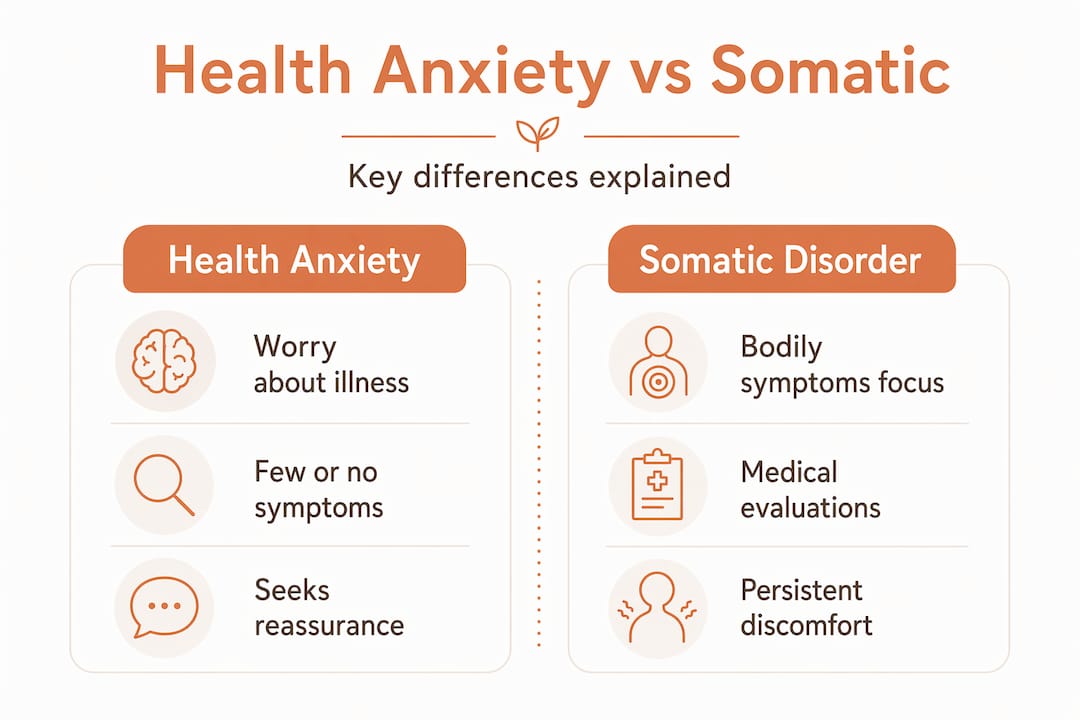
It also helps to understand what health anxiety disorder is not. It differs from somatic symptom disorder, where physical symptoms are real and distressing. In illness anxiety disorder, the physical symptoms are often minimal or absent, but the fear of disease is intense and unrelenting.
Recognizing health anxiety symptoms
Identifying the signs of health anxiety disorder in yourself requires looking at both how you feel and how you behave. The symptoms span three categories: physical, emotional, and behavioral.
-
Physical symptoms that trigger fear. People with health anxiety frequently misinterpret normal bodily sensations. Headaches, muscle twitches, heart palpitations, dizziness, and stomach discomfort all become potential evidence of serious illness. The physical experience is real. The interpretation is driven by anxiety.
-
Emotional and cognitive patterns. Persistent fear of illness, catastrophizing minor symptoms, and a deep intolerance of medical uncertainty are the emotional hallmarks of this condition. You may find yourself convinced by any unusual sensation or feel temporary relief from a doctor’s reassurance, only to have the fear return within hours or days.
-
Behavioral responses. This is where health anxiety becomes clearest. Common behaviors include repeatedly checking your body for symptoms, researching conditions online (a pattern sometimes called cyberchondria), seeking reassurance from doctors, family, or friends, and avoiding activities or places linked to illness fears. Frequent doctor visits or, paradoxically, avoiding doctors out of fear of a diagnosis are both common presentations.
The emotional toll is significant. People with health anxiety often report reduced work performance, strained relationships, and diminished enjoyment of daily life. Research links health anxiety to high rates of anxiety impairment across multiple life domains.
Pro Tip: If you find yourself spending more than an hour a day worrying about your health or researching symptoms, that frequency alone is a clinical signal worth taking seriously.

Why reassurance-seeking keeps anxiety alive
Here is something that surprises most people learning about health anxiety: the behaviors that feel most helpful are the ones that sustain the disorder. Googling symptoms, asking a doctor for repeated tests, texting a friend to confirm your symptoms sound normal — all of these feel necessary in the moment. They produce genuine short-term relief. The problem is that reassurance-seeking reinforces the anxiety cycle and prevents you from learning to tolerate uncertainty.
The mechanism works like this: anxiety spikes, you seek reassurance, anxiety drops, your brain registers that reassurance-seeking was the solution. The next time anxiety spikes, the urge to check becomes stronger. Over time, you need more reassurance to achieve the same relief, and the threshold for triggering the anxiety drops lower.
Breaking this cycle requires a different skill entirely. It requires tolerating uncertainty without resolving it. This sounds uncomfortable because it is, at first. But anxiety waves, if not fed by checking behaviors, peak and pass naturally in 10 to 20 minutes. Your nervous system is designed to calm itself. You just have to let it.
Several techniques support this process:
- Labeling thoughts, not fighting them. Instead of arguing with the thought “this headache might be serious,” simply label it: “I’m having a health anxiety thought.” Observation creates distance without suppression.
- Delaying the response. Set a physical timer before checking a symptom online or reaching out for reassurance. Starting with a 15-minute delay and building from there helps interrupt automatic behavior.
- Writing down fears. Writing fears down rather than mentally rehearsing them reduces their emotional intensity and makes them easier to examine objectively.
- Exposure and Response Prevention (ERP). This is a structured therapeutic technique where you deliberately expose yourself to health-related triggers and practice resisting checking behaviors. ERP rewires anxiety responses effectively over time.
Pro Tip: The next time you feel the urge to Google a symptom, set a timer for 20 minutes and redirect your attention. Most of the time, the urgency fades before the timer goes off.
Evidence-based treatment for health anxiety
Managing health anxiety long-term requires more than willpower. The following approaches have strong clinical backing.
Cognitive-behavioral therapy
CBT is the first-line treatment for health anxiety disorder. It works by helping you identify distorted thought patterns, understand the behavioral cycles maintaining your anxiety, and practice new responses to physical sensations. CBT typically involves 6 to 8 sessions, and most patients experience significant remission within a year. The structured nature of CBT makes it particularly effective for health anxiety because the disorder is largely driven by thinking patterns that can be directly examined and changed.
If you are in Texas or Colorado, Journeymhw offers online anxiety treatment with licensed providers who specialize in anxiety disorders, including health anxiety.
Medication management
| Medication type | How it helps | Timeline to feel effects |
|---|---|---|
| SSRIs (e.g., sertraline, fluoxetine) | Reduce baseline anxiety and fear responses | 2 weeks to 3 months for full effect |
| SNRIs (e.g., venlafaxine, duloxetine) | Target both anxiety and physical symptoms | 2 weeks to 3 months for full effect |
SSRIs and SNRIs are the most commonly prescribed medications for anxiety disorders, including health anxiety. They are not quick fixes. Setting realistic expectations is part of effective treatment. Medication works best in combination with therapy, not instead of it.
Daily strategies worth adopting
A few practical habits support recovery between therapy sessions. Dr. Chesworth’s three-day waiting period for non-emergency symptoms is one of the most clinically supported: before scheduling a doctor visit for a new symptom, wait three days. This reduces anxiety-driven medical overuse and gives your nervous system time to regulate.
Reducing reliance on wearable health devices and symptom trackers is equally helpful. Constant monitoring feeds the hypervigilance cycle. Give your attention somewhere else to go.
When you are ready to seek help, knowing what to expect at your first appointment can reduce the anxiety that sometimes prevents people from making that call at all.
Health anxiety and other mental health conditions
Health anxiety rarely exists in isolation. Understanding its connections to other conditions helps explain why it can feel so persistent and complex.
People with health anxiety frequently experience comorbid conditions, including:
- Panic disorder. The physical symptoms of panic attacks (chest tightness, racing heart, shortness of breath) are easily misinterpreted as medical emergencies, creating a painful feedback loop.
- Generalized anxiety disorder. Worry about health becomes one channel for a broader anxiety tendency that also touches relationships, finances, and work.
- Obsessive-compulsive disorder. The repetitive checking behaviors in health anxiety mirror OCD’s compulsion structure, and ERP treatments overlap significantly.
- Depression. Chronic health worry is exhausting and isolating. Anxiety and depression together are common, with each condition amplifying the other.
The healthcare system feels this overlap acutely. About 25% of ER visits for chest pain in the U.S. are anxiety-related. People with health anxiety frequently cycle through medical appointments without receiving a mental health referral, which means the underlying condition goes untreated while frustration grows on both sides.
Integrated care, where mental and physical health providers communicate and coordinate, produces better outcomes. If your physical symptoms have been evaluated and cleared repeatedly, that is a strong signal to seek mental health support as the primary path forward.
My take on health anxiety after years in mental health care
I have noticed something consistent over years of working in this space: the people who struggle most with health anxiety are often the most self-aware, conscientious individuals you will meet. They are not dramatic. They are not looking for attention. They are genuinely trying to protect themselves from something that feels very real. That matters, because it changes how we need to talk about this.
What I have found is that the hardest part of treatment for most people is not the therapy itself. It is accepting that seeking reassurance, the most natural thing in the world when you are scared, is actually making things worse. Telling someone to stop Googling their symptoms without explaining why feels dismissive. Understanding the mechanism changes everything. When you see that reassurance is feeding the loop, you get a real choice about whether to continue.
I also want to say plainly: health anxiety can be unlearned. It is a pattern, not a permanent state. I have watched people who spent years in fear of their own bodies reach a place where physical sensations stop being terrifying. That shift is possible. It takes time, the right support, and the willingness to sit with discomfort a little longer than feels comfortable. But it happens.
— Jamie
Start managing health anxiety with Journeymhw
If what you have read today sounds familiar, you do not have to figure out next steps alone. Journeymhw is a telehealth mental health platform serving adults in Texas and Colorado, offering virtual evaluations, personalized care plans, and ongoing medication management for anxiety disorders including health anxiety.
Getting started does not require months on a waiting list. Journeymhw is designed to get you connected with a licensed provider quickly, so you can begin the process of understanding and treating your anxiety without unnecessary delays. Whether you need anxiety treatment or a full evaluation to clarify what you are experiencing, the process is straightforward and built around your schedule. Explore Journeymhw’s medication management and treatment plans to find the right fit for where you are right now.
FAQ
What is health anxiety disorder, exactly?
Health anxiety disorder, clinically called illness anxiety disorder, is a condition where a person experiences persistent and excessive fear of having or developing a serious illness, even without significant physical symptoms or in spite of negative medical tests.
Is health anxiety a real medical diagnosis?
Yes. Health anxiety is recognized in the DSM-5 under the category of illness anxiety disorder and somatic symptom and related disorders. It is a genuine clinical condition, not a personality trait or attitude problem.
What are the most common signs of health anxiety disorder?
The most recognized signs include persistent fear of illness, misinterpreting normal physical sensations as dangerous, frequent symptom checking, repetitive internet research about diseases, and seeking frequent medical reassurance that provides only brief relief.
How is health anxiety treated?
CBT is the primary treatment and typically involves 6 to 8 sessions with meaningful improvement within a year. Medications such as SSRIs or SNRIs may also be prescribed, particularly when anxiety is severe, and both approaches are often used together.
Can health anxiety go away on its own?
Without treatment, health anxiety tends to persist or worsen because the behaviors that temporarily reduce it, like reassurance-seeking, actually reinforce the cycle. With appropriate therapy and support, most people see significant, lasting improvement.