

ADHD and Altitude Effects Explained: What Science Shows
How does living at high altitude affect ADHD prevalence and symptoms?
Living at higher altitudes is associated with meaningfully lower rates of ADHD, and the science behind that pattern centers on one key neurotransmitter: dopamine. Research analyzing CDC datasets found that ADHD prevalence decreases with increasing altitude, with mean state altitude explaining approximately 64.3% of the variance in ADHD rates across states when controlling for demographic variables. That is a striking figure for a single environmental variable.
The leading biological explanation is hypobaric hypoxia. At higher elevations, atmospheric oxygen pressure drops, and the brain responds by producing more dopamine, a neurotransmitter that plays a central role in attention, motivation, and impulse control. Because ADHD is characterized by reduced dopamine activity, altitude-driven increases in dopamine may naturally reduce symptom severity in some people.
Key points at a glance:
- ADHD prevalence shows a decrease with increasing altitude, based on CDC data
- Mean state altitude accounts for a significant portion of the variance in state-level ADHD rates
- Hypobaric hypoxia at altitude increases brain dopamine, the primary neurotransmitter implicated in ADHD
- Sunlight exposure and circadian rhythm changes at altitude may also contribute to lower ADHD rates
- Correlation does not equal causation; altitude is not a treatment strategy
Statistic to know: In animal studies, just one hour of exposure to hypoxic conditions produced an 80% increase in brain dopamine levels, suggesting a rapid and potent neurochemical response to reduced oxygen.
What does the research actually show about altitude and ADHD rates?
The landmark study on this topic came from the University of Utah, led by researcher Rebekah S. Huber and colleagues. The team analyzed two separate state-level CDC datasets to test whether states at higher mean altitudes had lower rates of ADHD in youth. Both datasets independently confirmed the inverse relationship.
The full multivariate regression model, which controlled for low birth weight, race and ethnicity, and household composition, accounted for 64.3% of the variance in ADHD prevalence across states. Mean state altitude was a statistically significant predictor in both models. A simpler four-variable model that included altitude and household adult presence still explained 53.3% of the variance.
| Variable | Direction of effect on ADHD prevalence |
|---|---|
| Mean state altitude (per foot increase) | Decreases slightly |
| Low birth weight (per 1% increase) | — |
| Hispanic population (per 1% increase) | — |
| Black, non-Hispanic population (per 1% increase) | — |
| Two or more adults in household (per 1% increase) | — |
The study controlled for potential confounders including birth weight, ethnicity, and household size, making the altitude finding more credible than a raw correlation would suggest. Researchers also noted that behavioral effects of altitude can appear at elevations as low as 2,000 feet, which is well within the range of many American cities, including Denver, Colorado.
Key findings from the research:
- Two independent CDC datasets both confirmed the altitude-ADHD inverse relationship
- The effect held after controlling for socioeconomic and demographic variables
- Western states, which tend to sit at higher elevations, consistently showed lower ADHD rates
- This was the first published study to examine altitude’s effect on regional ADHD variation
What biological mechanisms connect altitude to ADHD symptoms?
Dopamine is the central thread. In people with ADHD, dopamine systems that govern motor control, motivation, and reward processing function below typical levels. Medications like stimulants work by targeting dopamine reuptake sites to increase its availability in the brain. Altitude may produce a similar effect through a different route.

Dopamine synthesis depends on oxygen. At higher elevations, mild hypobaric hypoxia reduces available oxygen, which paradoxically triggers the brain to upregulate dopamine production. Animal studies by Orset and colleagues demonstrated an 80% rise in brain dopamine after just one hour of hypoxic exposure. A separate study by Ray and colleagues found over 100% increases in dopamine after 7 and 14 days at simulated altitudes of 25,000 feet. These are animal models, so direct translation to humans requires caution, but the neurochemical signal is consistent.
Beyond dopamine, two molecular pathways deserve attention:
- Hypoxia-inducible factor 2α (HIF-2α): This protein activates under low-oxygen conditions and regulates neurogenesis, angiogenesis, and brain metabolism. It also modulates acetylcholine signaling, which affects memory and cognitive function.
- Erythropoietin (EPO): Produced in response to hypoxia, EPO helps maintain neural networks and may protect against cognitive deficits under hypoxic stress.
Key neurochemical changes at altitude:
- Increased brain dopamine via hypobaric hypoxia
- HIF-2α activation supporting neuronal survival and plasticity
- EPO release helping maintain cognitive network integrity
- Possible reduction in acetylcholine synthesis under chronic hypoxia (a complicating factor)
Pro Tip: Individual responses to altitude vary considerably. Some people experience mood changes or cognitive disruption at elevation rather than improvement. If you have ADHD and are considering a move to a higher-altitude area, discuss the potential effects with your prescribing clinician before making any changes to your treatment plan.
What environmental and lifestyle factors at altitude may also influence ADHD?
Dopamine is not the only explanation researchers have proposed. A separate line of inquiry, published in the Journal of Attention Disorders, examined whether solar intensity and circadian rhythm changes at altitude might independently account for some of the regional variation in ADHD rates. Higher elevations receive more intense sunlight, which affects melatonin production and the body’s internal clock, both of which influence dopamine regulation.

Sleep is another altitude-related variable that directly touches ADHD. High-altitude environments can disrupt sleep patterns, including through breathing instability and mild sleep apnea, even in otherwise healthy people. Sleep disruption worsens attention, working memory, and executive function, all of which are already compromised in ADHD. So while altitude may boost dopamine, it can simultaneously undermine sleep quality in ways that offset some of that benefit.
Additional environmental and lifestyle factors associated with altitude living:
- Sunlight intensity: Greater UV exposure at elevation may regulate circadian dopamine rhythms
- Physical activity: Higher-altitude communities often have higher rates of outdoor physical activity, which independently supports dopamine function
- Household composition: The University of Utah study found that having two or more adults in the home also predicted lower ADHD rates, suggesting family environment interacts with altitude effects
- Lower population density: Many high-altitude regions in the American West have lower population density, which may reduce environmental stressors associated with ADHD diagnosis rates
Understanding what causes adult ADHD requires looking at multiple interacting factors, not just one variable. Altitude is one piece of a much larger picture that includes genetics, family environment, and access to care.
Statistic to consider: Regression models combining altitude with household composition, ethnicity, and birth weight explained over 50% of variance in state-level ADHD rates, underscoring that no single factor tells the whole story.
What are the limitations of current research on altitude and ADHD?
The correlation between altitude and lower ADHD rates is real and statistically significant, but it does not establish causation. Every study conducted so far has used state-level data, which means researchers are comparing averages across large geographic areas rather than tracking individual patients over time. A person living in Denver and a person living in a rural Colorado mountain town both count as “Colorado residents,” even though their actual elevations differ by thousands of feet.
Confounding factors remain a serious challenge. Socioeconomic status, access to mental health care, cultural attitudes toward diagnosis, and family structure all influence how often ADHD gets diagnosed and reported. States at higher altitude also tend to be in the American West, where demographic and healthcare patterns differ from the East and South in ways that are difficult to fully separate from elevation effects.
High-altitude exposure also carries real cognitive risks, as discussed by Anxiety Therapy SD, including mood and cognitive effects that can influence mental health outcomes. Research shows that above 2,500 meters, people face increased risk of memory impairment, anxiety, and mood disturbances. Reduced attention has been documented above 3,500 meters, and impaired spatial and working memory above 4,000 meters. These effects complicate any simple “altitude is protective” narrative.
Key limitations and cautions:
- All major studies use state-level, not individual-level, data
- Causation has not been established; correlation could reflect unmeasured variables
- High altitude carries its own cognitive and mood risks, especially above 2,500 meters
- Altitude should never be used as a standalone intervention for ADHD
- Diagnostic rates may reflect access to care and cultural factors as much as actual prevalence
How does ADHD symptom severity compare at different altitude ranges?
The relationship between altitude and ADHD symptoms is not a simple on/off switch. Behavioral effects of altitude can begin at as little as 2,000 feet, a threshold that covers cities like Denver (5,280 feet), Albuquerque (5,312 feet), and Salt Lake City (4,226 feet). At these moderate elevations, mild hypobaric hypoxia may gently increase dopamine without producing the more disruptive cognitive effects seen at extreme heights.
Above 2,500 meters (roughly 8,200 feet), the picture becomes more mixed. Oxygen desaturation becomes measurable, sleep disruption increases, and mood changes including anxiety and depression become more common. For someone with ADHD who also experiences anxiety symptoms, this altitude range could amplify emotional dysregulation rather than reduce it. Above 3,500 meters, reduced attention speed has been documented in otherwise healthy adults, which would likely worsen ADHD-related attention deficits rather than help them.
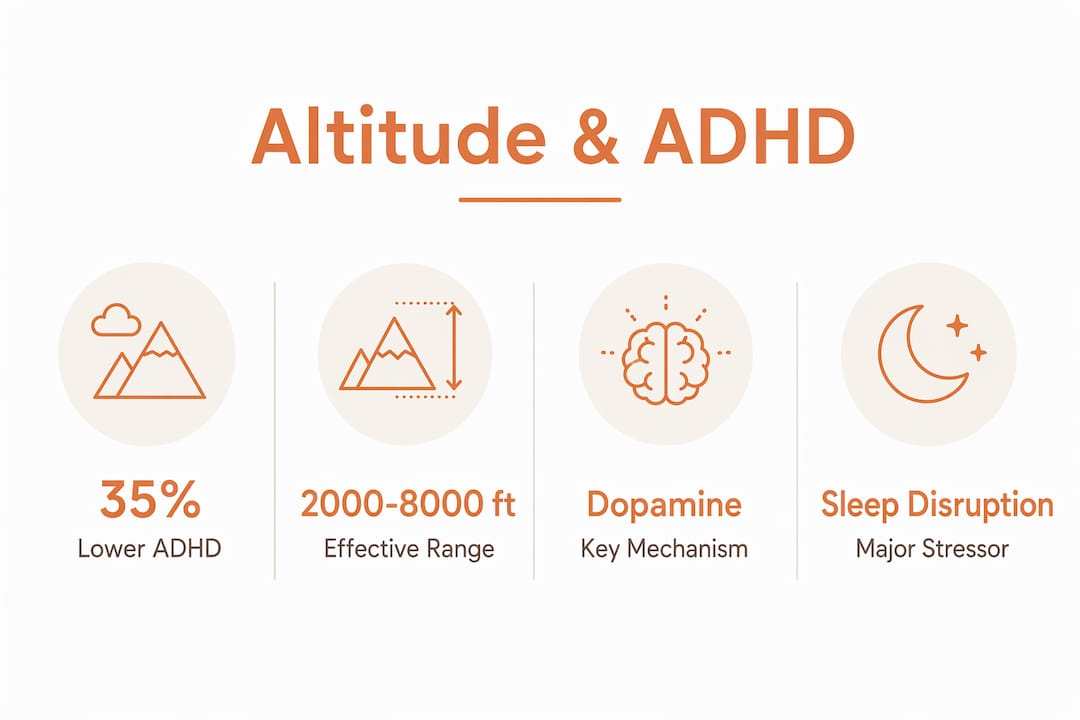
The practical takeaway is that moderate elevations, roughly 2,000–8,000 feet, represent the range where altitude’s potential dopaminergic benefits are most plausible without the severe cognitive risks associated with extreme heights.
Could altitude affect how ADHD medications work?
This is an area where clinical data is limited, but the physiological logic is worth understanding. Stimulant medications for ADHD, including amphetamine-based and methylphenidate-based drugs, work by increasing dopamine availability at synaptic sites. If altitude independently raises brain dopamine through hypoxia, the combined effect of medication plus altitude could theoretically alter the effective dose a person needs.
There is also the question of metabolism. Higher altitudes can affect cardiovascular function, breathing rate, and overall metabolic activity, particularly during the acclimatization period. These changes could influence how quickly the body processes medications, though no published clinical trials have specifically examined stimulant pharmacokinetics at altitude in ADHD patients. Clinicians working with patients who relocate to high-altitude areas should monitor for changes in medication response, both in terms of efficacy and side effects like elevated heart rate or sleep disruption.
How do altitude-related stressors affect ADHD symptoms day to day?
Sleep disturbance is the stressor most likely to worsen ADHD symptoms at altitude. Even at moderate elevations above 1,600 meters, sleep patterns can shift. Breathing instability during sleep, including periodic breathing and mild central apnea, reduces sleep quality in ways that directly impair working memory, attention, and executive function the next day. For someone managing hyperactive ADHD, a poor night’s sleep can make symptoms feel significantly more intense.
Physical exertion at altitude adds another layer. Exercise itself is beneficial for ADHD, partly because it raises dopamine and norepinephrine levels. But at high elevations, physical activity requires more effort for the same output, and overexertion can lead to fatigue that undermines the cognitive benefits. Acclimatization typically takes 7–21 days, during which mood instability, irritability, and difficulty concentrating are common even in people without ADHD.
What are the clinical implications for diagnosing and managing ADHD at high altitude?
For clinicians practicing in high-altitude states like Colorado, the altitude-ADHD relationship raises practical questions. Diagnostic thresholds developed at sea level may not account for the neurochemical environment at elevation. A child or adult whose dopamine levels are naturally elevated by altitude might present with milder symptoms than the same person would show at sea level, potentially leading to underdiagnosis or delayed diagnosis.
Treatment planning in high-altitude populations should account for the full picture. Altitude may offer some natural dopaminergic support, but it does not replace structured psychiatric care. Sleep quality, mood stability, and medication response all warrant closer monitoring in patients who live or travel to high-elevation areas. ADHD treatment in Colorado specifically benefits from clinicians who understand these regional variables and can adjust care accordingly.
Get personalized ADHD care from wherever you are

If you’re trying to make sense of how your environment, including where you live, might be affecting your ADHD, you don’t have to figure it out alone. Journeymhw offers virtual psychiatric evaluations and personalized ADHD treatment plans designed around your specific needs, whether you’re in Colorado, Texas, or anywhere in between. Our team provides structured, compassionate care with quick appointment availability so you can get answers and support without long delays. Book your evaluation and take the first step toward understanding what’s driving your symptoms.
Key Takeaways
Living at high altitude is associated with lower ADHD prevalence, primarily through dopamine-boosting effects of hypobaric hypoxia, but altitude alone is not a treatment and carries its own cognitive risks above 2,500 meters.
| Point | Details |
|---|---|
| Altitude and ADHD prevalence | ADHD prevalence shows a decrease with increasing altitude, as the University of Utah study explained 64.3% of ADHD prevalence variance using altitude and demographic controls. |
| Dopamine mechanism | One hour of hypoxic exposure raised brain dopamine by 80% in animal models, supporting the biological link. |
| Research strength | The University of Utah study explained 64.3% of ADHD prevalence variance using altitude and demographic controls. |
| Cognitive risks above 2,500 meters | Memory impairment, anxiety, and attention deficits increase at high elevations, complicating the protective narrative. |
| Clinical caution | Altitude is not a standalone ADHD intervention; individual responses vary and medication management should continue. |