

How Anxiety Medication Works: A Clear, Honest Guide
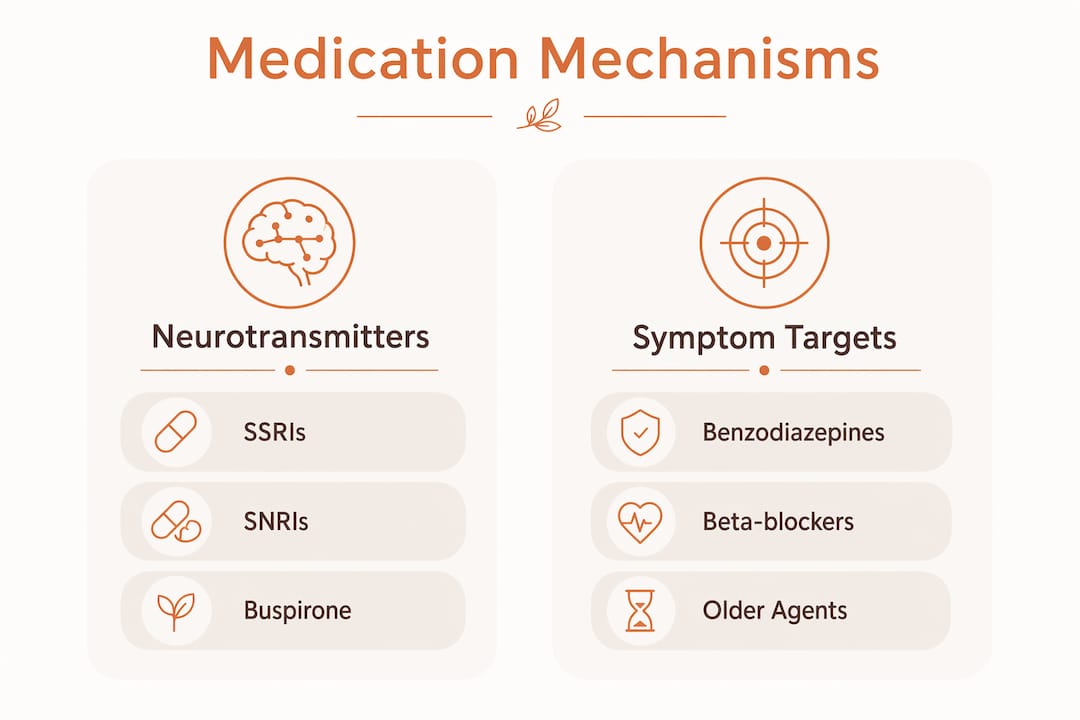
Anxiety medications reduce overactive anxiety circuits in the brain by changing how neurotransmitters are produced, absorbed, or signaled — and understanding that mechanism is the first step toward feeling confident about your treatment. The three primary ways they do this:
- Increase neurotransmitter availability: SSRIs (like sertraline and fluoxetine) and SNRIs (like venlafaxine and duloxetine) block the reabsorption of serotonin and/or norepinephrine, leaving more of those calming chemicals active in the brain’s synapses.
- Enhance inhibitory signaling: Benzodiazepines (like alprazolam and lorazepam) amplify the effect of GABA, the brain’s main “slow down” neurotransmitter, producing rapid anxiety relief within hours.
- Blunt fight-or-flight signals: Beta-blockers like propranolol reduce the physical symptoms of anxiety — racing heart, trembling, sweating — by blocking norepinephrine’s effects on the heart and blood vessels.
At Journeymhw, we see patients every day who feel less anxious once they understand what their medication is actually doing. This guide walks through each drug class, what to expect, and how to work with your clinician to find the right fit.
Table of Contents
- What anxiety medications are and why clinicians prescribe them
- How each medication class works in the brain
- How clinicians decide which medication is right for you
- Side effects, interactions, dependence, and withdrawal
- What people typically feel on anxiety medication
- How medication works best alongside therapy and lifestyle changes
- A clinician’s view from Journeymhw: medication management in practice
- Key Takeaways
- What I want you to take away from all of this
- Authoritative sources and further reading
- Personalized anxiety care, available from home
What anxiety medications are and why clinicians prescribe them
The clinical term for anti-anxiety medication is anxiolytic, which literally means “to loosen” — a useful way to think about how these drugs reduce anxiety’s grip on the nervous system. Many different drug classes carry anxiolytic effects, from antidepressants to antihistamines, and clinicians choose among them based on the specific anxiety disorder, the patient’s history, and the treatment goals.
The conditions most commonly treated with anxiolytics include generalized anxiety disorder (GAD), panic disorder, social anxiety disorder, PTSD, performance anxiety, and OCD. One nuance worth knowing: OCD often requires higher SSRI doses than other anxiety disorders and sometimes longer trial periods before benefit is clear.
Medication is rarely the whole picture. For most anxiety disorders, combining medication with CBT improves outcomes compared with either treatment alone. Think of medication as a stabilizing tool that calms overactive physiological responses enough to make therapy and behavioral work more effective. Lifestyle factors — sleep, exercise, limiting caffeine — support both.
How each medication class works in the brain
SSRIs: the most commonly prescribed first-line option
SSRIs (selective serotonin reuptake inhibitors) work by blocking the reabsorption of serotonin in the brain, leaving more of it available in the synapse. More synaptic serotonin gradually recalibrates mood-regulating circuits, which is why SSRIs are first-line for most anxiety disorders. They are not sedatives and do not produce immediate calm — the benefit builds over weeks.
Common SSRIs prescribed for anxiety:
- Sertraline (Zoloft): Broad use across GAD, panic disorder, PTSD, social anxiety, and OCD.
- Fluoxetine (Prozac): Long half-life makes it forgiving if a dose is missed; used for panic disorder, OCD, and social anxiety.
- Escitalopram (Lexapro): Often preferred for GAD; generally well tolerated with a clean side-effect profile.
- Paroxetine (Paxil): Approved for GAD, panic disorder, social anxiety, PTSD, and OCD; more sedating than others in the class.
- Citalopram (Celexa): Used for GAD and panic disorder; cardiac monitoring is recommended at higher doses.
Onset: Partial response often appears at 2–4 weeks; full therapeutic effect typically takes 6–8 weeks or longer. For more on how serotonin drives anxiety symptoms, see Journeymhw’s guide to serotonin and anxiety disorders.
Pros: Non-addictive, broad disorder coverage, safe for long-term use. Cons: Sexual side effects, initial nausea, and insomnia are common early on; abrupt stopping causes discontinuation syndrome.
SNRIs: adding norepinephrine to the equation
SNRIs (serotonin-norepinephrine reuptake inhibitors) block reabsorption of both serotonin and norepinephrine. The norepinephrine component can help with physical symptoms of anxiety — fatigue, pain, and concentration problems — making SNRIs a strong choice when anxiety and depression co-occur.
- Venlafaxine (Effexor): First-line for GAD, panic disorder, and social anxiety; blood pressure monitoring is recommended at higher doses.
- Duloxetine (Cymbalta): Approved for GAD; also used when chronic pain accompanies anxiety.
Onset: Similar to SSRIs — partial response at 2–4 weeks, full effect at 6–8 weeks or beyond.
Pros: Effective for both anxiety and depression; duloxetine also addresses pain comorbidity. Cons: Discontinuation syndrome can be more pronounced than with SSRIs; nausea and elevated blood pressure are possible.
Benzodiazepines: fast relief with real trade-offs
Benzodiazepines amplify GABA’s inhibitory effect on the central nervous system, producing rapid relief of muscle tension, panic, and insomnia — often within 30–60 minutes. That speed is their main clinical advantage and also the source of their risk.
- Alprazolam (Xanax): Short-acting; used for panic disorder and acute anxiety episodes.
- Lorazepam (Ativan): Intermediate-acting; used for acute anxiety and as a pre-procedure anxiolytic.
- Clonazepam (Klonopin): Longer-acting; used for panic disorder and social anxiety, sometimes as a bridge during SSRI initiation.
Many clinicians prescribe a short course of a benzodiazepine (typically 2–4 weeks) alongside a new SSRI to manage acute symptoms while the SSRI builds up, then taper the benzodiazepine to reduce dependence risk.
Pros: Rapid symptom relief; useful for acute panic and situational anxiety. Cons: Tolerance, physical dependence, dangerous interactions with alcohol and opioids, and cognitive dulling with prolonged use.

Buspirone: a non-addictive option for chronic anxiety
Buspirone (Buspar) works differently from benzodiazepines. It acts on serotonin and dopamine receptors without producing sedation or dependence, making it a preferred choice for long-term GAD management in patients who cannot use SSRIs or who have a history of substance use.
Onset: Slower than benzodiazepines — benefit typically takes 2–4 weeks to appear, sometimes longer.
Pros: No dependence risk, no sedation, safe for long-term use. Cons: Does not work for acute panic; requires consistent daily dosing to be effective.
Beta-blockers: targeting the body, not the brain
Beta-blockers like propranolol (Inderal) reduce the physical symptoms of anxiety by blocking norepinephrine’s effects on the heart and blood vessels. They do not affect anxiety cognition — they will not quiet worried thoughts — but they reliably reduce trembling, rapid heartbeat, and sweating. That makes them well suited for performance anxiety and situational anxiety (a presentation, a flight, a medical procedure).
Onset: Within 1–2 hours of a single dose; typically taken as needed rather than daily.
Pros: Fast, targeted physical relief; no dependence risk; non-sedating. Cons: Not effective for cognitive anxiety symptoms; contraindicated in asthma and certain cardiac conditions.
TCAs and MAOIs: older agents with specific roles
Tricyclic antidepressants (TCAs) and monoamine oxidase inhibitors (MAOIs) predate SSRIs and are used less often today because of their side-effect profiles and interaction risks. They remain options when first- and second-line treatments have failed.
- Amitriptyline (Elavil): A TCA used for anxiety, depression, and chronic pain; anticholinergic effects (dry mouth, constipation, blurred vision) are common.
- Phenelzine (Nardil): An MAOI effective for social anxiety disorder and atypical depression; requires strict dietary restrictions (tyramine-containing foods like aged cheeses and cured meats must be avoided to prevent hypertensive crisis).
Pros: Effective for treatment-resistant cases; phenelzine has strong evidence for social anxiety. Cons: Significant side-effect burden; MAOIs carry serious drug and food interaction risks.
Bupropion and other agents
Bupropion (Wellbutrin) is a norepinephrine-dopamine reuptake inhibitor (NDRI) primarily used for depression and smoking cessation. It is sometimes used off-label for anxiety, though it can increase anxiety in some patients early in treatment. Hydroxyzine, an antihistamine, is another non-addictive option used for acute anxiety and sleep disruption.
Medication class comparison at a glance
| Dimension | SSRIs | SNRIs | Benzodiazepines | Buspirone | Beta-blockers | TCAs/MAOIs |
|---|---|---|---|---|---|---|
| Primary mechanism | Serotonin reuptake inhibition | Serotonin + norepinephrine reuptake inhibition | GABA potentiation | Serotonin/dopamine receptor modulation | Norepinephrine receptor blockade | Monoamine reuptake inhibition / MAO inhibition |
| Typical onset | Partial response: 2–4 weeks; full effect: 6–8 weeks or longer | Partial response: 2–4 weeks; full effect: 6–8 weeks or longer | 30–60 minutes | 2–4 weeks | 1–2 hours (as needed) | 2–6 weeks |
| Common uses | GAD, panic, social anxiety, PTSD, OCD | GAD, panic, social anxiety, depression | Acute panic, short-term anxiety, bridge therapy | GAD (long-term) | Performance anxiety, situational anxiety | Treatment-resistant anxiety, depression |
| Major side effects | Nausea, sexual dysfunction, insomnia | Nausea, elevated BP, sexual dysfunction | Sedation, cognitive dulling, coordination impairment | Dizziness, headache, nausea | Fatigue, low heart rate, cold extremities | Anticholinergic effects, cardiac risk (TCAs); dietary restrictions (MAOIs) |
| Dependence/withdrawal risk | Low (discontinuation syndrome possible) | Low (discontinuation syndrome possible) | High | None | None | Low–moderate |
| Usual duration | 6–12 months or longer | 6–12 months or longer | 2–4 weeks maximum | Long-term | As needed or short-term | Long-term (when used) |
How clinicians decide which medication is right for you
Choosing an anxiety medication is not a one-size-fits-all process. Clinicians weigh several factors simultaneously, and understanding that framework helps you participate more actively in your own care.
Primary symptoms matter first. If your anxiety is mostly cognitive — constant worry, racing thoughts — SSRIs and SNRIs are typically the starting point. If physical symptoms dominate (pounding heart before a presentation), a beta-blocker may address those directly. When both are present, an SSRI is usually the anchor.

Comorbid conditions shift the calculus. Depression alongside anxiety often points toward an SNRI or SSRI. A history of substance use disorder generally rules out benzodiazepines. Bipolar disorder requires careful evaluation before any antidepressant is started. When anxiety and ADHD co-occur, the treatment plan needs to account for both — Journeymhw’s guide to managing ADHD and anxiety together covers that overlap in detail.
Pregnancy and age require specific choices. Certain SSRIs have more safety data in pregnancy than others; paroxetine is generally avoided during the first trimester. Older adults may need lower starting doses and more monitoring for drug interactions. Pediatric prescribing follows its own evidence base.
The trial period is part of the plan. Clinicians typically start at a low dose and titrate upward, watching for tolerability in the first 2 weeks and evaluating efficacy at 6–8 weeks. Early partial response at weeks 2–4 often predicts eventual benefit and helps clinicians decide whether to adjust the dose or stay the course.
A practical checklist for the first 8–12 weeks of a new prescription:
- Log your anxiety severity daily (a 0–10 scale works well).
- Note any new physical symptoms and when they started.
- Track sleep quality and any changes in appetite.
- Record missed doses and the reason.
- Bring your log to every follow-up appointment.
- Contact your clinician if you experience severe agitation, suicidal thoughts, or signs of serotonin syndrome (confusion, rapid heart rate, muscle twitching).
Side effects, interactions, dependence, and withdrawal
Understanding the risks of anxiety medications is not about scaring you away from treatment. It is about knowing what to watch for so you can respond quickly and stay safe.
Class-by-class side-effect highlights
- SSRIs/SNRIs: Nausea and headache are most common in the first 1–2 weeks and usually resolve. Sexual side effects (reduced libido, delayed orgasm) can persist and are worth discussing with your clinician. Insomnia or vivid dreams may occur, especially with fluoxetine.
- Benzodiazepines: Drowsiness, slowed reaction time, and impaired coordination are expected. Memory problems can develop with regular use. Never combine with alcohol or opioids — the combination can suppress breathing.
- TCAs: Dry mouth, constipation, blurred vision, and weight gain are common anticholinergic effects. Cardiac monitoring is recommended, especially in older adults.
- Beta-blockers: Fatigue, cold hands and feet, and a lower resting heart rate are typical. They are contraindicated in asthma because they can trigger bronchospasm.
Drug and supplement interactions
Serious interactions include combining any serotonergic medication with an MAOI — this can cause serotonin syndrome, a potentially life-threatening condition. MAOIs require a washout period of at least 14 days before switching to or from another serotonergic drug.
Supplements are not automatically safe. Clinicians routinely screen for supplements before prescribing because the FDA does not monitor them to the same standard as prescription drugs, and interaction data are limited. St. John’s wort can increase serotonin levels and should not be combined with SSRIs or SNRIs. Kava carries its own sedation and liver-toxicity risks. Always tell your prescriber everything you are taking, including vitamins and herbal products.
Dependence and withdrawal
Benzodiazepine dependence can develop within weeks of regular use. Physical withdrawal from benzodiazepines can be severe — including seizures in extreme cases — which is why tapering under clinician supervision is non-negotiable. Prescriptions are typically limited to 2–4 weeks for this reason.
SSRI discontinuation syndrome is different from addiction but still uncomfortable. Stopping abruptly can cause flu-like symptoms, dizziness, electric-shock sensations (“brain zaps”), and rebound anxiety. A gradual taper — typically over several weeks or months depending on the dose and duration of use — prevents most of these symptoms.
Red flags that require immediate clinician contact:
- Severe sedation or difficulty staying awake
- Breathing problems or unusual slowing of breath
- New or worsening suicidal thoughts (especially in the first weeks of treatment)
- Signs of serotonin syndrome: agitation, confusion, rapid heart rate, muscle twitching, high fever
What people typically feel on anxiety medication
One of the most common questions we hear: “Will this medication change who I am?” The short answer is no. SSRIs and SNRIs do not alter personality — they reduce the intensity of overactive anxiety circuits, which often allows your actual personality to come through more clearly. Many patients describe it as the volume on worry being turned down, not as feeling like a different person.
Common early experiences:
- The first 1–2 weeks may bring mild nausea, fatigue, or a temporary uptick in anxiety before improvement begins.
- Sleep often improves before mood or worry does.
- Benzodiazepines produce noticeable calm within an hour; SSRIs require weeks of consistent dosing before the shift is felt.
Myths worth correcting:
- “If I feel better, I can stop.” Feeling better is a sign the medication is working, not a sign you no longer need it. Stopping early increases relapse risk.
- “Anxiety medication is addictive.” SSRIs and SNRIs carry no addiction risk. Benzodiazepines do carry dependence risk, which is why they are prescribed carefully and for short periods.
- “It will make me numb.” Emotional blunting can occur at high doses, but it is a side effect to report and address — not an inevitable outcome.
Tracking your response effectively:
Keep a brief daily log: rate your anxiety (0–10), note sleep quality, and flag any new physical symptoms. Bring this to your 2-week and 6-week follow-ups. Early partial response at weeks 2–4 is a meaningful signal — clinicians use it to decide whether to hold the dose or adjust.
How medication works best alongside therapy and lifestyle changes
Medication stabilizes symptoms. Therapy changes the patterns that drive them. For most anxiety disorders, the combination of medication and cognitive behavioral therapy produces better outcomes than either approach alone. That is not a minor distinction — it shapes how treatment is structured from the start.
A practical checklist for combining care:
- Use the first weeks of medication to reduce acute symptoms enough that you can engage meaningfully in therapy sessions.
- Keep your prescriber and therapist informed about each other’s work — coordination between providers improves outcomes.
- Prioritize sleep: poor sleep amplifies anxiety and blunts medication response.
- Exercise regularly. Even 20–30 minutes of moderate aerobic activity several times per week has a measurable effect on anxiety symptoms.
- Limit caffeine and alcohol, both of which can worsen anxiety and interfere with medication.
- Consider medical marijuana as an adjunct only under clinician guidance, as evidence and legal status vary by state.
When medication alone may be considered: Mild, time-limited anxiety (a situational stressor with a clear endpoint) may respond to short-term medication without formal therapy. For moderate to severe anxiety, or when symptoms have persisted for months, combination care is the standard recommendation. If your current prescriber has not discussed a therapy referral, it is worth asking.
A clinician’s view from Journeymhw: medication management in practice
At Journeymhw, medication management for anxiety follows a structured, patient-centered process designed to reduce delays and keep you informed at every step. Here is how a typical care pathway looks.
Intake and history: The first appointment covers your full symptom picture — anxiety type, severity, duration, prior treatments, current medications, and relevant medical history. This is where comorbidities like depression or ADHD are identified, since they directly affect medication choice. Journeymhw’s anxiety treatment services are available virtually, so this evaluation happens from wherever you are.
Starting dose and early monitoring: Clinicians begin at a conservative dose and schedule a follow-up at 2 weeks to assess tolerability. This early check catches side effects before they become reasons to stop treatment unnecessarily.
Efficacy evaluation at 6–8 weeks: This is the primary window for judging whether the medication is working. If partial response appeared at weeks 2–4, the clinician may hold the dose. If response is minimal, a dose adjustment or medication change is considered.
Ongoing maintenance: Once a stable, effective dose is established, follow-ups shift to monthly or quarterly depending on clinical status. The goal is the lowest effective dose for the shortest necessary duration, with a clear plan for eventual tapering when appropriate.
Patient-facing safety practices: Keep an updated medication list (including supplements), report side effects early rather than waiting for your next scheduled visit, and never stop a medication abruptly without guidance. If you use other providers — a primary care physician, a therapist, a specialist — let each one know what the others have prescribed.
Pro Tip: Before each follow-up, write down three things: your current anxiety level compared to when you started, any side effects you noticed and when they appeared, and any questions about your medication. A two-minute prep like this makes your appointment significantly more productive.
Key Takeaways
Anxiety medications reduce overactive anxiety circuits through three primary mechanisms: increasing neurotransmitter availability, enhancing GABA-based inhibitory signaling, or blunting peripheral fight-or-flight responses.
| Point | Details |
|---|---|
| Three core mechanisms | SSRIs/SNRIs raise serotonin or norepinephrine; benzodiazepines amplify GABA; beta-blockers block peripheral norepinephrine effects. |
| Timelines vary by class | SSRIs and SNRIs show partial response at 2–4 weeks, full effect at 6–8 weeks or longer; benzodiazepines act within hours; buspirone takes 2–4 weeks. |
| Dependence risk is class-specific | Benzodiazepines carry real dependence risk and are typically limited to 2–4 weeks; SSRIs and buspirone carry none. |
| Combined care outperforms medication alone | Pairing medication with CBT produces better outcomes for most anxiety disorders than either treatment by itself. |
| Journeymhw offers structured virtual care | Journeymhw provides online psychiatric evaluations and medication management for anxiety, with follow-ups at 2 weeks and 6–8 weeks. |
What I want you to take away from all of this
Medication is a tool, not a verdict. Finding the right one takes time, honest communication with your clinician, and a willingness to track what is actually changing week by week. The biology is real — these drugs do measurable things in the brain — but the process of matching the right medication to the right person is still a partnership, not a formula.
If you are preparing for your first appointment or a follow-up, bring a written symptom history: when anxiety started, what triggers it, how it affects your daily functioning, and what you have already tried. That information cuts through the guesswork and helps your clinician move faster toward a plan that fits you.
Authoritative sources and further reading
The sources below represent peer-reviewed research, major medical centers, and clinical guidelines. They are the strongest available references for anyone who wants to go deeper on the pharmacology, clinical evidence, or safety data behind anxiety medication.
- Pharmacological treatment of anxiety disorders — PMC/NIH: A comprehensive clinical review of drug classes, mechanisms, and first-line recommendations.
- Antidepressant onset and response timelines — PMC/NIH: Research on how early response predicts long-term benefit.
- Anxiolytics: What They Are, Uses, Side Effects and Types — Cleveland Clinic: Plain-language overview of anxiolytic drug classes and mechanisms.
- Medication and treatment options — Anxiety and Depression Association of America (ADAA): Clinician-reviewed guidance on medication choices, including OCD dosing nuances.
- SSRIs and benzodiazepines for general anxiety — ADAA: Expert blog post on combining SSRIs and benzodiazepines safely.
- Anxiety: Diagnosis and treatment — Mayo Clinic: Covers supplement interactions and general treatment principles.
- Anxiety medication: List, types, and side effects — Medical News Today: Accessible overview of drug types, mechanisms, and withdrawal guidance.
- Medicines for anxiety — Healthdirect: Patient-facing guidance on medication choices and the trial-and-error process.
This article is general health information, not medical advice. Always confirm your treatment plan with a qualified clinician who knows your full history.
Personalized anxiety care, available from home
Getting clarity on how anxiety medication works is a meaningful first step. The next one is working with a clinician who can apply that knowledge to your specific situation.
Journeymhw offers virtual psychiatric evaluations and structured medication management for anxiety, available from your home in Texas and Colorado. There is no long wait for an in-person appointment and no need to navigate a referral chain. You complete an intake evaluation online, your clinician reviews your history and symptoms, and you leave with a clear treatment plan — including a follow-up scheduled at 2 weeks to check tolerability and again at 6–8 weeks to assess whether the medication is working.
If you have been managing anxiety on your own or feel like your current treatment is not quite right, a structured evaluation is the most direct way to find out what would actually help. Journeymhw’s anxiety treatment program is built for exactly this: people who want personalized psychiatric care without the friction of traditional clinic scheduling. Schedule your evaluation today and get a plan that is built around you.
Recommended
- SSRI Medication for Anxiety: What You Need to Know – Journey Mental Health
- Anxiety Medication Management Options in Texas: 2026 Guide – Journey Mental Health
- Serotonin and Anxiety Disorders: What You Need to Know – Journey Mental Health
- Generalized Anxiety Disorder Treatment Guide – Journey Mental Health