

What a Controlled Substance Agreement Means in Psychiatry
A controlled substance agreement in psychiatry is a written contract between you and your prescriber that spells out the responsibilities, safety checks, and monitoring involved in treatment with medications like stimulants, benzodiazepines, or buprenorphine. Signing one is routine, not a red flag. It’s how prescribers document expectations such as pharmacy database checks and urine testing while keeping care with providers like Journey Mental Health moving forward safely.
TL;DR:
- Most controlled substance agreements are introduced at the start of medication, regardless of substance use history, and include rules on prescriber and pharmacy boundaries.
- Monitoring involves urine drug screens, prescription database checks, and pill counts, which support safe prescribing rather than accusing patients.
- Buprenorphine and opioid treatment agreements require additional counseling, frequent testing, and limited take-home doses to ensure safety.
- Violations often lead to dose reduction, temporary discontinuation, or discharge, but patients retain rights to ask questions and request taper plans.
- Virtual care programs, like Journey Mental Health, incorporate monitoring into every step, ensuring safety without in-person visits.
Table of Contents
- What is a controlled substance agreement in psychiatry, and why do prescribers use one?
- Who gets asked to sign one, and when
- What’s actually in the form: clauses and your responsibilities
- How monitoring and safety checks actually work
- Buprenorphine and MAT agreements ask for more
- What happens if you don’t follow the agreement, and what rights you keep
- How Journey Mental Health handles controlled substance agreements in virtual care
- Why the paperwork matters more than most patients assume
- Ready to start monitored medication management with Journey Mental Health
- Sources
What is a controlled substance agreement in psychiatry, and why do prescribers use one?
A controlled substance agreement is a care-coordination tool, not a liability waiver dressed up in clinical language. It exists because scheduled medications carry real risks (diversion, misuse, dangerous interactions) and because psychiatrists need a documented way to manage those risks without treating every patient like a suspect.
The rationale is practical. Stimulants and benzodiazepines have street value, so agreements reduce the odds that pills end up with someone other than the patient. Combining a benzodiazepine with alcohol, opioids, or certain sleep aids can slow breathing to a dangerous degree, and prescribing guidance from the Maudsley Prescribing Guidelines treats that kind of interaction check as a core part of safe psychotropic prescribing. Agreements formalize the conversation that should already be happening.
Here’s what an agreement actually accomplishes:
- Documents that both sides understand the risks of a specific medication class
- Gives the prescriber a clear basis for monitoring, not just a hunch
- Reduces ambiguity if a dose needs to change or treatment needs to pause
None of that implies distrust. A patient starting Adderall for newly diagnosed ADHD and a patient in long-term opioid use disorder treatment might sign nearly identical forms, because the paperwork addresses the drug class, not the person’s history.
Who gets asked to sign one, and when
Almost anyone prescribed a scheduled medication in psychiatry will encounter this paperwork at some point. It’s not reserved for people with a documented substance use history.
The most common medication categories tied to these agreements:
- Stimulants for ADHD, including amphetamine salts and methylphenidate
- Benzodiazepines for anxiety or panic disorder, such as clonazepam or alprazolam
- Hypnotics for insomnia, including certain Z-drugs
- Buprenorphine and other medications used in medication-assisted treatment (MAT) for opioid use disorder
Timing follows a simple pattern: the agreement usually gets introduced the moment a controlled medication enters the treatment plan, whether that’s at the first prescription or later, when a new symptom (persistent insomnia layered on top of anxiety, for example) calls for adding a second scheduled drug. Practice guidelines from the American Psychiatric Association frame this as part of a broader standard: comprehensive assessment and ongoing monitoring whenever psychotropic medications carry meaningful risk.
What’s actually in the form: clauses and your responsibilities
Most agreements read like a list of promises in both directions, and once you’ve seen one, the rest look fairly similar.
- Single prescriber, single pharmacy. You agree to fill controlled substance prescriptions at one pharmacy and receive them from one prescriber, which closes the door on unintentional or intentional double-prescribing.
- Refill rules. Early refills, lost prescriptions, or “my dog ate it” scenarios typically aren’t accommodated, and the form usually says so directly.
- No sharing or selling. Giving, selling, or trading medication to anyone else, including a family member with the same diagnosis, violates the agreement and is illegal.
- Disclosure of other prescribers. You’re required to tell your psychiatric prescriber about any other doctor prescribing you controlled substances, including a dentist prescribing pain medication after a procedure.
- Monitoring consent. You agree to urine drug screens, pill counts, or prescription database checks as requested.
Sample language from a North Dakota Department of Health and Human Services controlled substance agreement spells out the risks directly, naming addiction, overdose, and diversion, and frames the document as a mutual commitment to using the medication safely rather than a one-sided rulebook.
Some clauses are medication-specific. Agreements for buprenorphine often add counseling attendance requirements, and forms for anyone who could become pregnant may include warnings about specific drug classes.
Pro Tip: Read the termination clause before you sign anything. It tells you exactly what triggers a taper or discharge, and knowing that upfront means fewer surprises later.
How monitoring and safety checks actually work
Monitoring isn’t about catching you doing something wrong. It’s the mechanism that lets a prescriber safely continue a higher-risk medication instead of defaulting to “no” out of caution.
Prescription Drug Monitoring Programs (PDMPs) are state-run databases that show every controlled substance prescription filled at any pharmacy, under any prescriber. A quick PDMP query tells your psychiatrist whether another provider is also prescribing you something that could interact dangerously with what they’re prescribing.
Urine drug testing confirms the prescribed medication is actually present (and that nothing unexpected is) and might happen at intake, periodically, or randomly depending on the medication and clinical picture. For MAT patients, testing frequency often runs weekly early in treatment, based on program models like the one used at University of Colorado Anschutz.
- Pharmacies routinely share fill data through the PDMP system, which is standard, not exceptional
- Records are shared with law enforcement only under specific legal conditions, generally a warrant, court order, or documented suspicion of diversion, not as a matter of routine
Pill counts, where you bring your remaining medication to an appointment, catch discrepancies early rather than after a crisis.
Buprenorphine and MAT agreements ask for more
Agreements built around buprenorphine or other opioid use disorder treatment go further than a standard psychiatric medication contract, because the treatment model itself is more hands-on.
A sample IHS buprenorphine treatment agreement requires participation in counseling or support groups and states plainly that skipping those sessions can put continued treatment at risk. That’s consistent with guidance from the WHO mhGAP Intervention Guide, which recommends pairing medication with psychosocial support rather than prescribing in isolation.
Typical MAT agreement terms include:
- Visits are initially frequent early in treatment and may decrease as stability improves
- Urine testing is conducted regularly, with some tests supervised to ensure specimen integrity
- Take-home doses are limited until negative tests are consistently documented
- Attendance at counseling or support groups is required, with noncompliance considered a risk to continued treatment
Sample language from ASAM reflects the same structure: office-based opioid treatment comes with explicit program rules, not a prescription handed over with no follow-up. If you’re managing a benzodiazepine taper alongside opioid treatment, ask specifically how the two monitoring schedules interact. Extra reading on the risks involved is available through Sozo Recovery Center’s guide to benzodiazepine treatment.
What happens if you don’t follow the agreement, and what rights you keep
Violating an agreement doesn’t automatically mean treatment ends, but it does trigger a response, and it helps to know what that response usually looks like before you’re in the middle of it.
- Dose reduction or taper. A single missed test or a documented concern often leads to a more conservative dose rather than an immediate cutoff.
- Abrupt discontinuation in emergencies. If diversion or a serious safety issue is confirmed, a prescriber may stop the medication immediately, particularly with benzodiazepines where abrupt stopping carries its own risks that should be managed medically.
- Discharge from the practice. Repeated or serious violations, especially diversion, can end the treatment relationship entirely.
- Reporting. Confirmed diversion may be reported to appropriate authorities, consistent with the authorization clauses in the Psychiatric Professionals of Georgia sample agreement.
You keep rights throughout this process: informed consent about any medication change, the ability to ask questions, and the ability to request a documented taper plan instead of an abrupt stop. If something feels off, whether it’s a missed refill window or a test result you don’t understand, say so early. A prescriber who knows about a problem before it becomes a crisis has more room to work with you.
How Journey Mental Health handles controlled substance agreements in virtual care
Telepsychiatry doesn’t loosen these standards. At Journey Mental Health, controlled substance agreements are built directly into the virtual evaluation and medication management process, so patients in Texas and Colorado know exactly what monitoring looks like before a prescription is ever written.
Structured programs like The Simple Plan set clear expectations upfront, including follow-up cadence, so patients starting a stimulant or other scheduled medication aren’t guessing about what comes next. For anyone titrating a new ADHD medication, our guide to ADHD medication titration walks through what typical early visits look like.
Why the paperwork matters more than most patients assume
The conventional advice on controlled substance agreements treats them like a formality to skim and sign. That undersells what the document is actually doing. A well-written agreement is the clearest signal you’ll get about how your prescriber plans to keep a higher-risk medication working for you over months or years, not just at the first visit.
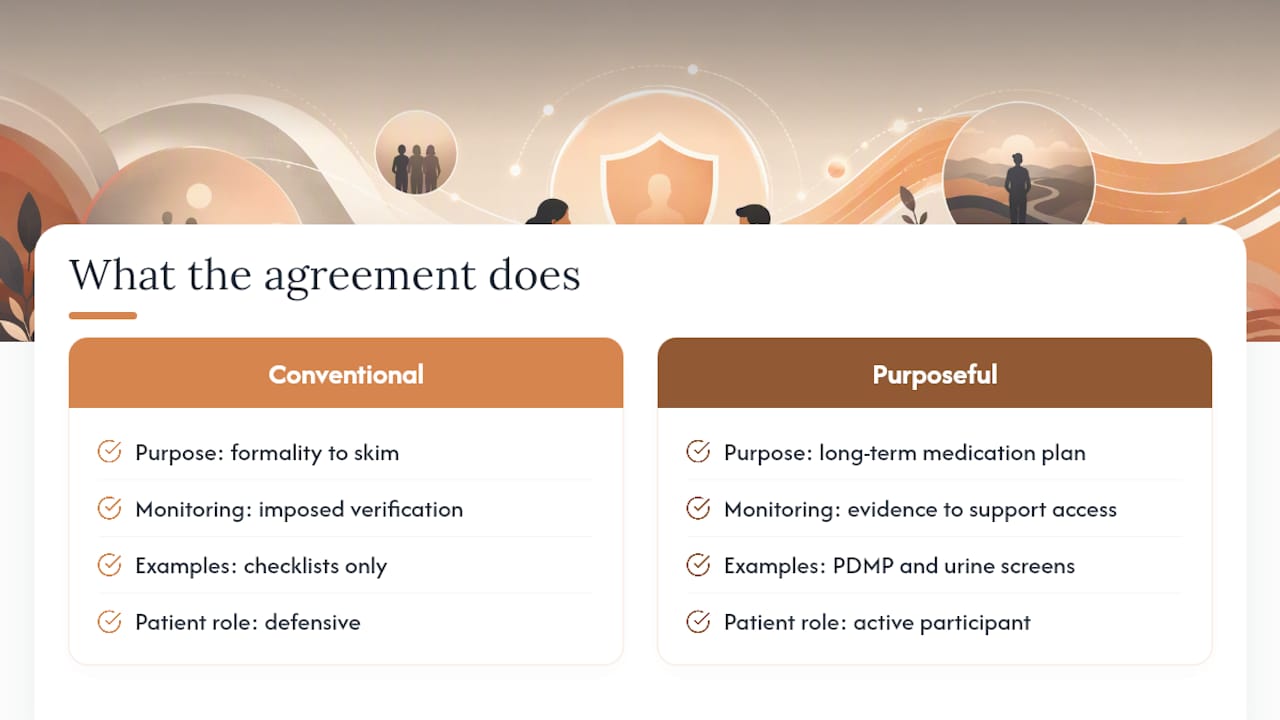
Where most explainers fall short is treating monitoring as something imposed on patients rather than something patients can use. A PDMP check or a urine screen isn’t just verification, it’s evidence that can support you keeping access to a medication that’s working, especially if your history is clean and consistent. Patients who understand that tend to engage differently with monitoring, less defensively, more as participants.
If you’re about to sign one of these forms, prioritize understanding the termination and taper clauses before anything else. That’s the section that determines what happens on your worst day of adherence, not your best, and it’s the part most people skip past to get to the signature line.
— Jamie
Ready to start monitored medication management with Journey Mental Health
If you’re weighing whether virtual psychiatric care can handle a controlled substance safely, the honest answer is that it depends entirely on whether monitoring is built into the process from day one. Journey Mental Health structures every evaluation and follow-up around that principle, offering virtual psychiatric evaluations, ADHD testing, and ongoing medication management for adults in Texas and Colorado without the multi-week wait typical of in-person psychiatry.
Getting started is simple: complete the online intake, schedule your telehealth evaluation, and have your pharmacy information ready so your first prescription, if one is appropriate, moves without delay. If ADHD is the primary concern, our ADHD treatment page outlines what evaluation and monitoring looks like from the first appointment onward. For anyone managing anxiety, depression, or an existing controlled substance prescription, our medication management services page explains exactly what ongoing care and monitoring involve, so you know what you’re agreeing to before your first visit.
This article is general information, not a substitute for advice from a qualified doctor. Consult a qualified healthcare professional about your own circumstances before acting on anything here.
Sources
- CONTROLLED SUBSTANCE AGREEMENT — Department of Health and Human Services (SFN 736)
- BUPRENORPHINE (SUBOXONE) TREATMENT AGREEMENT — IHS
- Sample patient treatment agreement for MAT — CU Anschutz
- Clinical practice guidelines — American Psychiatric Association (APA)
- Sample treatment agreement — ASAM