

ADHD Burnout Symptoms: What Adults Need to Know
ADHD burnout symptoms are defined as a state of severe cognitive, physical, and emotional exhaustion caused by the sustained effort required to manage ADHD in a neurotypical world. This condition is clinically distinct from general burnout and major depressive disorder, though it shares surface features with both. Adults with ADHD often reach this state after months of overcompensating through rigid routines, masking behaviors, and sheer willpower. Recognizing the specific pattern of these symptoms is the first step toward getting the right support.
What are the core ADHD burnout symptoms?
ADHD burnout produces symptoms across three domains: physical, cognitive, and emotional. Understanding all three is critical because treating only one rarely leads to recovery.
Physical and cognitive exhaustion
Chronic exhaustion is one of the most misunderstood ADHD fatigue signs. Adults with ADHD often wake up tired even after a full night of sleep. This happens because executive function tasks like planning, switching between activities, and organizing information demand as much energy as physical labor, even though the effort is invisible to others.

Task paralysis is another defining feature. You may sit in front of a task for an hour and produce nothing, not from laziness, but from a genuine cognitive collapse. Planners stop working. Reminders get ignored. The coping scaffolds you built over years suddenly fail all at once.
Pro Tip: If your usual systems like to-do lists, timers, and calendar alerts have stopped working entirely, that is a strong signal of burnout rather than a bad week.
Emotional and sensory symptoms
Rejection sensitive dysphoria, known as RSD, is a hallmark of ADHD emotional fatigue. It causes emotional pain that feels physically real in response to perceived criticism or failure. This is not an overreaction. It reflects a regulatory system pushed past its limit.
Sensory hypersensitivity also spikes during burnout. Sounds that were once tolerable become unbearable. Textures, lighting, and background noise can trigger irritability or tearfulness. These are signs of ADHD exhaustion, not anxiety or mood disorder alone.
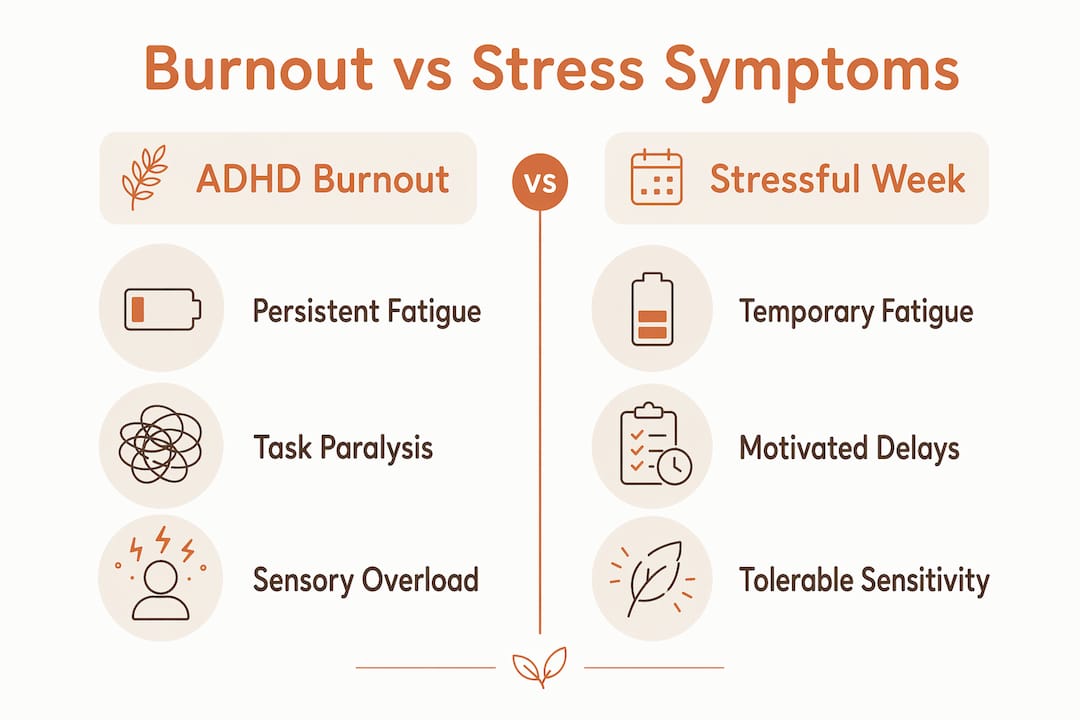
The table below compares core ADHD burnout symptoms with what you might expect from general stress or a difficult week:
| Symptom | During ADHD burnout | During a stressful week |
|---|---|---|
| Fatigue | Persistent, unrelieved by rest | Improves with sleep |
| Task completion | Near-impossible, even for easy tasks | Slowed but possible |
| Emotional reactivity | Intense, disproportionate responses | Elevated but manageable |
| Coping tools | Stop working entirely | Reduced effectiveness |
| Sensory tolerance | Severely lowered | Mildly lowered |
How does ADHD burnout differ from depression and general burnout?
ADHD burnout and major depressive disorder overlap enough to confuse even experienced clinicians. The distinction matters because the treatments differ significantly.
The clearest difference is in motivation. ADHD burnout features task-specific motivation loss that can return when the environment changes. A person in ADHD burnout may feel completely unable to write a work report but still feel genuine excitement about a hobby. In major depressive disorder, motivation loss is pervasive. Nothing feels worth doing, regardless of context.
Distinguishing ADHD burnout from depression is also important because ADHD burnout responds more clearly to actual rest and reduced demands. Depression often requires medication and therapy before any improvement appears. If a weekend away from responsibilities genuinely lifts your mood and energy, that pattern points more toward ADHD burnout than clinical depression.
The comparison below highlights the key differences:
| Feature | ADHD burnout | Major depression | General burnout |
|---|---|---|---|
| Motivation loss | Task-specific | Pervasive | Work-specific |
| Emotional range | Volatile, reactive | Flat, numb | Cynical, detached |
| Response to rest | Partial improvement | Minimal improvement | Significant improvement |
| Sense of self | Intact but frustrated | Often negative or hopeless | Diminished but present |
| Coping system failure | Complete collapse | Gradual withdrawal | Progressive decline |
For a deeper look at how these conditions overlap, the Journeymhw guide on depression vs. ADHD covers the clinical distinctions adults most often ask about.
What neurobiological factors drive ADHD burnout symptoms?
ADHD burnout is not a personal failure. It has a neurobiological basis rooted in how the ADHD brain manages energy and regulation.
Adults with ADHD operate with lower baseline levels of dopamine and norepinephrine. These neurochemicals support executive function, attention regulation, and emotional control. When they are chronically depleted, every cognitive task requires disproportionate effort. Executive fatigue accumulates in the same way physical fatigue does after intense exercise, except it builds from tasks most people find routine.
Masking neurodivergent traits in neurotypical environments is a major-hidden drain on this already limited energy. Masking means suppressing impulsive speech, forcing eye contact, mimicking social norms, and constantly monitoring your own behavior. It is exhausting work that happens in the background of every interaction. For adults who have masked for years, burnout often arrives suddenly when the effort becomes unsustainable. The Journeymhw article on ADHD masking costs explains this drain in detail.
Emotional outbursts during burnout are a sign of physiological overload, not character flaws. The brain’s regulatory systems, already working overtime, simply run out of capacity to filter emotional responses. Small frustrations produce large reactions because the buffer is gone.
Pro Tip: Track the days when your emotional reactions feel out of proportion to the trigger. A pattern of escalating reactivity over two to three weeks is a reliable early warning sign of burnout onset.
Understanding ADHD executive dysfunction at the neurological level helps you stop blaming yourself and start addressing the actual cause.
What strategies help with managing ADHD burnout?
Recovery from ADHD burnout requires more than a vacation. Because burnout represents an executive shutdown, the coping systems that previously worked must be rebuilt from the ground up, not just rested.
-
Reduce demands immediately. Identify the top three obligations draining your executive function and temporarily reduce or delegate them. This is not giving up. It is triage.
-
Rest in ADHD-compatible ways. Passive rest like lying in a dark room rarely works for the ADHD brain. Active rest, such as a slow walk, gentle music, or low-demand creative activity, tends to restore energy more effectively.
-
Address emotional dysregulation directly. Techniques like body doubling, where you work alongside another person, reduce the emotional isolation that amplifies burnout. Journeymhw’s guide on ADHD emotional dysregulation offers specific approaches for adults.
-
Rebuild coping scaffolds one at a time. Do not restart all your systems at once. Choose one structure, such as a single daily anchor task, and stabilize it before adding more.
-
Manage sensory load. Reduce noise, screen time, and social obligations during recovery. Your nervous system needs a lower input environment to reset.
-
Seek professional evaluation. When burnout is severe or recurring, a psychiatric evaluation can determine whether medication adjustments, therapy, or both are needed. Chronic ADHD symptoms that do not improve with rest warrant clinical attention.
For adults who want a broader framework, the Journeymhw resource on ADHD overwhelm strategies covers practical tools that work specifically for the ADHD brain.
Key Takeaways
ADHD burnout symptoms are a distinct clinical pattern driven by executive fatigue, masking, and regulatory overload, and recovery requires rebuilding coping systems rather than simply resting.
| Point | Details |
|---|---|
| Burnout is neurobiological | Executive fatigue and dopamine depletion cause physical exhaustion, not laziness or poor effort. |
| Symptoms span three domains | Physical exhaustion, task paralysis, and emotional dysregulation all appear together during burnout. |
| It differs from depression | Motivation loss in ADHD burnout is task-specific and improves with environmental changes, unlike in MDD. |
| Masking accelerates burnout | Suppressing neurodivergent traits in neurotypical settings drains energy faster than most adults realize. |
| Recovery requires rebuilding | Coping scaffolds must be rebuilt one at a time, not simply restarted after a break. |
What I’ve learned from watching ADHD burnout up close
The part that surprises most adults is how sudden it feels. One week the systems are holding. The next, nothing works. The planner is ignored, the reminders are dismissed, and even simple tasks feel impossible. From what I have seen, that abruptness is not random. It is the result of months of invisible effort finally exceeding capacity.
What I find most underappreciated is the role of masking. Adults who have spent years performing neurotypicality at work and in social settings often do not realize how much energy that performance costs. By the time burnout arrives, they have been running on empty for a long time. The burnout is not the problem. It is the signal that the problem has been building for months.
The other thing worth saying plainly is this: emotional outbursts during burnout are not personality problems. They are physiological events. When the regulatory system is overloaded, it stops filtering. That is a brain state, not a character flaw. Treating it as a character flaw delays recovery and adds shame to an already depleted system.
Recovery is real, but it is slower than most adults want it to be. The adults I have seen recover well are the ones who stopped trying to push through and started treating rest and reduced demands as medical necessities, not indulgences. Getting a proper evaluation and, where appropriate, medication support changes the recovery timeline significantly.
— Jamie
Journeymhw supports adults with ADHD burnout
Recognizing ADHD burnout symptoms is one thing. Getting the right support to address them is another.

Journeymhw specializes in adult ADHD evaluation and medication management for adults in Texas and Colorado. If your burnout symptoms are recurring or worsening, a structured psychiatric evaluation can clarify whether your current treatment plan needs adjustment. Journeymhw offers both virtual and in-person appointments, with quick availability and a clear care pathway from assessment to treatment. You do not have to keep managing this alone. Scheduling an evaluation is a concrete step toward feeling and functioning better.
FAQ
What are the first signs of ADHD burnout?
The earliest signs are usually a sudden failure of coping tools like planners and reminders, combined with disproportionate emotional reactions to minor frustrations. Physical exhaustion that does not improve with sleep is also a common early indicator.
Can ADHD burnout be mistaken for depression?
Yes. Both conditions share fatigue and reduced motivation, but ADHD burnout’s motivation loss is task-specific and can lift in low-stress environments, while depression produces pervasive motivation loss across all areas of life.
How long does ADHD burnout last?
Recovery time varies depending on severity and whether the underlying causes are addressed. Because burnout involves executive system failure, recovery requires rebuilding coping structures gradually, which typically takes weeks to months rather than days.
Does masking cause ADHD burnout?
Masking is one of the leading contributors to ADHD burnout. Suppressing neurodivergent traits in neurotypical settings depletes the energy reserves adults with ADHD need for basic executive function.
When should I seek professional help for ADHD burnout?
Seek professional support when burnout symptoms are severe, recurring, or not improving with rest and reduced demands. A psychiatric evaluation can determine whether medication adjustments or structured therapy are needed to support recovery.
Recommended
- Depression vs ADHD symptoms explained for adults – Journey Mental Health
- ADHD Overwhelm in Adults: Strategies That Actually Work – Journey Mental Health
- ADHD Emotional Dysregulation: What Adults Need to Know – Journey Mental Health
- ADHD and Anxiety Overlap Explained for Adults – Journey Mental Health