

What Psychiatrists Do for Anxiety Treatment in Texas
In Texas, psychiatrists diagnose anxiety disorders, prescribe and manage medications, coordinate psychotherapy referrals, and handle complex or comorbid cases — and you can access that care in person or through licensed telepsychiatry, often with an initial appointment within the same week. Board-certified psychiatrists use standardized tools like the GAD-7 to measure symptom severity and track your progress over time. Journeymhw offers a practical telepsychiatry pathway for Texans who need timely psychiatric evaluations and ongoing medication management from home.
Table of Contents
- What a psychiatrist does in anxiety treatment
- How psychiatrists assess and diagnose anxiety disorders
- Evidence-based treatments psychiatrists provide or coordinate
- How psychiatrists start, adjust, and monitor medications for anxiety
- Accessing psychiatric care in Texas: telehealth, licensure, and insurance
- What to expect at your first psychiatry appointment
- When to seek urgent help: recognizing a psychiatric crisis
- How to choose a psychiatrist in Texas that fits your needs
- Key Takeaways
- What we’ve learned from treating anxiety through telehealth
- Psychiatric care for anxiety is closer than you think
- Useful sources and further reading
What a psychiatrist does in anxiety treatment
A psychiatrist’s role goes well beyond writing a prescription. As a licensed medical doctor with specialized psychiatric training, a psychiatrist brings a clinical depth that therapists and primary care providers cannot fully replicate.
Core clinical responsibilities include:
- Comprehensive assessment and diagnosis: Evaluating your full medical and psychiatric history to identify the specific anxiety disorder and any co-occurring conditions
- Medication management: Prescribing, titrating, and monitoring medications — including SSRIs and SNRIs — and adjusting them based on your response and side effects
- Safety evaluation: Screening for suicidal ideation, self-harm risk, and psychiatric emergencies at every visit
- Psychotherapy coordination: Referring you to a therapist for CBT or exposure-based treatment and collaborating with that provider on your care plan
- Long-term monitoring: Tracking symptom trends, functional improvement, and medication tolerability across follow-up visits
What separates a psychiatrist from a therapist is prescribing authority and the ability to conduct a full medical workup. A therapist can deliver CBT with skill, but cannot order labs, rule out thyroid dysfunction as a cause of anxiety, or manage a medication interaction. Primary care physicians can prescribe SSRIs, but they rarely have the time or training to manage complex comorbidities like anxiety plus ADHD or anxiety plus substance use. That’s where a board-certified psychiatrist adds the most value.
Pro Tip: When searching for a psychiatrist for anxiety in Texas, look specifically for board certification through the American Board of Psychiatry and Neurology (ABPN). Board certification signals that the clinician has passed rigorous competency standards beyond basic licensure.
How psychiatrists assess and diagnose anxiety disorders
The first psychiatric evaluation is thorough by design. It typically lasts about as long as a standard medical visit but covers more ground in detail.
A psychiatrist will review your medical history, current medications, substance use, family psychiatric history, and the specific symptoms you’re experiencing. Critically, they’ll ask about functional impact: how anxiety affects your sleep, work, relationships, and daily activities. When a medical cause for anxiety symptoms is possible (thyroid disease, cardiac arrhythmia, stimulant use), they may request labs or coordinate with your primary care provider.
Standardized symptom scales like the GAD-7 are a cornerstone of measurement-based care in psychiatry. The GAD-7 scores seven items on a 0–3 scale, producing a total score that maps to mild, moderate, or severe anxiety. Psychiatrists use it at intake and at every follow-up to track whether your symptoms are improving, stable, or worsening — giving both you and your provider an objective benchmark rather than relying on memory alone.
Differential diagnosis is one of the most important steps. Generalized anxiety disorder, panic disorder, and social anxiety disorder are among the most common presentations, but anxiety frequently co-occurs with depression, ADHD, or substance use disorders. Treating anxiety without addressing a co-occurring condition often produces incomplete results. A psychiatrist is trained to untangle these overlapping presentations and prioritize treatment accordingly.
Most patients can expect a preliminary diagnosis and initial treatment plan by the end of the first visit, with a follow-up scheduled within a few weeks to assess early medication response or therapy progress.

Evidence-based treatments psychiatrists provide or coordinate
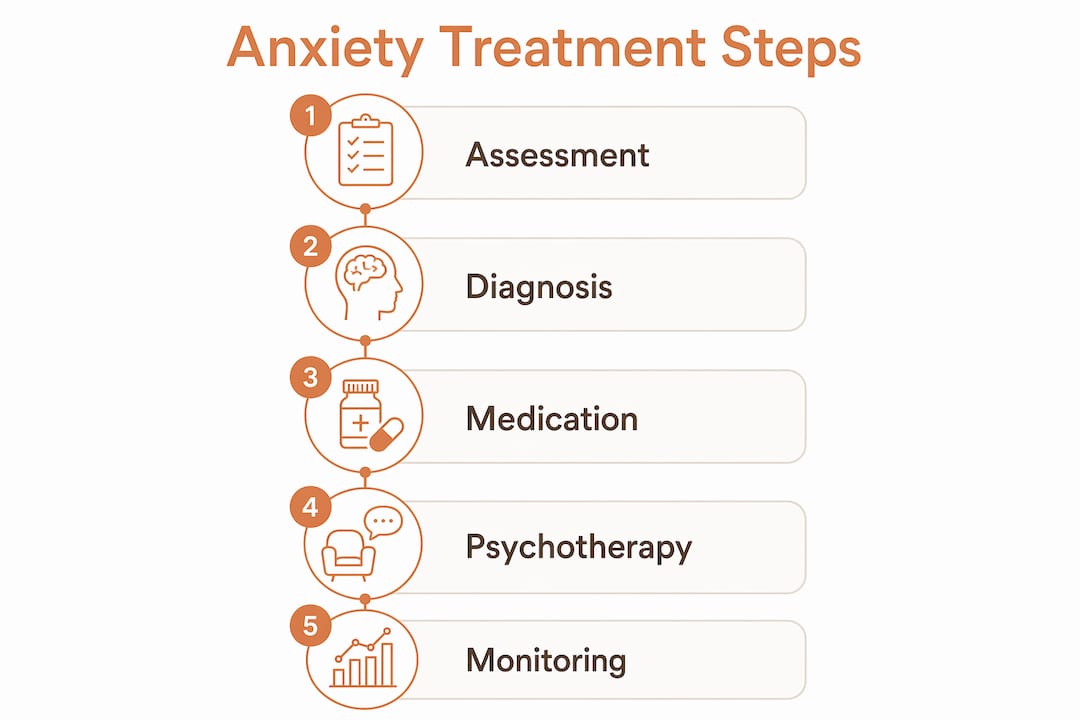
Psychiatrists draw from three broad treatment approaches, and the right combination depends on your diagnosis, symptom severity, and personal preferences.
| Treatment Approach | Speed of Relief | Long-Term Evidence | Side-Effect Considerations | Typical Duration |
|---|---|---|---|---|
| Psychotherapy (CBT, exposure) | Gradual (weeks to months) | Strong for lasting change | Minimal; requires active participation | Typically multiple sessions or ongoing |
| Pharmacotherapy (SSRIs/SNRIs) | Moderate (a few weeks) | Strong with consistent use | GI effects, sleep changes, sexual side effects possible | Often long-term |
| Benzodiazepines (short-term) | Rapid (hours) | Limited for long-term use | Sedation, dependence risk | Intended for brief use |
| Combined therapy + medication | Moderate | Strongest for many patients | Depends on specific agents used | Tailored to individual needs |
Psychotherapy, particularly CBT and exposure-based approaches, produces durable improvements by changing the thought patterns and avoidance behaviors that maintain anxiety. Pharmacotherapy with SSRIs or SNRIs reduces symptom intensity, which often makes it easier to engage in therapy. For many patients, combined treatment outperforms either approach alone.
Benzodiazepines are sometimes used for short-term relief during a crisis or at the start of SSRI treatment, but they are not a long-term solution. A psychiatrist will monitor for dependence risk and taper them carefully.
Safety monitoring runs throughout treatment. Psychiatrists screen for suicidal ideation at every visit, check for medication interactions, and assess whether the current level of care is sufficient. When anxiety is severe enough to impair daily functioning significantly, a referral to a partial hospitalization program (PHP) or intensive outpatient program (IOP) may be appropriate.
How psychiatrists start, adjust, and monitor medications for anxiety
Starting a medication is a structured process, not a one-time decision. Here’s what that process typically looks like:
- Informed consent: Your psychiatrist explains the medication’s mechanism, expected timeline for effect, common side effects, and what to do if problems arise
- Baseline checks: For some medications, labs or an EKG may be ordered before starting
- Starting dose: Most anxiety medications begin at a low dose to minimize side effects, with a plan to titrate upward over weeks
- Titration: Dose increases are made based on your symptom response and tolerability, usually at 2–4 week intervals
- Ongoing monitoring: Scheduled follow-ups use symptom scales (like the GAD-7) and direct clinical assessment to track progress
- Lab monitoring: Some medications require periodic blood work (thyroid function, metabolic panels) depending on the agent
- Tapering and discontinuation: When it’s time to stop, psychiatrists taper medications gradually to avoid discontinuation symptoms
Pro Tip: Keep a brief symptom log between appointments — even a few sentences per day noting anxiety level, sleep quality, and any side effects. Bringing this to your follow-up gives your psychiatrist concrete data to work with rather than a general impression of “better” or “worse.”
Regular use of symptom scales shortens the feedback loop for medication adjustments. When a psychiatrist can see that your GAD-7 score dropped from 16 to 9 after four weeks on an SSRI, that’s a clear signal to continue the current plan. If it barely moved, that’s a prompt to reassess the dose or consider adding psychotherapy.
Accessing psychiatric care in Texas: telehealth, licensure, and insurance
Texas is a large state with significant mental health provider shortages in rural areas. Telepsychiatry addresses that gap directly.
For telepsychiatry to be legal and safe, the clinician must be licensed in Texas, and the platform must use a HIPAA-compliant, secure connection. Patients should confirm both before their first appointment. Interstate practice rules mean that a psychiatrist licensed only in another state cannot legally treat you as a Texas resident, so verifying Texas licensure is a practical first step.
Telehealth removes the geographic friction that keeps many Texans from getting psychiatric care. A patient in West Texas or the Panhandle who previously faced a three-hour drive to the nearest psychiatrist can now complete an evaluation, receive a diagnosis, and start medication management from home. Many telehealth platforms schedule initial consultations within about one week, compared to wait times of several months at many in-person clinics.
On the insurance side, major carriers operating in Texas — including Blue Cross Blue Shield of Texas, Aetna, and Cigna — cover telepsychiatry visits for in-network providers. Out-of-network visits may still be partially reimbursable through your plan’s out-of-network benefits. Some platforms also offer fee-for-service pricing or annual subscription plans that bundle evaluations and follow-ups into a predictable cost.
Journeymhw’s structured anxiety treatment plans are designed specifically for Texas residents, with online booking, licensed clinicians, and a clear pathway from initial evaluation to ongoing medication management.
Pro Tip: Before booking, call your insurance carrier and ask specifically whether telepsychiatry visits with your chosen platform are covered as in-network benefits. Get the reference number for that call — it protects you if a claim is disputed later.
What to expect at your first psychiatry appointment
Preparation makes a real difference. Here’s what to gather before your first visit:
- Current medication list — include dosages, prescribing providers, and how long you’ve been taking each
- Prior psychiatric or therapy records — even a brief summary from a previous provider helps
- Medical history summary — chronic conditions, recent lab work, and any hospitalizations
- Symptom examples — specific situations where anxiety has affected your work, relationships, or daily functioning
- GAD-7 or similar self-assessment — if you’ve completed one recently, bring it or note your score
- Family psychiatric history — anxiety, depression, bipolar disorder, or substance use in first-degree relatives
- Questions you want answered — about diagnosis, medication options, therapy referrals, or what to expect next
The appointment itself typically starts with your psychiatrist reviewing your history and asking open-ended questions about your symptoms. A mental status exam follows — this is a structured clinical observation of your mood, thought process, cognition, and behavior, not a test you can pass or fail. The psychiatrist will also conduct a brief safety screen, asking directly about thoughts of self-harm or suicide.
By the end of the visit, you should have a preliminary diagnosis or a clear next step, an initial treatment recommendation, and a follow-up appointment scheduled. If you leave without understanding the plan, ask before you go.
When to seek urgent help: recognizing a psychiatric crisis
Some anxiety symptoms require immediate attention, not a scheduled appointment.
If you or someone you know is experiencing thoughts of suicide or self-harm, call or text 988 (the Suicide and Crisis Lifeline) or call 911 immediately. Crisis lines are staffed 24 hours a day, 7 days a week, and can connect you with local emergency psychiatric resources anywhere in Texas.
Seek urgent evaluation if you experience:
- Suicidal ideation, thoughts of self-harm, or a plan to hurt yourself or others
- Psychotic symptoms (hallucinations, paranoid beliefs, disorganized thinking) alongside anxiety
- Inability to care for yourself — not eating, not sleeping for days, unable to leave home
- Severe panic symptoms that mimic a cardiac event (chest pain, shortness of breath, numbness) and have not been medically cleared
- A sudden, significant worsening of symptoms after starting or stopping a medication
In a crisis, go to the nearest emergency department or call 911. Texas also has a network of mental health crisis centers through the Texas Health and Human Services system. Document your symptoms as clearly as you can — onset, severity, and any recent medication changes — and share that information with the treating provider.
How to choose a psychiatrist in Texas that fits your needs
Not every psychiatrist is the right fit, and the selection process matters for long-term care continuity.
Key criteria to evaluate:
- Board certification: Verify ABPN certification through the official board website
- Specialty focus: Look for psychiatrists who list anxiety disorders, mood disorders, or adult psychiatry as primary areas
- Telehealth experience: For virtual care, confirm the provider uses a stable, HIPAA-compliant platform and is comfortable with remote assessment
- Insurance and network status: Confirm in-network status with your specific plan before booking
- Follow-up availability: A psychiatrist who can only see you every three months is not well-suited for active medication titration
- Cultural and linguistic fit: For patients who prefer to communicate in Spanish or another language, or who want a provider with cultural familiarity, ask about this directly during the intake call
Questions worth asking before your first appointment:
- What is your approach to medication for anxiety — do you start with therapy, medication, or both?
- How do you coordinate with my therapist if I have one?
- What is your protocol if I have a crisis between appointments?
- How often will we meet during the first three months?
- What are the costs if my insurance doesn’t cover a visit?
For rural Texans, telepsychiatry is often the most practical path to consistent care. Hybrid arrangements — an initial in-person evaluation followed by virtual follow-ups — are also increasingly common and can offer the best of both models.
Key Takeaways
Psychiatrists in Texas provide the full clinical spectrum of anxiety care: diagnosis, medication management, safety monitoring, and coordination with therapists — and telepsychiatry makes that care accessible statewide, often within a week.
| Point | Details |
|---|---|
| Psychiatrist vs. therapist | Psychiatrists prescribe and manage medications; therapists deliver talk therapy — both roles are often needed together. |
| Standardized assessment | The GAD-7 is used at intake and follow-up to objectively track anxiety severity and guide medication adjustments. |
| Combined treatment | Evidence supports combining CBT or exposure therapy with SSRIs or SNRIs for stronger, more lasting outcomes. |
| Telepsychiatry access | Texas-licensed telepsychiatry platforms offer same-week initial evaluations and remove geographic barriers for rural patients. |
| Journeymhw for Texans | Journeymhw provides online psychiatric evaluations, medication management, and structured anxiety treatment plans for Texas residents via telehealth. |
What we’ve learned from treating anxiety through telehealth
The most common misconception we see is that a psychiatrist’s job is simply to hand over a prescription. In practice, the diagnostic work that precedes any medication decision is where the real clinical value lives. Anxiety disorders overlap with depression, ADHD, trauma histories, and medical conditions in ways that make a surface-level assessment genuinely risky. When a patient has been on three different SSRIs with limited results, the question is rarely “which SSRI next?” — it’s “what are we missing?”
Measurement-based care changes that dynamic. When we track GAD-7 scores at every visit, we’re not just collecting data. We’re creating a shared language between patient and provider that makes it easier to have honest conversations about what’s working and what isn’t. Patients who can point to a score dropping from 18 to 7 feel the progress concretely. Those whose scores haven’t moved after six weeks know, without ambiguity, that something needs to change.
Telepsychiatry has made this kind of consistent, structured follow-up more achievable for Texans who previously couldn’t access it. The patients who benefit most aren’t just those in rural areas — they’re also working adults who can’t take half a day off for a clinic visit, parents managing childcare, and people for whom the logistics of in-person care were quietly becoming a reason to stop showing up. Removing that barrier doesn’t lower the quality of care. For many patients, it raises it.
Psychiatric care for anxiety is closer than you think
Texans dealing with anxiety no longer need to wait months for an in-person appointment or drive hours to see a specialist. Journeymhw offers online psychiatric evaluations for anxiety conducted by licensed clinicians, with structured medication management and follow-up plans built into the process from day one. Whether you’re managing generalized anxiety, panic disorder, or social anxiety, the care pathway is clear: evaluation, diagnosis, a personalized treatment plan, and scheduled check-ins to track your progress.
Insurance is accepted through major carriers, and self-pay options are available for those without coverage. Appointments are typically available within the same week. To get started, book your initial evaluation through Journeymhw’s online platform and take the first concrete step toward feeling better.
This article is for general informational purposes only and does not constitute medical advice. Please consult a qualified mental health professional or your primary care provider for guidance specific to your situation.
Useful sources and further reading
- National Institute of Mental Health — Mental Illness Statistics
- Texas Health and Human Services — Mental Health and Substance Use
- Treatment of Anxiety Disorders — PMC, National Institutes of Health
- Initial Psychiatric Assessment — Merck Manual (Professional)
- Anxiety Treatment in Texas — Journeymhw
- Anxiety Treatment Plans for Texas Residents — Journeymhw Blog
- Telehealth Services — Building Block Resolutions
Recommended
- Anxiety Treatment in Texas & Colorado | Online Anxiety Help & Medication – Journey Mental Health
- Anxiety Treatment in Texas & Colorado | Online Anxiety Help & Medication – Journey Mental Health
- Anxiety Treatment in Texas & Colorado | Online Anxiety Help & Medication – Journey Mental Health
- Anxiety Treatment Plans for Texas Residents: 2026 Guide – Journey Mental Health