

ADHD Inattentive Type Explained: Symptoms and Care
ADHD inattentive type, clinically defined as “ADHD, predominantly inattentive presentation” under the DSM-5, is a neurodevelopmental condition marked by persistent difficulty sustaining attention, staying organized, and following through on tasks without the hyperactivity or impulsivity seen in other presentations. Many people still use the older term “ADD,” but that label was retired when the DSM-5 unified all presentations under the ADHD umbrella. Understanding ADHD inattentive characteristics matters because this presentation is frequently missed, misread as laziness, or confused with anxiety and depression. According to Yale Medicine, inattentive ADHD reflects a difference in dopamine and norepinephrine regulation, not a deficit in motivation or character.
What is inattentive ADHD, and how is it diagnosed?
The DSM-5 defines three ADHD presentations: predominantly inattentive, hyperactive-impulsive, and combined. Inattentive ADHD centers on attention, organization, and follow-through, and individuals often appear distracted, disorganized, and forgetful without any obvious restlessness. This symptom profile is what makes the condition easy to overlook in clinical and educational settings.
Diagnosis requires meeting a specific number of inattentive symptom criteria. Children need six or more symptoms, while adults require at least five. That lower adult threshold reflects how some symptoms become less visible with age, even as functional impairment persists.
The nine DSM-5 inattentive symptom criteria include:
- Making careless mistakes in schoolwork, work tasks, or other activities
- Difficulty sustaining attention during tasks or play
- Appearing not to listen when spoken to directly
- Failing to follow through on instructions or finish tasks
- Struggling to organize tasks and activities
- Avoiding or disliking tasks that require sustained mental effort
- Losing items needed for tasks, such as keys, glasses, or paperwork
- Being easily distracted by unrelated stimuli
- Being forgetful in daily activities
Symptoms must also be present in two or more settings, such as home, school, or work, and must cause meaningful impairment in daily functioning. This multi-setting requirement is critical. A person who struggles only at home but performs well at work may not meet the full diagnostic threshold, which is why a thorough evaluation draws on input from multiple sources.
Pro Tip: If you are preparing for a clinical evaluation, bring written examples of how symptoms affect you across different areas of your life. Concrete, real-world examples carry more weight than general descriptions.
How does inattentive ADHD differ from hyperactive-impulsive and combined types?
Understanding the differences in ADHD types helps clarify why inattentive presentations are so often missed. The hyperactive-impulsive type involves fidgeting, interrupting, difficulty waiting, and physical restlessness. The combined type meets criteria for both inattentive and hyperactive-impulsive symptoms. Inattentive ADHD, by contrast, presents quietly.
| ADHD Type | Core Symptoms | Behavioral Presentation |
|---|---|---|
| Predominantly inattentive | Distractibility, disorganization, forgetfulness | Quiet, appears daydreamy or unmotivated |
| Hyperactive-impulsive | Fidgeting, interrupting, impulsivity | Physically restless, disruptive in group settings |
| Combined presentation | Both inattentive and hyperactive-impulsive symptoms | Variable; may shift with age or environment |
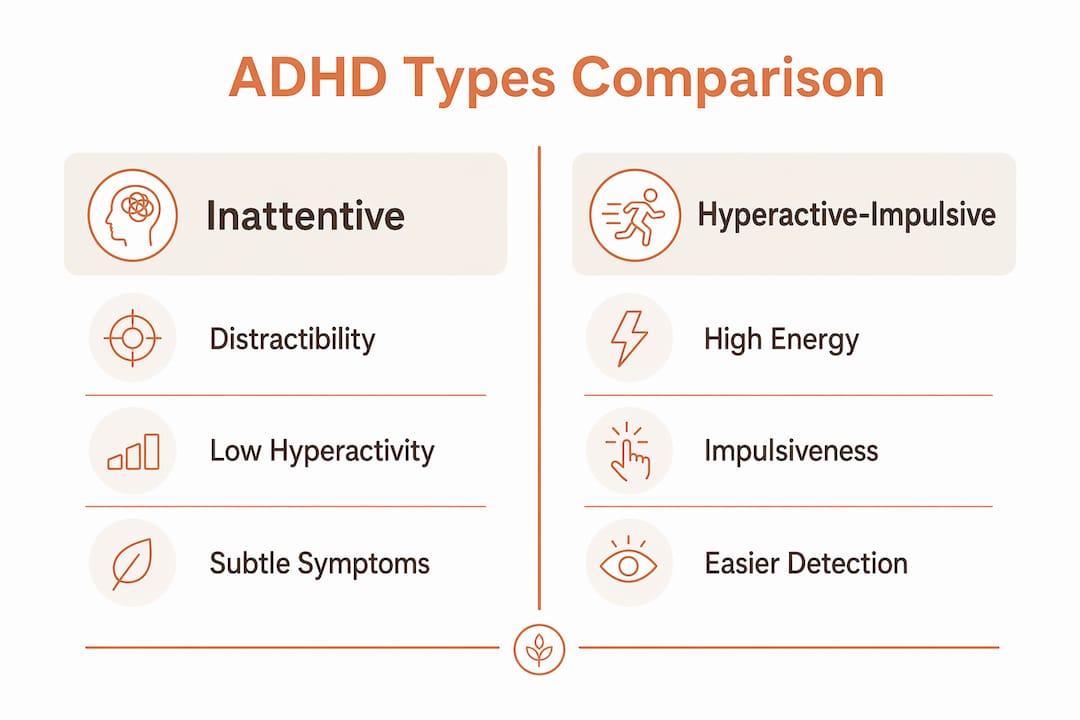
The behavioral contrast is significant. A child with hyperactive-impulsive ADHD is likely to be flagged by teachers early because the behavior disrupts the classroom. A child with inattentive ADHD may sit quietly, stare out the window, and turn in incomplete work without anyone connecting those patterns to a neurodevelopmental condition. That child is far more likely to be labeled as unmotivated or distracted rather than referred for evaluation.
Symptom profiles can also shift over time. Many adults who were diagnosed with combined-type ADHD in childhood find that hyperactive symptoms reduce with age, leaving inattentive symptoms as the dominant challenge. This evolution means that adults may not recognize their current experience as ADHD because it no longer looks the way it did in childhood.
What makes diagnosing inattentive ADHD so difficult?
Questionnaires alone can miss inattentive ADHD because symptoms are shaped by cultural context, environmental structure, and individual coping strategies. A person who grew up in a highly structured household, attended a regimented school, or works in a role with tight external deadlines may never have experienced the full weight of their impairment until a life transition removed those supports.
Structured environments can mask inattentive ADHD symptoms until transitions expose functional difficulties. College, a new job, parenthood, or the loss of a consistent routine are common trigger points where previously managed symptoms suddenly become unmanageable. This is why many adults receive their first ADHD diagnosis in their 30s or 40s.
Several factors complicate accurate diagnosis:
- High-achieving individuals may compensate through extra effort, masking impairment until burnout sets in
- Cultural norms around attention and behavior influence what gets flagged as a problem
- Overlapping conditions like anxiety, depression, and sleep disorders share symptoms with inattentive ADHD
- Self-report questionnaires capture current perception, not the full developmental history
Multi-informant history from teachers and caregivers is critical to accurate diagnosis because subtle symptom presentation can be invisible to a single observer. A clinician who relies only on a self-report checklist may miss the pattern entirely. Clinical interpretation, not just scoring, is what separates a thorough evaluation from a superficial one. Journeymhw’s focus issue evaluations are structured to gather exactly this kind of multi-context information.
Performance gaps, such as starting tasks but rarely finishing them, are key functional signals that go beyond behavior and point directly to inattentive ADHD. Documenting these real-world misses before your evaluation gives your clinician concrete evidence to work with.
What are effective management strategies for inattentive ADHD?
Managing inattentive ADHD works best when treatment combines medication, behavioral support, and environmental design. No single approach covers everything, and the most effective plans are built around your specific symptom profile and daily demands.

Medication is often the first clinical tool. Stimulant medications, including amphetamine-based and methylphenidate-based formulations, increase dopamine availability and improve sustained attention. Non-stimulant options like Strattera (atomoxetine) and Intuniv (guanfacine) are effective alternatives for those who do not tolerate stimulants or have co-occurring conditions. External structure tools such as planners, alarms, and task breakdowns work alongside medication to reduce the cognitive load on an already taxed executive function system.
Behavioral approaches add another layer of support. Cognitive Behavioral Therapy, or CBT, helps address the negative thought patterns that often develop around chronic underperformance. Executive function coaching focuses specifically on planning, prioritization, and time management. Both approaches teach skills that medication alone does not provide.
Here is a practical management framework to build from:
- Start with a clinical evaluation to confirm diagnosis and rule out co-occurring conditions
- Work with your provider to determine whether medication is appropriate and which type fits your needs
- Identify your three highest-impact problem areas, such as mornings, task initiation, or deadlines
- Build one external system for each area before adding more
- Use time-blocking to assign specific tasks to specific windows rather than relying on memory
- Schedule a weekly review to assess what worked and adjust what did not
- Track symptom fluctuations, noting that ADHD symptoms show seasonal variation, with higher rates in winter and early spring, likely tied to vitamin D levels and sunlight exposure
Pro Tip: Stop trying to remember harder. Instead, design your environment so forgetting becomes harder. Set an alarm for every transition, place items you need in your path, and write tasks down the moment they occur to you. Externalizing cognitive tasks reduces the burden on impaired internal executive functioning.
How does inattentive ADHD affect daily life, and what coping strategies actually help?
The functional impact of inattentive ADHD extends well beyond forgetting where you put your keys. Time blindness, the inability to accurately sense how much time has passed or remains, causes chronic lateness and missed deadlines. Emotional dysregulation, though not a formal diagnostic criterion, is reported by many people with inattentive ADHD and leads to frustration, low self-esteem, and avoidance. Chronic overwhelm from incomplete tasks accumulates into a mental backlog that makes starting anything feel impossible.
Coping strategies that work in real life tend to share one quality: they reduce reliance on internal memory and willpower. Effective approaches include:
- Body doubling: Working alongside another person, in person or virtually, significantly improves task completion for many people with ADHD. The presence of another person creates gentle accountability without pressure.
- Noise-canceling headphones: Reducing auditory distractions is one of the fastest environmental fixes for focus. Tools like Sony WH-1000XM5 or Bose QuietComfort headphones are widely used for this purpose.
- Decluttered workspaces: Visual clutter competes for attention. A clear desk with only the current task visible reduces the number of stimuli pulling focus away.
- Time-blocking with visible timers: Apps like Focusmate or physical tools like the Time Timer make time visible and concrete, which directly addresses time blindness.
- Reminders at the point of action: A reminder that fires when you are already at your desk is more effective than one that fires while you are in the middle of something else.
Natural strategies for cognitive support through sleep, exercise, and nutrition also play a measurable role. Regular aerobic exercise increases dopamine and norepinephrine, the same neurotransmitters targeted by ADHD medication. Consistent sleep schedules reduce the cognitive fog that amplifies inattentive symptoms. These are not replacements for clinical treatment, but they meaningfully improve how well other interventions work.
Key takeaways
Inattentive ADHD is a real, diagnosable neurodevelopmental condition that requires clinical evaluation, multi-setting evidence, and a personalized combination of medication, behavioral support, and environmental design to manage effectively.
| Point | Details |
|---|---|
| DSM-5 classification | Inattentive ADHD is officially “ADHD, predominantly inattentive presentation,” not a separate condition called ADD. |
| Diagnostic thresholds | Adults need five or more inattentive symptoms; children need six or more, present in two or more settings. |
| Why it goes undiagnosed | Structured environments mask symptoms, and quiet behavior does not trigger clinical referrals the way hyperactivity does. |
| Most effective management | Combining medication, CBT or coaching, and external structure tools produces better outcomes than any single approach. |
| Daily life strategy | Externalizing memory through alarms, written lists, and visible timers reduces reliance on impaired executive function. |
What I’ve learned from watching inattentive ADHD get missed, again and again
The most consistent pattern I see is this: people with inattentive ADHD spend years being told they are smart but not working hard enough. Teachers say it. Employers say it. Sometimes they say it to themselves. By the time they reach a clinical evaluation, they have often internalized the idea that they are fundamentally flawed rather than neurologically different.
The ADHD and misdiagnosis overlap with anxiety and depression is real and clinically significant. Many people with undiagnosed inattentive ADHD develop secondary anxiety from years of missed deadlines and social consequences. Treating only the anxiety without addressing the underlying ADHD rarely produces lasting improvement.
What actually moves the needle is a combination of accurate diagnosis, appropriate medication when indicated, and a shift in how the person understands their own brain. Inattentive ADHD is not a character flaw. It is a wiring difference that responds well to the right supports. The goal is not to become a different person. It is to build systems that let you function as the person you already are, without fighting your own neurology every single day. Patience with the process matters. Progress is rarely linear, but it is real.
— Jamie
How Journeymhw can help you take the next step
If you recognize yourself in this article, a structured clinical evaluation is the most direct path forward. Journeymhw offers virtual psychiatric evaluations and ADHD treatment in Texas and Colorado, including medication management and personalized care plans designed around your specific symptom profile. Appointments are available quickly, and the process is built to reduce the friction that often keeps people from getting care.

Whether you are exploring a diagnosis for the first time or looking for a provider who understands the nuances of inattentive ADHD, Journeymhw’s team is ready to support you. You can also explore ADHD medication management options online, from stimulant and non-stimulant prescriptions to ongoing monitoring, all from home.
FAQ
What is the difference between ADD and inattentive ADHD?
ADD is an outdated term that was replaced when the DSM-5 unified all ADHD presentations under one diagnosis. What was once called ADD is now formally classified as “ADHD, predominantly inattentive presentation.”
How many symptoms are needed to diagnose inattentive ADHD in adults?
Adults require at least five inattentive symptoms from the DSM-5 criteria, present in two or more settings and causing measurable impairment in daily functioning.
Can inattentive ADHD be missed in high-achieving individuals?
Yes. Quiet individuals with inattentive ADHD can be high achievers who compensate through extra effort, which masks impairment until burnout or a major life transition removes the external structure they relied on.
What medications are used to treat inattentive ADHD?
Stimulant medications such as amphetamine and methylphenidate formulations are the most commonly prescribed. Non-stimulant options including Strattera and Intuniv are effective alternatives for those who cannot tolerate stimulants.
Does inattentive ADHD get worse at certain times of year?
ADHD symptoms, including inattentive ones, show seasonal variation with higher rates reported in winter and early spring, likely connected to reduced vitamin D levels and decreased sunlight exposure.