

ADHD Evaluation Cost in Texas: What You'll Actually Pay
An ADHD evaluation in Texas costs between $350 and $2,500 out of pocket, with most private-pay patients landing near $1,200. If you have Medicaid or qualify for a sliding-scale program, that same evaluation can cost as little as $0 to $150.
Here’s where the most common scenarios fall:
- Psychiatrist initial visit (clinical interview, no testing): typical fees range widely but can be around $200 to $400; follow-ups are generally less expensive.
- Psychologist comprehensive evaluation (interview + rating scales + written report): fees often fall within typical private practice ranges.
- Full neuropsychological battery (cognitive testing, detailed report): private clinics often charge more, while university or training clinics typically have lower fees.
- Telehealth flat-fee adult evaluation: some providers offer all-inclusive packages at consistent flat rates, providing clarity and predictability.
The private-pay midpoint is around $1,200. Sliding-scale services through Texas’s 39 Local Mental Health Authorities (LMHAs) can bring that figure down to $0–$150 depending on your income.
Key Takeaways
Private-pay ADHD evaluations in Texas range from $350 to $2,500, with the most common midpoint near $1,200, but sliding-scale and telehealth options can bring that cost well below $500 for many patients.
| Point | Details |
|---|---|
| Private-pay cost range | Out-of-pocket evaluations typically run $350–$2,500; the common midpoint is around $1,200. |
| Low-cost Texas options | Texas’s 39 LMHAs offer sliding-scale assessments for $0–$150; university clinics charge $600–$1,200. |
| Insurance action step | Call member services with CPT codes 96130–96133 and 90791 to confirm coverage and prior auth requirements. |
| Telehealth flat-fee option | Adult telehealth evaluations are available for around $995 all-in, often with faster scheduling. |
| Journeymhw for Texas | Journeymhw offers virtual psychiatric evaluations and medication management statewide, with superbills for insurance reimbursement. |
Table of Contents
- How much does an ADHD evaluation cost in Texas by provider type?
- How does insurance affect what you pay for ADHD testing?
- What does a full ADHD evaluation actually include?
- Practical ways to lower your ADHD evaluation cost in Texas
- How Journeymhw’s Texas telehealth option fits your situation
- How to choose where to get evaluated in Texas
- A note on telehealth assessments and what patients often get wrong
- Journeymhw offers Texas patients a faster path to evaluation
- Sources
How much does an ADHD evaluation cost in Texas by provider type?
The price you pay depends heavily on who evaluates you and what the evaluation includes. A psychiatrist conducting a clinical interview is not the same as a psychologist administering a full cognitive battery, and the price difference reflects that.
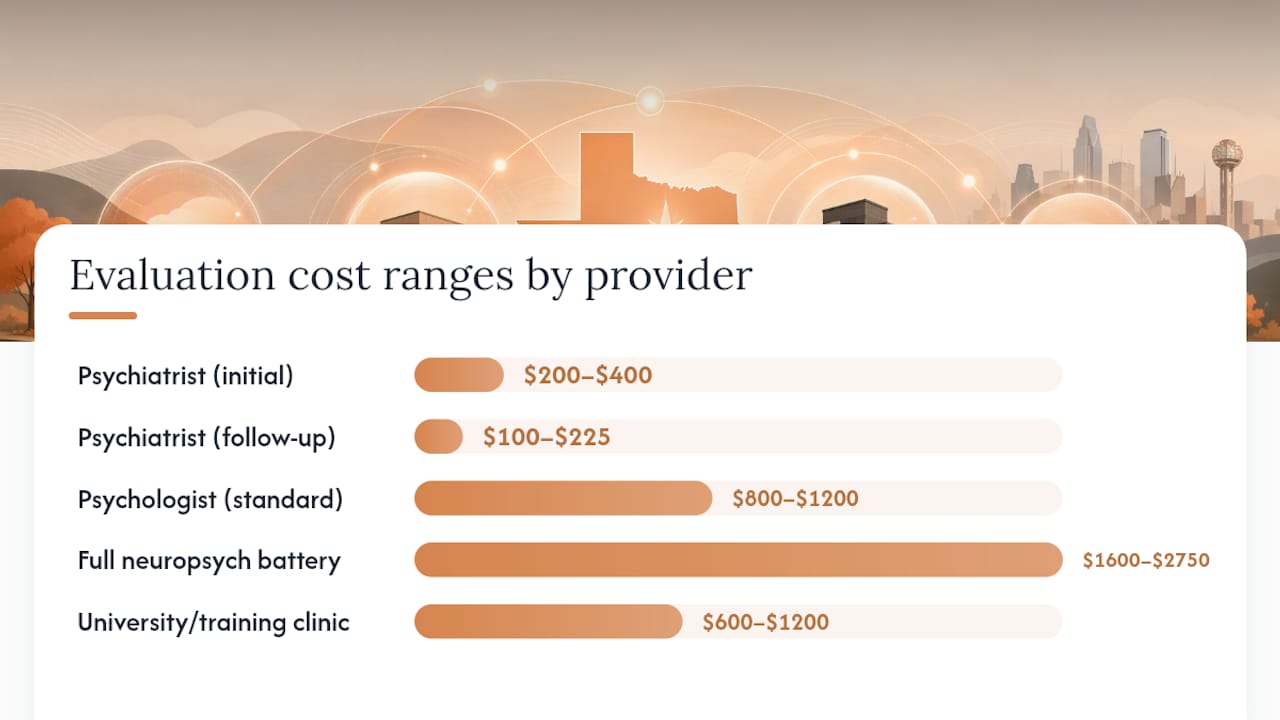
Houston-area provider listings show initial clinical interviews commonly running $225–$375, computerized testing add-ons around $100, and comprehensive batteries ranging $1,600–$2,750. Those figures are consistent with what you’ll find across Austin, Dallas, and Houston. Rural Texas providers sometimes charge less for the interview portion but may not offer full neuropsychological testing at all, which means a longer drive to a metro clinic for anything beyond a basic assessment.
| Provider Type | Typical Price Range | What’s Included |
|---|---|---|
| Psychiatrist (initial visit) | $200–$400 | Clinical interview, symptom review, possible Rx |
| Psychiatrist (follow-up) | $100–$225 | Medication check, symptom monitoring |
| Psychologist (standard evaluation) | $800–$1,200 | Interview + rating scales + written summary |
| Full neuropsychological battery | $1,600–$2,750 | Cognitive testing, detailed written report |
| University/training clinic | $600–$1,200 | Supervised full battery, longer turnaround |
| Telehealth flat-fee (adult) | $995 | Interview, testing, report, feedback session |
| LMHA sliding-scale | $0–$150 | Varies by agency; often interview-based |
Some private practices publish tiered package pricing — Diagnostic Silver, Gold, or Platinum tiers — that bundle the evaluation with follow-up visits or medication management. Before you book, confirm exactly what each tier includes, because a lower-priced package may exclude the written report you’ll need for workplace accommodations or school documentation.
Regional note: Austin and Dallas practices tend to price toward the upper half of these ranges. Telehealth providers, by contrast, often post flat fees that don’t vary by zip code, which makes them a predictable option if you’re in a rural county or simply want to know the total cost before you commit.
How does insurance affect what you pay for ADHD testing?
Insurance can dramatically reduce your cost, but the path isn’t always straightforward. A clinical interview with a psychiatrist is generally easier to get covered than a full neuropsychological battery, which insurers sometimes classify as educational rather than medically necessary.
Before your appointment, check these specifics with your insurer’s member services line:
- Network status: Is this provider in-network? Out-of-network benefits, if you have them, typically reimburse 50–80% after your deductible.
- Deductible and copay: Has your deductible been met? A $1,200 evaluation billed to insurance may still cost you $800 if your deductible is outstanding.
- Prior authorization: Some plans require pre-approval for psychological testing. Ask whether CPT codes 96130, 96131, 96132, or 96133 (neuropsychological testing) require prior auth, and whether 90791 or 90792 (psychiatric diagnostic interview) are covered without it.
- Medical necessity: Ask whether the plan covers “psychological testing for ADHD” and whether a physician referral is needed to establish medical necessity.
- Superbill availability: If your provider is out-of-network, ask whether they can issue a superbill. A superbill is an itemized receipt with CPT codes and diagnosis codes that you submit directly to your insurer for partial reimbursement.
Texas Medicaid (STAR managed care) can cover ADHD diagnosis, therapy, and medications for eligible adults, often with copays of $0–$4. Network availability varies by county, so confirm your plan’s participating providers before scheduling.
Pro Tip: When you call member services, read the CPT codes aloud: 96130–96133 for neuropsychological testing, 90791 for a psychiatric diagnostic interview. Ask specifically, “Does my plan cover these codes, and is prior authorization required?” Writing down the representative’s name and call reference number protects you if a claim is later denied.
What does a full ADHD evaluation actually include?
A meaningful ADHD evaluation is more than a 20-minute conversation. The ADHD testing process typically involves several distinct components, and understanding what’s included helps you judge whether a quoted price is reasonable.
Every credible evaluation should include:
- Clinical interview: A structured conversation covering symptom history, childhood behavior, academic and work performance, and current functioning. This is the foundation of any diagnosis.
- Standardized rating scales: Tools like the Conners Adult ADHD Rating Scales or the Adult ADHD Self-Report Scale (ASRS) help quantify symptom severity. The ASRS is a validated screener developed through Harvard and National Comorbidity Survey resources; it identifies who should progress to a full evaluation but is not a substitute for one.
- Collateral information: Input from a partner, parent, teacher, or employer adds an outside perspective on how symptoms show up in daily life. Many evaluators request this in writing before the appointment.
- Rule-out assessment: Anxiety, depression, sleep disorders, and thyroid issues can mimic ADHD. A thorough evaluation considers these alternatives.
- Cognitive testing (for comprehensive batteries): Measures of attention, processing speed, working memory, and executive function. Typically administered by a psychologist.
- Written report: A formal document summarizing findings, diagnosis, and recommendations. Required for school accommodations (IEP/504 plans) and many workplace accommodation requests.
Calendar-wise, expect 2–8 weeks from your first contact to a finalized report at most private practices. University and training clinics often run longer, sometimes 8–12 weeks, because evaluations are supervised by licensed faculty. Telehealth providers focused on adult ADHD can sometimes schedule an initial evaluation within days, with a written report delivered within 1–2 weeks of the appointment.
Practical ways to lower your ADHD evaluation cost in Texas
Cost doesn’t have to be a barrier. Texas has several legitimate lower-cost pathways, each with honest tradeoffs.
- Local Mental Health Authorities (LMHAs): Texas operates 39 LMHAs covering every county. Sliding-scale fees commonly run $0–$150 based on income. These agencies are the most reliable low-cost option for uninsured or low-income Texans, though wait times can be longer and testing scope narrower than private practice.
- Texas Medicaid (STAR): If you qualify, STAR can cover ADHD diagnosis and medication management with minimal copays. Eligibility depends on income, household size, and whether you’re enrolled in a participating managed care plan.
- University psychology clinics: Programs at UT Austin, Texas A&M, and other state universities run supervised training clinics where doctoral students conduct evaluations under licensed faculty supervision. Fees typically fall in the $600–$1,200 range for a full battery. Turnaround is slower, but the quality of the written report is generally strong.
- Telehealth flat-fee services: Some Texas telehealth providers offer adult ADHD evaluations for a single flat rate around $995, including a written report and feedback session, with no hidden fees. This can be meaningfully less expensive than a private in-person battery, and appointments are often available faster.
- HSA/FSA accounts: ADHD evaluations qualify as a medical expense under IRS rules. Paying with a Health Savings Account or Flexible Spending Account reduces your effective cost by your marginal tax rate.
- Payment plans: Many private practices and telehealth providers offer installment options. Ask before you assume you have to pay in full upfront.
For families comparing ADHD-related costs across different service types, autism therapy cost breakdowns offer a useful parallel for understanding how evaluation and treatment costs are typically structured.
Pro Tip: When calling an LMHA, have your most recent tax return or pay stub ready. Most agencies use a sliding-fee schedule based on household income and family size. Documenting your income before you call speeds up the intake process considerably. To find your county’s LMHA, use the Texas HHS behavioral health services directory.
How Journeymhw’s Texas telehealth option fits your situation
For many Texas adults, the gap between “I think I have ADHD” and “I have a diagnosis and a treatment plan” comes down to access and cost predictability. Journeymhw addresses both.

Journeymhw’s Texas ADHD treatment is delivered entirely via telehealth, which means you can be evaluated from anywhere in the state without driving to a metro clinic or waiting months for an in-person appointment. The pricing sits within the telehealth flat-fee range discussed earlier, and the platform offers structured care plans that include both the initial psychiatric evaluation and ongoing medication management.
What Texas patients receive through Journeymhw:
- Initial psychiatric evaluation: A structured virtual assessment conducted by a licensed psychiatric provider
- Medication management visits: Follow-up appointments to monitor response, adjust dosing, and address side effects; MedlinePlus provides patient-centered information on commonly prescribed ADHD medications if you want to review options before your visit
- Structured treatment plans: Including options like The Simple Plan, which bundles evaluation and ongoing care at a predictable rate
- Superbills for insurance reimbursement: If your insurer offers out-of-network benefits, Journeymhw can provide the documentation you need to submit a claim
- Statewide availability: Licensed to serve patients across Texas, including rural counties where in-person specialists are scarce
Telehealth psychiatric evaluations for ADHD are clinically appropriate for the majority of adults who present with straightforward symptom histories. When cognitive testing or a full neuropsychological battery is clinically indicated, a telehealth provider can coordinate a referral to an in-person psychologist while continuing to manage medication and follow-up care.
Check your insurance plan’s out-of-network benefits before your first appointment. If your plan reimburses out-of-network psychiatric services, a Journeymhw superbill may recover a meaningful portion of your cost.
How to choose where to get evaluated in Texas
The three things that matter most when selecting an ADHD evaluator: the scope of testing they offer, their credentials, and how clearly they handle billing and insurance. Everything else is secondary.
Questions to ask before you book:
- Does the quoted fee include the written report, or is that billed separately?
- Do you accept my insurance, and can you verify my benefits before the appointment?
- If you’re out-of-network, can you provide a superbill with CPT and diagnosis codes?
- What is your typical turnaround time from the evaluation to the final written report?
- Will the report meet the documentation requirements for workplace or school accommodations?
- What credentials does the evaluating clinician hold? (Look for licensed psychologist, licensed psychiatrist, or licensed psychological associate under supervision.)
For a broader look at ADHD treatment plan components that a good evaluation should set the stage for, it helps to understand what a diagnosis is meant to lead to before you choose your evaluator.
Red flags to watch for:
- No written report is offered or promised — a verbal “you have ADHD” without documentation is not a clinical evaluation.
- The provider pressures you to purchase supplements, neurofeedback devices, or proprietary tests as part of the evaluation package.
- Billing is cash-only with no receipt, no CPT codes, and no paperwork.
- The provider cannot name the specific tests or rating scales used in the evaluation.
- Turnaround time is described as “indefinite” or the provider cannot give a reasonable estimate.
- The evaluation is completed in under 30 minutes with no collateral information gathered.
Credential verification is straightforward in Texas. The Texas State Board of Examiners of Psychologists and the Texas Medical Board both maintain public license lookup tools. Confirm that any evaluator you’re considering holds an active, unrestricted license before you pay a deposit.
A note on telehealth assessments and what patients often get wrong
Telehealth can reliably diagnose ADHD for the majority of adults, and the quality of a virtual psychiatric evaluation depends far more on the clinician’s thoroughness than on whether you’re in the same room. We see patients regularly who delayed getting evaluated for years because they assumed telehealth meant a lesser standard of care. That assumption costs people time they don’t need to lose.
The realistic limits are narrow but worth knowing. If your presentation is complex, if there’s significant overlap with a learning disability, or if a school district requires a full cognitive battery for an IEP, an in-person neuropsychological evaluation may be necessary. In those cases, a telehealth provider can still manage your medication and coordinate your care while you complete in-person testing separately. The two aren’t mutually exclusive.
For documentation purposes, a written report from a licensed telehealth psychiatric provider is generally accepted by employers for ADA accommodation requests. Schools vary, and some districts require testing from a licensed psychologist specifically. Ask the school’s 504 coordinator what they require before you schedule, so you’re not surprised after the fact.
Journeymhw offers Texas patients a faster path to evaluation
Getting an ADHD evaluation shouldn’t mean a six-month wait or a $2,000 bill you didn’t plan for. Journeymhw provides telehealth ADHD evaluations and treatment for Texas residents with transparent pricing, online booking, and no commute required.

Here’s what you get when you start with Journeymhw:
- A structured virtual psychiatric evaluation with a licensed provider
- Medication management and follow-up care built into your plan
- Superbills to help with possible out-of-network insurance reimbursement
- Statewide telehealth access, including rural Texas counties
- Predictable plan pricing without unexpected additional fees
If you’re ready to move forward, visit Journeymhw’s Texas ADHD treatment page to review current plan options and book your initial evaluation online. The intake process takes minutes, and appointments are typically available far sooner than in-person specialty clinics.
Sources
These are the most useful starting points for verifying costs, finding local providers, and understanding your coverage. Insurance specifics always require a direct call to your plan’s member services line.
- ADHD Diagnosis & Therapy Costs in Texas (2025-2026) | ADHD Cost Compare
- Hhs
- Uh
- Adult ADHD Evaluation in Texas (Telehealth) | No Waitlist
This article provides general information about ADHD evaluation costs and options in Texas. It is not a substitute for professional medical or clinical advice. Confirm current pricing, insurance coverage, and provider credentials directly with your chosen provider and insurer before scheduling.